 Robert Ambrogi Blog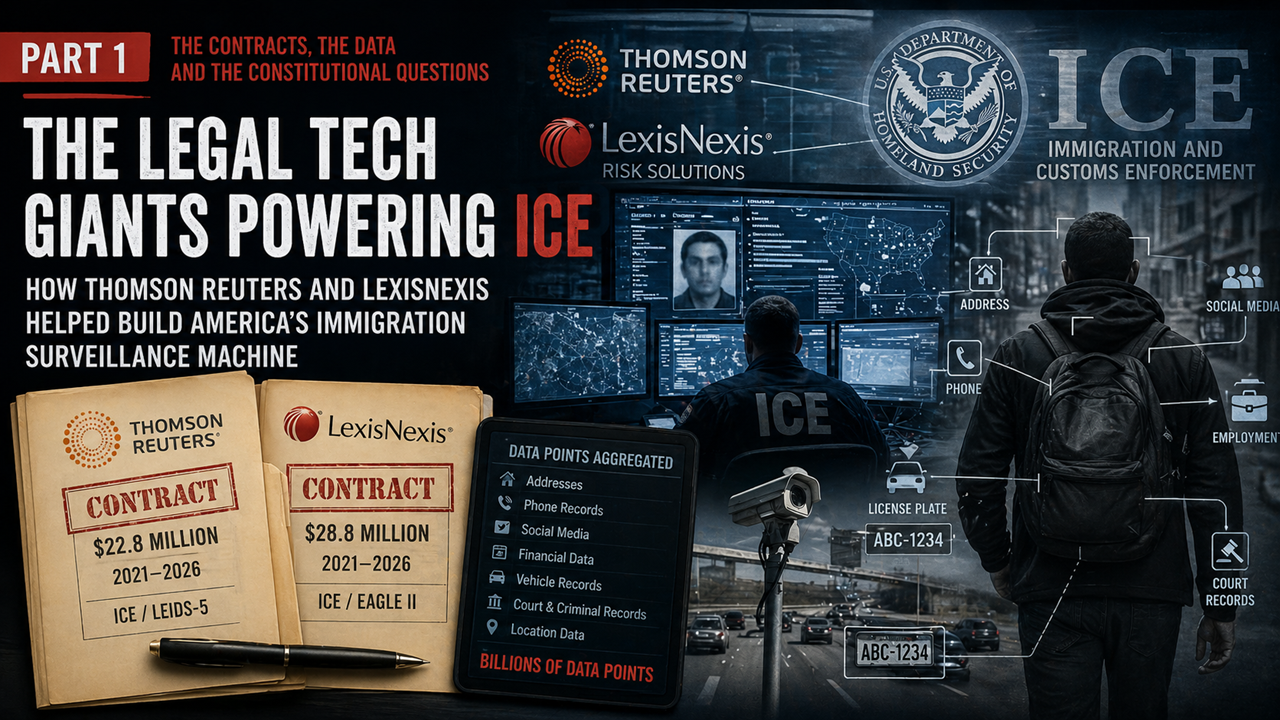


[Note: Since first publishing this post, I have made several edits and updates based on information provided by Thomson Reuters and other sources. In most cases, I have indicated where I have changed or added information.]
For the lawyers and other legal professionals who use Westlaw and LexisNexis every day, these platforms are familiar tools of the trade – essential systems for finding case law, checking citations and getting practical guidance.
See Part Two: The Pushback: Employees, Shareholders, Lawyers and the Fight Over May 31.
But behind those familiar research services is a less-familiar story. The same two corporate parents that dominate legal research have, since the early 2000s, built a parallel business selling vast quantities of personal data to U.S. Immigration and Customs Enforcement, enabling what civil liberties advocates have described as the most extensive domestic surveillance system in American history.
(Update: Thomson Reuters this morning published: Setting the Record Straight on Thomson Reuters CLEAR.)
Between 2003 and 2021, the Department of Homeland Security awarded contracts worth more than $161 million to Thomson Reuters-related entities and, from 2005-2024, more than $172 million to RELX subsidiaries, according to estimates compiled by the American Friends Service Committee’s Investigate project.
Three flagship contracts alone – two held by Thomson Reuters, one by LexisNexis – have funneled roughly $51.6 million into investigative tools that aggregate billions of data points on large portions of the U.S. population, mostly without their knowledge or consent.
Now, as ICE’s enforcement tactics have come under increasing public scrutiny and criticism, many in the legal profession are wanting to learn more about how ICE has been supported by tools provided by two of the profession’s most essential technology vendors.
These questions are made even more immediate by the fact that Thomson Reuters’ $22.8 million ICE contract is set to expire on May 31, 2026, and many – including many of its own employees – are wondering whether that contract will be renewed.
Against that backdrop, I decided to dive in and learn more about the ties between these two companies and ICE. This is the first of a two-part report examining the intersection of legal technology, mass surveillance and immigration enforcement. The second will appear tomorrow.
Part One explores the contracts themselves, the technology they fund, and some of the questions they raise. Part Two will examine the growing opposition – from employees, shareholders, journalists, and legal ethicists – and what it means for the legal profession.
In writing this report, I have relied heavily on the shoe leather of others who have investigated and written about the ICE contracts. I cite to them liberally throughout these two posts.
What CLEAR and Accurint Do
The two flagship products at the center of this story are CLEAR, provided by Thomson Reuters, and Accurint, provided by LexisNexis Risk Solutions. Both are investigative platforms sold primarily to law enforcement, but their capabilities extend beyond traditional criminal databases.
CLEAR (Consolidated Lead Evaluation and Reporting) aggregates billions of data points from public and non-public sources, including driver’s license records, vehicle registrations, credit data, phone records, real estate transactions, criminal and court records, social media activity and healthcare provider information.
In an email sent to me following the initial publication of this report, Thomson Reuters said that CLEAR does not include information about an individual’s citizenship or immigration status. The company said it also does not contain phone call logs, credit histories, bank or credit account financial information, insurance claims, internet search histories, health records, employment histories, or real-time geolocation data.
Also since initial publication of this report, I obtained a DHS document that was created to justify contracting with CLEAR as a brand-name source listed it as providing these types of data “essential to the mission of DHS”: Provider Data for Healthcare Fraud investigation, Passport Checker, Photo Images on Criminal Records, Cell Phone Data, Utility Data, Credit Reporting Bureaus, Real-Time Vehicle Registration Data, Global Business Data, License Plate Recognition (LPR) Data, and Real Time Incarceration Arrest Records.
The same document went on to say:
“If DHS does not procure this data, DHS would not have access to Key Investigation Content including CLEAR Exclusives data such as: Provider Data for Healthcare Fraud Investigation, Passport Checker, Photo Images on Criminal Records, Cell Phone Data, Utility Data, Credit Reporting Bureaus, Real-Time Vehicle Registration Data, Global Business Data, License Plate Recognition Data, CLEAR Adverse Media, CLEAR ID Confirm International, CLEAR Risk Inform, CLEAR ID Confirm, Asset Insights, World Check Risk Intelligence, Real Time Incarceration and Arrest Records, Real Time Incarceration and Arrest Alerts. Also, DHS would not have access to CLEAR Advanced Features and Capabilities such as: Criminal Analytics, System to System with New Developer Portal, Batch Services, Alerts, Web and Social Media, Associate Analytics, Company Family Tree, Graphical Display, News, Map Analytics, Quick Analysis Flags, Address Map, Customizable Dashboard, Vital Statistics, Linked Searching, Entity Resolution, Relevance Scores, Data Source Transparency, User Preferences, Customized Reporting, Workspace CLEAR Mobile Access, Compatibility with Analytical Programs, and Google Maps Compatibility.”
Thomson Reuters also contracts with ICE to provide License Plate Recognition (LPR) data derived from cameras and software developed by Motorola. Thomson Reuters’ LPR is the world’s largest collection of license-plate data, containing more than 20 billion scans as of 2023, and continuously updated.
McKenzie Funk, writing in The New York Times Magazine in 2019, described CLEAR as offering “an ever-evolving, 360-degree view of U.S. residents’ lives.”
When I asked Thomson Reuters about its CLEAR product and how it is used by customers, particularly ICE, it provided the following statement:
“We continue to work with our customers, providing technology and services that support investigations into areas of national security and public safety, such as child exploitation, human trafficking, narcotics and weapons trafficking and financial crime. We remain committed to this mission while maintaining strong safeguards that ensure our products and services are used in accordance with our contractual terms and applicable law. We do not comment on specific customer contracts.”
Accurint, the LexisNexis equivalent, aggregates similar categories of data, though its specific sources differ. According to Borderless, the LexisNexis platform maintains records on more than 276 million U.S. residents and, through a 2021 contract expansion, added real-time jail booking data via its Appriss Insights subsidiary. As of 2021, reporting has indicated that more than 11,000 ICE personnel had access to the LexisNexis platform.
The scope of data available through these systems is far reaching. Per the contract statement of work obtained through records requests and reported by Maurizio Guerrero for In These Times, CLEAR provides ICE with information that identifies possible locations of targets and tracks changes in identifying information, from addresses and phone numbers to email addresses, Social Security numbers, utility records, arrests, employment history, insurance activity, and affiliations with organizations.
In addition to providing data, contractor personnel associated with Thomson Reuters have, at times, worked in close coordination with ICE personnel, including providing support related to data access and analysis, according to government documents and advocacy reports.
The Three Key Contracts
To understand the current controversy, it helps to understand the specific contractual relationships at issue, as detailed in government spending records, FOIA disclosures, and reporting by outlets including In These Times, The Baron (a publication devoted to covering Thomson Reuters), the ABA Journal, and others.
Thomson Reuters LEIDS-5 ($22.8 million, 2021–2026). In December 2020, ICE issued a solicitation for its fifth-generation Law Enforcement Investigative Database Subscription, or LEIDS-5. The contract was awarded to Thomson Reuters’ Special Services LLC, a TR subsidiary, in May 2021, providing ICE’s Enforcement and Removal Operations (ERO) and Homeland Security Investigations (HSI) divisions with access to its license-late data. By 2025, ICE was explicitly using the subscription to access license plate reader data for “potential arrest, seizure and forfeiture.” This contract is set to expire on May 31, 2026, and, as Kashmir Hill recently reported in The New York Times, its renewal is now the subject of intense internal and external pressure.
When I asked Thomson Reuters whether it intends to renew, it replied: “We do not comment on customer contracts.”
Update: In the original version of this article, I reported that the LEIDS-5 contract included access to CLEAR. In Thomson Reuters’ “Setting the Record Straight” document referenced above, the company states that this contract “does not include CLEAR.” Upon further looking into this, that statement appears to be correct (although the company has declined to provide the actual contract to review).
That said, it appears that Thomson Reuters does provide DHS with access to CLEAR through a separate contract. That contract was set to expire on March 31, 2026, but was renewed as of that date, pursuant to a Sole Source Justification that stated that only CLEAR provides the range of law enforcement data the agency requires. It appears that renewal will run through at least next year and possibly through 2029. I have asked Thomson Reuters to confirm this but have not received a response specific to this question.
Thomson Reuters Jail Alert Service ($6.7 million, 2018–2023). Awarded to Thomson Reuters Special Services, this contract provided ICE’s Detention Compliance and Removals office with a continuous monitoring and alert service for real-time jail booking data. According to Privacy International, which publicly challenged the contract in June 2018, the system was designed to track 500,000 identities per month, scanning for FBI numbers, state IDs, credit history, insurance data, wire transfers, employment records and individual taxpayer identification numbers (ITINs).
The contract expired around 2023 and was not renewed – but its capabilities were effectively transferred to LexisNexis, which had expanded its own ICE contract in 2021 to include jail booking data through its Appriss Insights subsidiary.
LexisNexis LEIDS ($22.1 million, 2021–2026). Awarded to LexisNexis Risk Solutions, this contract gave ICE access to the Accurint platform and, following a June 2021 expansion, to Appriss Insights’ Justice Intelligence module for real-time incarceration data. The contract reached the end of its five-year base period in February 2026 and is marked as “completed” on USASpending.gov. While DHS has historically exercised option years on similar contracts, no successor award has been publicly confirmed as of this writing.
Asked by me whether it has entered into a successor contract or intends to, LexisNexis did not directly answer.
Combined, these three contracts represent approximately $51.6 million – which is itself only a fraction of a broader data-broker ecosystem that has channeled over $333 million from DHS to Thomson Reuters and LexisNexis since 2003.
A Fourth Amendment Loophole?
Some constitutional scholars and civil liberties organizations see the legal architecture that enables these contracts as a loophole in Fourth Amendment protections.
The Fourth Amendment prohibits unreasonable government searches. Traditionally, if law enforcement wanted access to a person’s phone records, financial transactions or location history, it would need a warrant or subpoena.
But by purchasing commercial database subscriptions from private data brokers, federal agencies such as ICE can access much of the same information, and even more, without judicial authorization.
This framework rests on what legal scholars call the “third-party doctrine,” a principle holding that individuals have no reasonable expectation of privacy in data they voluntarily share with third parties such as banks, phone companies or social media platforms.
While the Supreme Court has begun to narrow this doctrine – most notably in the 2018 Carpenter v. United States decision, which held that accessing historical cell-site location data constitutes a search requiring a warrant – courts have not definitively ruled that the wholesale purchase of commercial data access constitutes a “search” under the Fourth Amendment.
ICE has explicitly acknowledged this, stating in contracting documents that it works with LexisNexis in part because of “an increase in the number of law enforcement agencies and state or local governments that do not share information about real-time incarceration of foreign-born nationals with ICE.”
In other words, even when sanctuary cities and states refuse to cooperate with ICE, the agency can turn to private data brokers to obtain much of the same information.
In Cook County, Ill., officials discovered that data their agencies had provided to LexisNexis for credit-check purposes was later made available to ICE through LexisNexis data products – directly undermining the county’s own ICE detainer ordinance, according to reporting cited in the AFSC’s investigation of RELX.
No comprehensive federal data broker regulation exists. Companies such as Thomson Reuters and LexisNexis operate under a patchwork of sector-specific laws – the Fair Credit Reporting Act, the Driver’s Privacy Protection Act, HIPAA – that leave significant gaps, particularly when it comes to reselling aggregated data to law enforcement.
The AI Amplification
In recent years, both companies have layered artificial intelligence capabilities on top of their research and investigative platforms, raising new concerns about the scope and scale of automated decision-making.
Thomson Reuters has integrated generative AI features into CLEAR, including a tool called Risk Analysis Summary (RAS), which combines AI with traditional data aggregation to produce automated profiles of individuals and organizations.
According to the BCGEU’s 2025 investor brief – a document prepared by the British Columbia General Employees’ Union for Thomson Reuters shareholders – this layering of AI over already sensitive personal data “raises serious concerns about accuracy, bias, and risk mitigation.”
A person familiar with Thomson Reuters’ product development described RAS to me differently – not as a law enforcement targeting tool but as a business due diligence tool that provides AI-generated summaries of existing business risk profiles in areas such as vendor procurement or supply chain analysis.
According to this person, the underlying reporting functionality was already available within CLEAR; the AI feature simply serves as an agent that automates the summarization of existing results.
In an email following publication of this report, Thomson Reuters said: “Risk Analysis Summary (RAS) is a risk-assessment feature in CLEAR which uses AI to help create effective summaries of due diligence on businesses, corporations, and potential vendors. It does not use generative AI to produce automated profiles of individuals or organizations.”
This may be a matter of semantic interpretation. If AI uses a collection of data about an individual to produce a summary about that individual, is that summary an “automated profile”?
Civil liberties advocates counter Thomson Reuters’ assertions, arguing that, regardless of its intended design, any AI-generated risk profiling tool integrated into a platform available to more than 11,000 ICE agents can be repurposed for immigration enforcement.
The BCGEU brief, authored by Emma Pullman, head of shareholder engagement and responsible investment at BDGEU, notes that Thomson Reuters has described its AI investments as “much bigger than a few new product launches,” aiming to develop “truly transformative products.”
But civil liberties advocates warn that automated risk-scoring tools could be used to flag individuals based on routine activities – name changes, address updates, new employment – without any human review, potentially reaching millions of people.
The concern is not merely theoretical. As In These Times has reported, CLEAR’s AI capabilities can automatically generate alerts and risk profiles that ICE agents use to prioritize targets.
Combined with the platform’s access to license plate reader data, social media monitoring, and real-time incarceration information, the system approaches what some DHS materials have described as “predictive” immigration enforcement.
Palantir and the Integration Stack
The surveillance infrastructure does not operate in isolation. Government contracting documents and reporting by Oakland Privacy, The New York Times, and the national research project American Dragnet have documented how Thomson Reuters’ CLEAR can be used to work with Palantir’s analytical platform in a system-to-system configuration.
Under an earlier Thomson Reuters contract with ICE’s Homeland Security Investigations division, CLEAR data was fed directly into Palantir’s controversial automated analysis system, which determined whom to target for investigation, as reported by Sarah Lamdan, then a professor at CUNY School of Law and now executive director of the Office for Intellectual Freedom at the American Library Association, in her 2019 article for the NYU Review of Law and Social Change, “When Westlaw Fuels ICE Surveillance: Legal Ethics in the Era of Big Data Policing.”
Lamdan, drawing on government contract documents, described how Thomson Reuters would provide the data and Palantir would conduct real-time analysis to identify targets for potential arrest.
“The contract specifies that Thomson Reuters will provide the data and the technology firm Palantir will conduct the real-time analysis to determine who to target through system-to-system communication,” Lamdan wrote.
“Together with a host of law enforcement agency databases provided by Thomson Reuters, Palantir’s controversial ‘automated policing’ system will determine whether people should be targeted for investigations in support of ICE’s increasingly aggressive scheme to arrest noncitizens.”
In an email following publication of this post, Thomson Reuters said: “Palantir is not a customer of CLEAR. Our standard terms do not allow the redistribution of CLEAR data to third parties, and, after a contract is ended, they provide that no CLEAR data may be retained by any customer.”
LexisNexis data is similarly integrated into ICE’s National Criminal Analysis and Targeting Center (NCATC), based at the Law Enforcement Support Center in Williston, Vt. The NCATC has been described in reporting and advocacy research as “the nerve center for ICE operations” – processing vast amounts of personal data, generating target lists, and coordinating fingerprint matching between local law enforcement and ICE.
According to the AFSC’s research on RELX, in the second quarter of 2022 alone, the center vetted over 2.3 million individuals for immigration enforcement. Critically, the NCATC’s mission includes targeting not only immigrants convicted of crimes but anyone “unlawfully present in the United States.”
LexisNexis data has also been reported by AFSC to feed into Customs and Border Protection’s Automated Targeting System (ATS), a tool that compares traveler, cargo, and conveyance information against law enforcement and intelligence databases, and the broader TECS platform used for border screening and law enforcement lookouts.
The Implications for Everyday Americans
It is important to understand that the data aggregated by CLEAR and Accurint is not limited to individuals suspected of criminal activity or immigration violations. Both platforms draw from the same commercial data pools that underpin credit checks, insurance underwriting, and background screening for the general population.
Thomson Reuters’ CLEAR database includes data collected from individuals who have never had any interaction with law enforcement. In 2024, Thomson Reuters agreed to pay $27.5 million to settle a California class-action lawsuit alleging the company had violated the privacy rights of approximately 40 million Californians by secretly collecting and selling their personal data through CLEAR without consent.
The lawsuit alleged that CLEAR profiles could be constructed on individuals – including those who had used paid data-scrubbing services – without their knowledge. Although it settled the case, Thomson Reuters denied liability.
LexisNexis profiles have also been alleged to contain errors, including incorrect Social Security numbers and wrongly attributed criminal convictions, according to reporting by CBS News and others.
An FTC complaint documented that data brokers like Thomson Reuters and LexisNexis rely on algorithms that use outdated or incorrect information to create profiles, putting immigrants – both documented and undocumented – at heightened risk of misidentification.
A Question of Scale
While the dollar values of these contracts are significant, they are modest relative to the companies’ total revenues. Thomson Reuters generated more than $7 billion last year. RELX is comparably large. The $22.8 million LEIDS-5 contract represents a rounding error in Thomson Reuters’ earnings.
But the reputational and governance stakes are disproportionate – and the implications for the legal profession are unique. Thomson Reuters and RELX are not ordinary defense contractors or surveillance startups. They are the companies that provide the fundamental infrastructure of legal research in the United States and, increasingly, a host of other law-practice tools, including AI.
A substantial majority of U.S. legal professionals, law schools and courts use Westlaw or LexisNexis in the course of their professional work.
This creates what some analysts have described as a “vendor consolidation risk.” The same corporations providing investigative tools to ICE also provide core legal research infrastructure to the lawyers who represent the people ICE is targeting.
That tension – and the growing internal and external pressure it has generated – is the subject of Part Two, which I will publish tomorrow.