 Robert Ambrogi Blog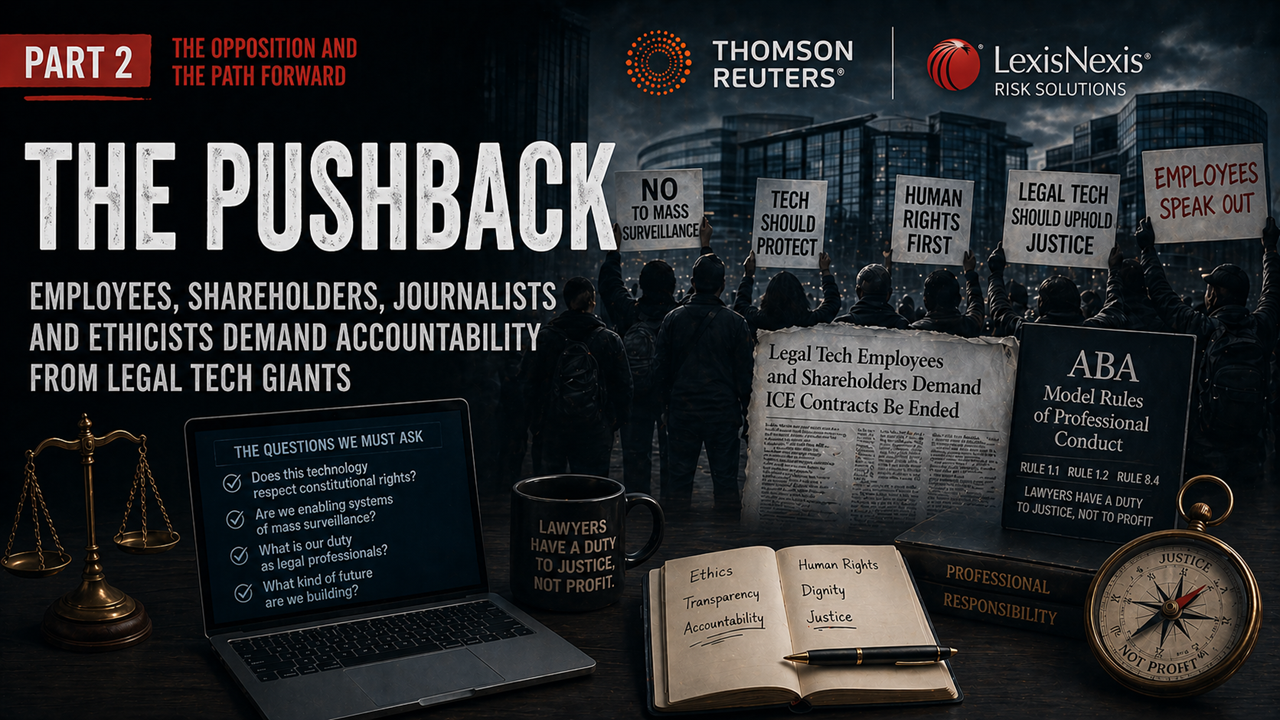


On March 11, 2026, some 200 employees of Thomson Reuters – many of them based at the company’s Westlaw operations in St. Paul, Minn. – sent a letter to management with an unequivocal demand: Do not renew the company’s $22.8 million contract with ICE, set to expire on May 31.
(See Part 1 of this two-part post: How Thomson Reuters and LexisNexis Helped Support America’s Immigration Surveillance Machine.)
The same week, more than 200 journalists at Law360 and other publications owned by RELX, the parent company of LexisNexis, signed their own letter demanding that RELX end its $22.1 million DHS contract and cease providing LexisNexis Risk Solutions’ database access for immigration enforcement.
These simultaneous revolts – with employees and journalists across two of the legal industry’s most important companies, all acting within the same month – represent the most significant internal challenges these contracts have faced in their two-decade history.
But they did not emerge out of nowhere. They followed years of shareholder activism, civil society organizing, litigation and a scholarly debate about the ethical obligations of lawyers who use research products linked to government surveillance.
The Minnesota Context
The March 2026 employee letters were motivated by events unfolding in the very communities where many Thomson Reuters employees live and work.
During the winter of 2025–2026, the federal government intensified immigration enforcement activity in the Minneapolis–St. Paul metropolitan area, with reporting indicating thousands of arrests across multiple operations.
Two fatal incidents involving federal agents drew particular public attention. On Jan. 7, 2026, Renée Nicole Good was shot and killed by an ICE officer. On Jan. 24, 2026, Alex Pretti was shot and killed by a U.S. Customs and Border Protection agent in a separate incident.
In January 2026, the United Nations top human rights official called for investigation of the shootings, raising concerns that they may have involved excessive or unlawful use of force. Separately, court challenges to aspects of the enforcement activity have resulted in some arrests being ruled unlawful, according to reporting, though the scope and legal basis of those rulings vary by case.
For Thomson Reuters employees in St. Paul – many of whom work on the Westlaw platform and are deeply embedded in the local community – the juxtaposition became untenable. The company that employed them was providing the very tools that were assisting ICE in locating and arresting their neighbors.
That led to the letter signed by more than 200 Thomson Reuters employees, in which they questioned “if our investigative products and services are being used in accordance with our mission and values, as well as in accordance with the law and our nation’s Constitution.”
When I asked Thomson Reuters about the concerns its employees raised in the letter, it provided me with a statement saying it “continue[s] to work with our customers, providing technology and services that support investigations into areas of national security and public safety, such as child exploitation, human trafficking, narcotics and weapons trafficking and financial crime.”
Internally, however, the company did take steps to address its employees’ concerns, according to a source familiar with the company’s response.
That source said that Thomson Reuters held one-on-one conversations with concerned employees, organized small group listening sessions both in-person and virtually, published an internal blog post addressing the issue, and convened a company-wide all-hands meeting with CEO Steve Hasker. The company also made its 24/7 Employee Assistance Program available for employees seeking personalized and confidential support.
But, according to The Baron, the company also shut down discussion of the ICE contracts on its internal communications platform, a move that may have undercut the conciliatory tone of the listening sessions. Employees subsequently organized on Signal and other channels outside corporate control.
And now, Billie Little, an Oregon-based senior attorney-editor at Thomson Reuters who organized the protest letter, has been fired by the company, she alleges in a whistleblower lawsuit she recently filed, according to her complaint and to reports by 404 Media and NPR.
The BCGEU’s Long Campaign
If the March 2026 employee letters represent the most dramatic internal challenge to these contracts, the most direct external pressure has come from a Canadian public employees’ union.
The British Columbia General Employees’ Union (BCGEU), which represents 95,000 members and is a long-term minority investor in Thomson Reuters, has been pressing the company on its ICE contracts since 2019, in a campaign led by the union’s Capital Stewardship Program.
In 2020, the BCGEU released a report to shareholders calling for an assessment of human rights risks related to the ICE contracts. At that year’s annual meeting, it introduced a shareholder proposal asking Thomson Reuters to adopt the UN Guiding Principles on Business and Human Rights. The proposal received support from approximately 30 percent of independent investors.
In 2021, the BCGEU resubmitted the proposal. This time, support surged to 70 percent of independent investors – a striking level of endorsement. In 2022, under mounting pressure, Thomson Reuters agreed to adopt the UN Guiding Principles, committing to human rights due diligence. But the company did not exit any of its ICE contracts.
In June 2025, the BCGEU submitted a new proposal asking Thomson Reuters to extend the UN Guiding Principles framework to its AI governance – an important escalation given the integration of generative AI into CLEAR.
The proposal, detailed in an investor brief written by Emma Pullman, head of shareholder engagement and responsible investment at BCGEU, argued that Thomson Reuters’ legacy 1941 Trust Principles – originally designed to safeguard journalistic independence – were inadequate for governing a technology company’s human rights risks.
Glass Lewis, one of the largest proxy advisory firms, recommended shareholders vote in favor of the BCGEU proposal.
The proposal received support from approximately 20 percent of independent shareholders – lower than previous years, but the decrease was likely explained by the fact that Thomson Reuters had already formally adopted the UN Guiding Principles, making the incremental ask less compelling to some investors.
Asked about the board’s recommendation against the proposal, Thomson Reuters directed me to its 2025 proxy circular, available on its investor relations website. In that document, the company’s board of directors recommended against the BCGEU’s proposal, stating in part:
“At Thomson Reuters we prioritize safe, responsible development and the ethical use of artificial intelligence (AI). Our proprietary content and technology, deep knowledge of the professionals we serve and focus on data privacy underscore Thomson Reuters commitment to a trusted customer experience. In furtherance of this commitment, Thomson Reuters has established a comprehensive framework of AI governance and risk management and the Board is of the view that the governance structure is well-suited for effectively overseeing responsible use and development of AI.”
There is, of course, a structural reality that limits the practical impact of any shareholder vote at Thomson Reuters, which is that approximately 70 percent of the company’s shares are held by the Woodbridge Company, the Thomson family’s investment vehicle.
Law360 Journalists Protest
The March 2026 journalist letter at RELX – signed by more than 200 staffers at Law360 and related publications – added a further dimension to the controversy. As Julianne Hill reported in the ABA Journal, the signatories expressed concern that RELX was “directly aiding the separation of families, the removal of children from schools and the death of individuals in detention centers.”
The letter, posted by nearly 80% of unionized Law360 journalists, specifically called out the LexisNexis Risk Solutions database for giving ICE the ability to find migrants’ home and work locations and to identify their family members, citing privacy and legal experts.
“Given ICE’s record, it is clear RELX is doing business with an organization that regularly flouts the ‘rule of law’ principles the company says it upholds,” the letter said.
For the legal industry, the journalists’ action was notable for several reasons. First, it put pressure on RELX from within its own media properties – the very publications that cover the legal industry – creating an acute reputational dilemma.
Second, it echoed the parallel Reuters journalists’ letter to Thomson Reuters leadership, demonstrating that internal opposition had emerged simultaneously at both companies.
Finally, it connected the ICE controversy directly to the professional identity of the very legal journalists who cover due process, civil rights and the rule of law.
The Lawsuits
Legal challenges have also played a role in shaping the debate, though with mixed results.
In 2020, activist Cat Brooks and other California plaintiffs filed a California class-action lawsuit alleging that Thomson Reuters’ CLEAR platform violated the privacy rights of approximately 40 million Californians by secretly collecting and selling personal data without consent.
In 2024, Thomson Reuters agreed to pay $27.5 million to settle the case. The settlement required the company to improve its safeguards and data retention policies, and it established the legal principle that CLEAR profiles could be constructed on individuals without their knowledge – even those who had taken steps to scrub their data from commercial databases.
On the LexisNexis side, a coalition led by Just Futures Law, the immigrant rights organization Mijente, and Organized Communities Against Deportations (OCAD), sued in Cook County, Illinois, in August 2022, alleging violations of the Illinois Consumer Fraud and Deceptive Business Practices Act.
The plaintiffs argued that LexisNexis collected and sold the personal data of immigrants without consent, enabling ICE to conduct warrantless surveillance and circumvent Cook County’s ICE Detainer Ordinance.
Specifically, the suit alleged that LexisNexis provided ICE with real-time incarceration data that allowed agents to arrest individuals at the moment of their release from jail, in violation of Illinois law.
However, in April 2024, the court dismissed the complaint, finding that the plaintiffs lacked standing under the Illinois consumer law and had failed to adequately plead other aspects of their lawsuit.
The plaintiffs did not amend the complaint or appeal the dismissal. In May 2024, the parties filed a stipulation closing the case with no finding of wrongdoing by LexisNexis.
Congressional scrutiny has been minimal. Following the publication of LexisNexis contract details obtained through FOIA, U.S. Senators Edward Markey and Ron Wyden called on ICE to shut down what Markey characterized as its data-gathering efforts. But no legislative action resulted.
The Legal Ethics Question
For lawyers and legal professionals – the primary customers of these companies – there may actually be ethical implications in all of this.
Sarah Lamdan, a former professor at CUNY School of Law and now executive director of the American Library Association’s Office for Intellectual Freedom, laid out the ethical framework in a landmark 2019 article published in the NYU Review of Law and Social Change, “When Westlaw Fuels ICE Surveillance: Legal Ethics in the Era of Big Data Policing.”
Lamdan’s argument proceeds on several fronts. First, she raises the question of conflicts of interest under ABA Model Rule 1.7. If an immigration attorney, for example, is obligated to pay Thomson Reuters for Westlaw access, and Thomson Reuters is simultaneously helping ICE – which may be on the opposing side in the attorney’s immigration case – has the attorney stumbled into an ethical conflict?
The possibility that an attorney is helping ICE investigate the attorney’s own clients increases significantly when the attorney uses legal research products that reserve the right to share user data across corporate subsidiaries, Lamdan argues.
Second, Lamdan examines confidentiality under Model Rule 1.6. At the time of her 2019 article, neither Thomson Reuters nor RELX had promised that its legal research products were independent from the data services sold to law enforcement.
Thomson Reuters’ privacy statement explicitly states that the company shares user information “within the Thomson Reuters group, with our business partners and third party service providers … and in accordance with law.”
When Lamdan, in preparing her article, asked leading legal research companies whether legal research user data was used in surveillance platforms, Bloomberg Law immediately responded, stating that its product does not save user data, but Thomson Reuters representatives were, in Lamdan’s account, “notably silent.”
In my own reporting for this story, a person familiar with Thomson Reuters’ data practices stated unequivocally that Westlaw user data – including search histories, saved research and account information – is not included in data sold to law enforcement, and that client usage information is treated as confidential.
When I asked LexisNexis the same question, it did not directly respond, other than issuing the statement I discuss later in this post.
Third, Lamdan invokes Model Rule 5.3, which requires lawyers to vet third-party vendors to ensure they use ethically sound practices. Under ABA guidance, lawyers must consider vendors’ security policies, use confidentiality agreements, and verify that vendors do not have conflicts of interest.
Yet the privacy agreements that Westlaw and LexisNexis provide to users do not make assurances that they will maintain the confidentiality and security standards required of the legal profession.
Lamdan’s ultimate conclusion is a call to action. Lawyers should consider whether their professional ethics require them to diversify away from Westlaw and LexisNexis – or at minimum, to demand that these companies formally wall off their legal research data from their law enforcement products.
“No conscientious lawyer can stand by idly when Westlaw and LexisNexis’s parent companies are building a ‘digital deportation machine’ with profits from their lawyer customers,” she wrote. “Instead, lawyers should switch to alternative products.”
The ABA has not directly opined on whether using products linked to surveillance projects violates confidentiality obligations. As Lamdan notes, this is partly because online legal research is a relatively recent phenomenon, and partly because ABA ethics guidance has focused on communications technology rather than research platforms.
But the question has grown more urgent as these companies integrate AI into their products. When CLEAR’s generative AI risk summaries can automatically flag individuals based on routine activities, and when the same corporate infrastructure processes both a lawyer’s Westlaw search history and an ICE agent’s surveillance query, the ethical distance between the two functions narrows considerably.
The Civil Society Campaign
The employee and shareholder efforts discussed above have been reinforced by a broader civil society campaign that has been sustained since 2018.
The #NoTechForICE campaign, launched by the immigrant rights organization Mijente, has maintained public pressure on both Thomson Reuters and LexisNexis for years. Key organizational participants include Just Futures Law, the National Immigrant Justice Center, the Electronic Privacy Information Center (EPIC), the Project On Government Oversight (POGO), and Organized Communities Against Deportations.
In February 2023, a coalition of more than 80 organizations wrote to then-DHS Secretary Alejandro Mayorkas urging cancellation of the LexisNexis contract before its Feb. 28 renewal date. DHS renewed the contract anyway.
The advocacy landscape also includes municipalities. In April 2019, the Berkeley City Council passed a Sanctuary Contracting Ordinance designed to prevent the city from entering into contracts with businesses that serve as data brokers for ICE — a measure that would encompass Thomson Reuters.
The Renewal Decision
As of this writing, the Thomson Reuters LEIDS-5 contract is set to expire on May 31, 2026. No public announcement has been made about renewal.
The dynamics surrounding this decision are complex. The contract’s value – $22.8 million over five years – is modest relative to Thomson Reuters’ market capitalization of approximately $39 billion. But the reputational stakes are substantial, particularly given the Minnesota enforcement context, the employee letter, and the BCGEU’s ongoing shareholder campaign.
As I wrote in part one of this two-part post, It appears that Thomson Reuters did just renew its separate contract to provide DHS with access to CLEAR. That contract was set to expire on March 31, 2026, but was renewed as of that date, pursuant to a Sole Source Justification that stated that only CLEAR provides the range of law enforcement data the agency requires. It appears that renewal will run through at least next year and possibly through 2029. I have asked Thomson Reuters to confirm this but have not received a response specific to this question.
There is some precedent for Thomson Reuters stepping back from ICE work. The company’s CBP CLEAR contract expired naturally in August 2024 without renewal. The TRSS jail booking alert contract expired around 2023 and was also not renewed, though its capabilities were effectively assumed by LexisNexis.
On the governance front, Thomson Reuters has built out its human rights infrastructure since adopting the UN Guiding Principles in 2022.
According to a person familiar with the company’s efforts, Thomson Reuters has established a Human Rights Steering Committee co-chaired by its chief legal officer and chief people officer, and has recently completed its second comprehensive human rights impact assessment, working with outside consultants and legal counsel.
The company expects to disclose key findings from the 2025 assessment on its website. The source did not say whether those findings would address the ICE contracts specifically.
According to this same source, CLEAR is supported by a “robust” credentialing and compliance program that includes routine customer audits, monitoring for suspicious activity, and required compliance acknowledgements at each login. Its terms prohibit the redistribution of CLEAR data by customers. Where misuse is identified, the source said, the company acts promptly, and the response may include termination of customer access.
However, when I asked Thomson Reuters directly whether it places specific limits on the purposes for which ICE can use CLEAR, the company again said it would not comment on customer contracts.
On the LexisNexis side, the outlook is different. DHS has renewed the LexisNexis contract at every option year despite organized opposition, and LexisNexis maintains a separate contract with Customs and Border Protection worth up to $25.7 million that runs through approximately 2027.
LexisNexis data also remains integrated into ICE’s National Criminal Analysis and Targeting Center infrastructure – meaning that even if the ICE contract formally expires, the data access may continue through other channels.
LexisNexis Response: A General Statement
I have already refereenced the response I received from Thomson Reuters. In addition, Thomson Reuters yesterday published, Setting the Record Straight on Thomson Reuters CLEAR, The statement is a response to “recent media reporting [that ]has speculated about how our data is used by government agencies and third-party technology platforms” and that, the company says, “reflects misunderstandings about how our products are governed and safeguarded. ”
I also sent LexisNexis a series of specific questions about its ICE contracts, including whether a successor contract was under negotiation, whether its data continues to flow to ICE through other channels such as the NCATC, how it responded to the Law360 journalists’ letter, whether legal research user data is firewalled from its Accurint platform, and whether it could provide current figures on ICE personnel with access to its systems.
LexisNexis did not directly answer any of these questions. Instead, the company provided a general statement in which it described itself as “a mission-driven company” that has “partnered with federal, state, local, and other public sector agencies across the United States to support public safety, national security, the delivery of authoritative legal content, and the protection of vulnerable populations.”
The company added: “As a federal agency within DHS, ICE has used certain LexisNexis products for many years, across both Democratic and Republican administrations.”
Rather than addressing my questions about the surveillance capabilities of its Accurint platform or its contracts with ICE’s enforcement divisions, the company pointed to a different service, noting that it provides electronic and print law library materials in immigration detention facilities, including immigration statutes, case law, federal regulations, and research tools available in multiple languages.
The company characterized this as supporting “due process rights for individuals in ICE custody.”
LexisNexis said it maintains governance structures “designed to oversee how our offerings are delivered and used, with a focus on responsible and appropriate application,” but provided no specifics.
What It Means for the Legal Profession
The story of Thomson Reuters, LexisNexis and ICE is ultimately a story about the legal profession’s own supply chain – and whether the profession’s moral and ethical standards extend to the vendors that make modern practice possible.
The one conclusion that cannot be avoided is this: Every lawyer who pays for a Westlaw or LexisNexis subscription contributes, however indirectly, to the revenue of companies that build and maintain surveillance tools for immigration enforcement.
The ethical questions raised by Sarah Lamdan in 2019 – about conflicts of interest, confidentiality and vendor oversight – have only grown more pressing as these companies integrate AI into their products, as immigration enforcement intensifies, and as the people being surveilled increasingly include the clients that lawyers represent.
The legal research market has changed since Lamdan first wrote about the Westlaw-LexisNexis duopoly. While no other competitor yet matches the comprehensive citator and headnote systems that Westlaw and LexisNexis have built over decades, the alternatives are more viable than they were even a few years ago – and their providers are not involved in law enforcement surveillance.
The question, as the May 31 deadline approaches, is whether the legal profession will continue to treat this as someone else’s problem – or whether the same attorneys who pride themselves on due process, civil rights and the rule of law will demand accountability from the vendors they depend on most.