 Robert Ambrogi Blog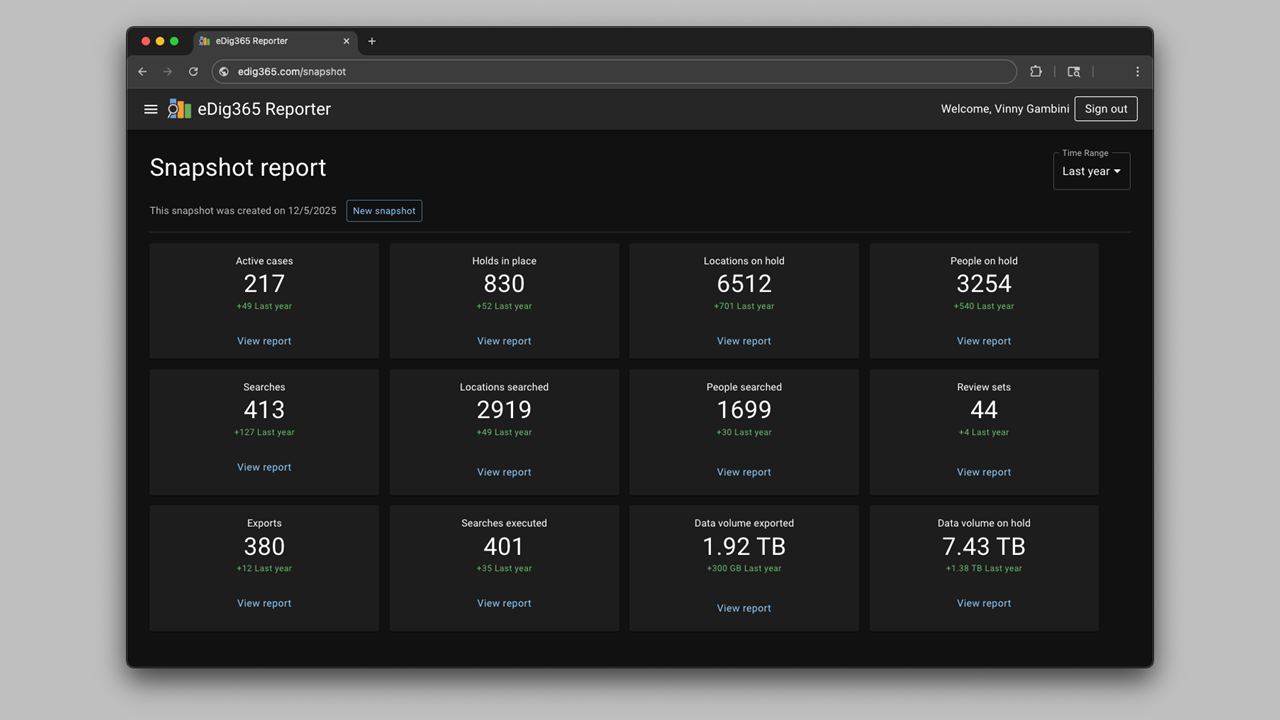


A new legal technology product called eDig365 is making its public debut this week at the CLOC Global Institute in Chicago, offering a reporting and observability layer built on top of Microsoft Purview eDiscovery.
The product is designed to address a gap that its founders say is common in corporate legal departments. Legal operations and compliance teams often have no direct visibility into what is happening inside Microsoft Purview eDiscovery — the platform many organizations use to manage legal holds, searches and data exports in Microsoft 365 — because the sensitive permissions required to access Purview are tightly controlled by IT.
eDig365 was developed by Five Star Legal, an e-discovery and compliance consulting firm that has been in business since 1992.
The Problem It Addresses
In many large organizations, e-discovery workflows are split between IT teams, who have the technical access to run Purview operations, and legal or compliance teams, who direct the work but cannot see it directly.
The result, according to eDig365, is a process that often relies on manual documentation — IT teams taking screenshots, copying data into spreadsheets, and manually generating reports to share with legal colleagues.
That workflow is not only slow, but also potentially risky, the company argues. Microsoft’s audit logs for Microsoft 365 roll off after 12 months, and discovery disputes can surface years after the underlying events.
Without a systematic record of how holds were placed, searches were conducted, or exports were executed, organizations may have difficulty demonstrating compliance.
Additionally, eDig365’s founders point to a specific Microsoft licensing constraint: Detailed processing reports within Purview are available only to organizations running Microsoft 365 E5 licenses, while many enterprises run hybrid E3/E5 environments or remain on E3 entirely.
What the Product Does
In a recent demonstration for LawSites, father-and-son cofounders Don Swanson and Hunter Swanson described eDig365 as a read-only reporting application that connects to Purview eDiscovery via Microsoft’s Graph API and surfaces data through a web-based dashboard.
It does not execute searches, place holds or export data, they said. Its function is to surface information about those activities in a form accessible to non-IT users.
The application provides a “snapshot report” — an aggregate view showing active cases, holds in place, locations on hold, custodians, searches, exports and data volumes, with year-over-year trend data.
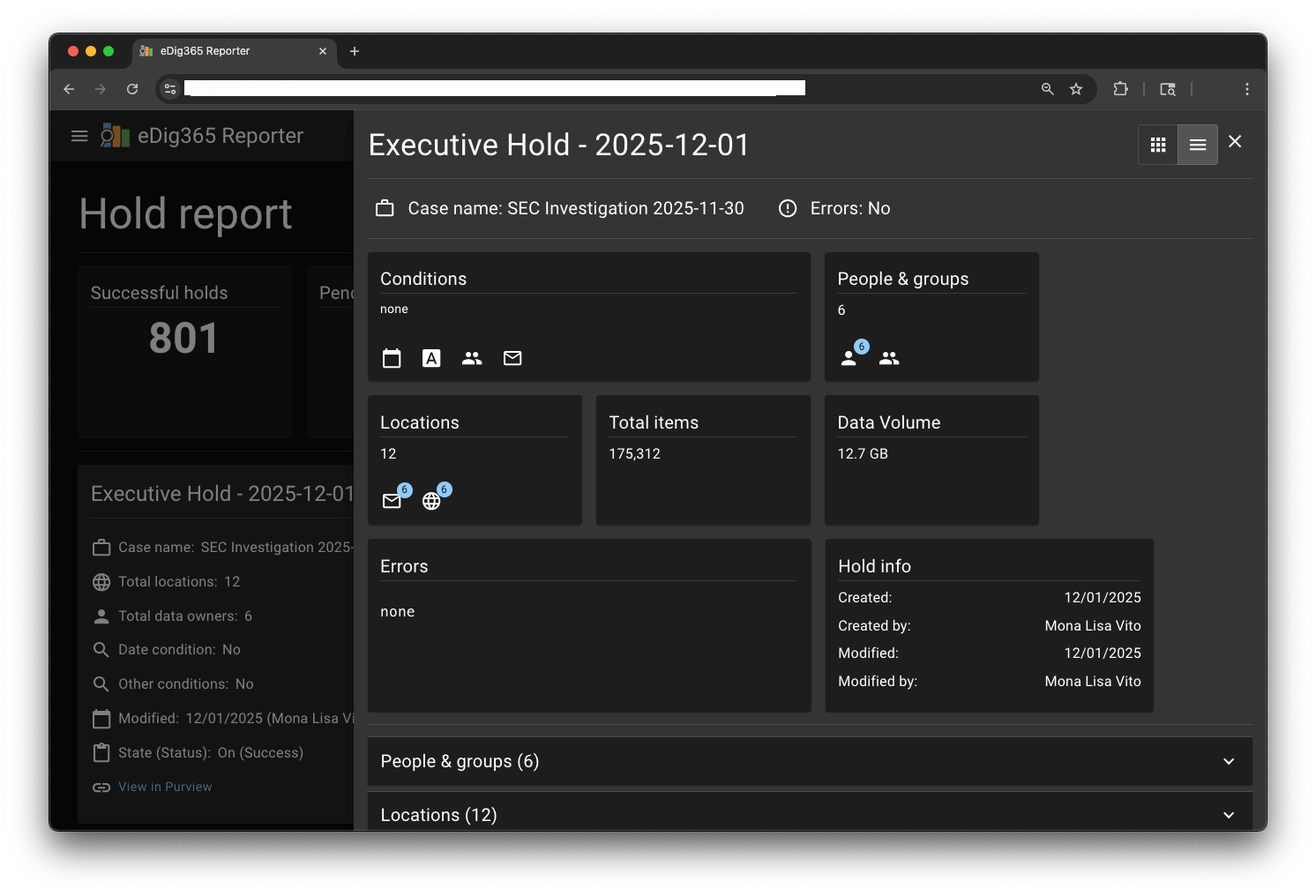
Users can drill down to the case level, hold level, and individual custodian level, viewing information such as which holds a particular custodian is subject to, what searches have been run against their data, what Teams channels they belong to, and basic mailbox and OneDrive statistics.
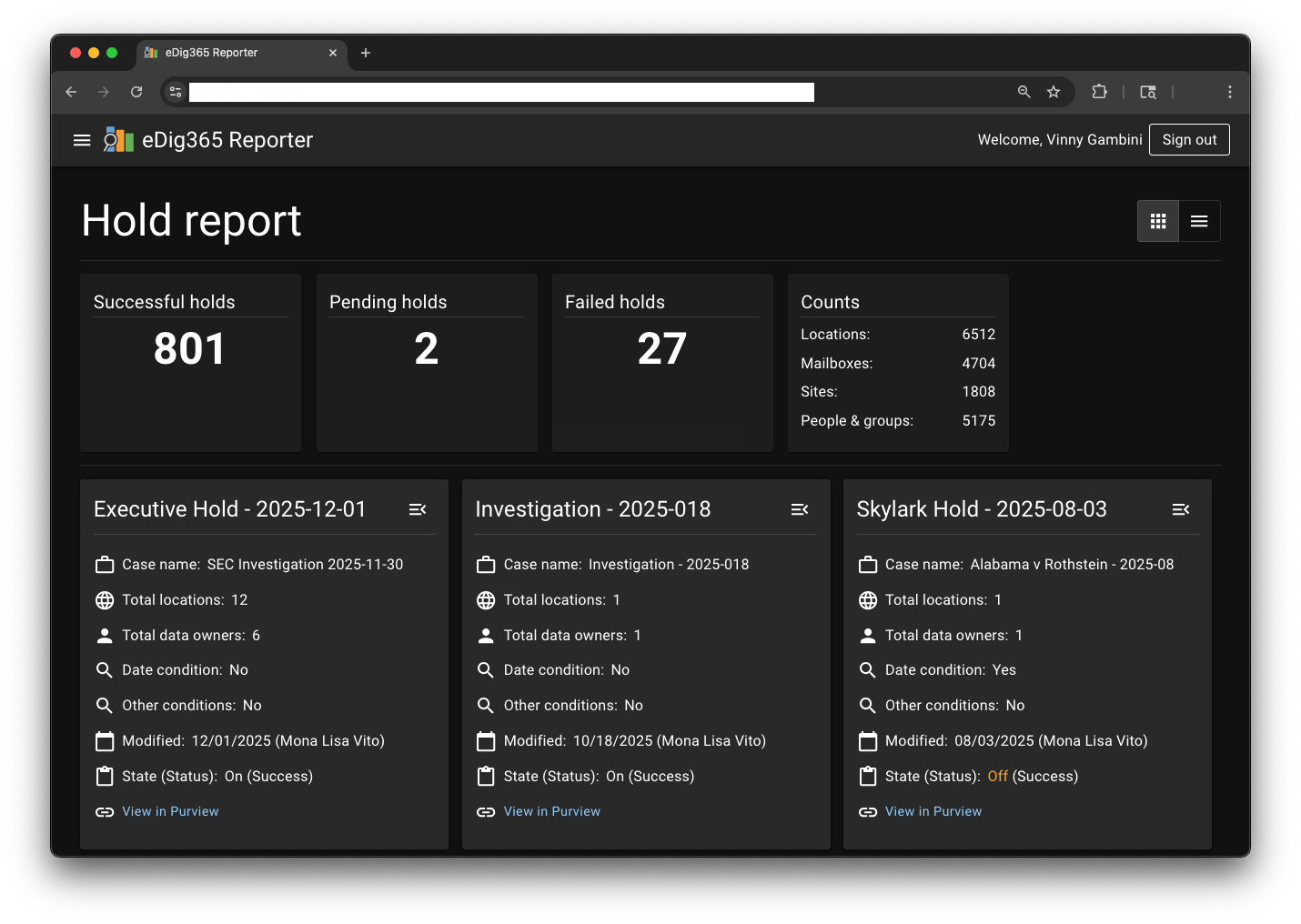
The hold reporting module shows successful, pending and failed holds, and flags holds that may be in an “off” state while still reflecting a successful status — a distinction that could be significant in a litigation context.
The custodian-level reporting also surfaces email folder structure and data volumes, which the company suggests can help teams assess the scope of a potential collection before requesting IT action.
There is even a use case involving GDPR compliance, the founders say. Because eDig365 provides an abstract reporting layer rather than direct access to content, legal and compliance teams can gather certain investigative information about a custodian — such as folder names and data volume — without triggering GDPR notification requirements that might apply if the mailbox itself were accessed.
Deployment and Pricing
eDig365 is deployed through the Microsoft Azure Marketplace, which the company says offers two advantages: Microsoft is already an approved vendor in most enterprise procurement environments, and the application runs entirely within the customer’s own Azure tenant.
The company says it has no connection to customer data — the application operates as an on-premises model hosted in the customer’s own cloud.
The application is priced at $2,500 per month on a flat-rate, month-to-month basis with no annual contract. That price covers unlimited users and unlimited reporting.
Because it is distributed through the Azure Marketplace, customers are billed by Microsoft rather than directly by eDig365. Organizations with Microsoft Azure Consumption Commitments (MACC) may be able to apply those credits toward the subscription cost.
The company says installation, once a customer has cleared internal security review, takes roughly an hour and is self-service, with documentation provided by eDig365.
Even as the company officially exhibits the product for the first time this week at CLOC, the founders they already have a number of customers, primarily Fortune 500-level organizations with significant litigation and investigation activity.
As of this writing, SOC 2 Type 2 certification is pending, with the company anticipating that certification within the next 30 to 45 days.
The Bottom Line
eDig365’s founders say the product currently has no direct competitors. Rather, they say, the primary competition is the status quo of IT teams managing custom reporting solutions, or organizations simply getting by without systematic reporting at all.
While other e-discovery platforms offer features such as hold management and reporting, eDig365 appears to have found a unique niche with regard to Purview-native reporting — and thereby solved a problem no one else has tackled.
In a sense, the product’s value proposition is essentially the inverse of a migration pitch: rather than moving e-discovery workflows to a third-party platform, eDig365 enables organizations already invested in Microsoft Purview to get more out of that investment without replacing it.