 Robert Ambrogi Blog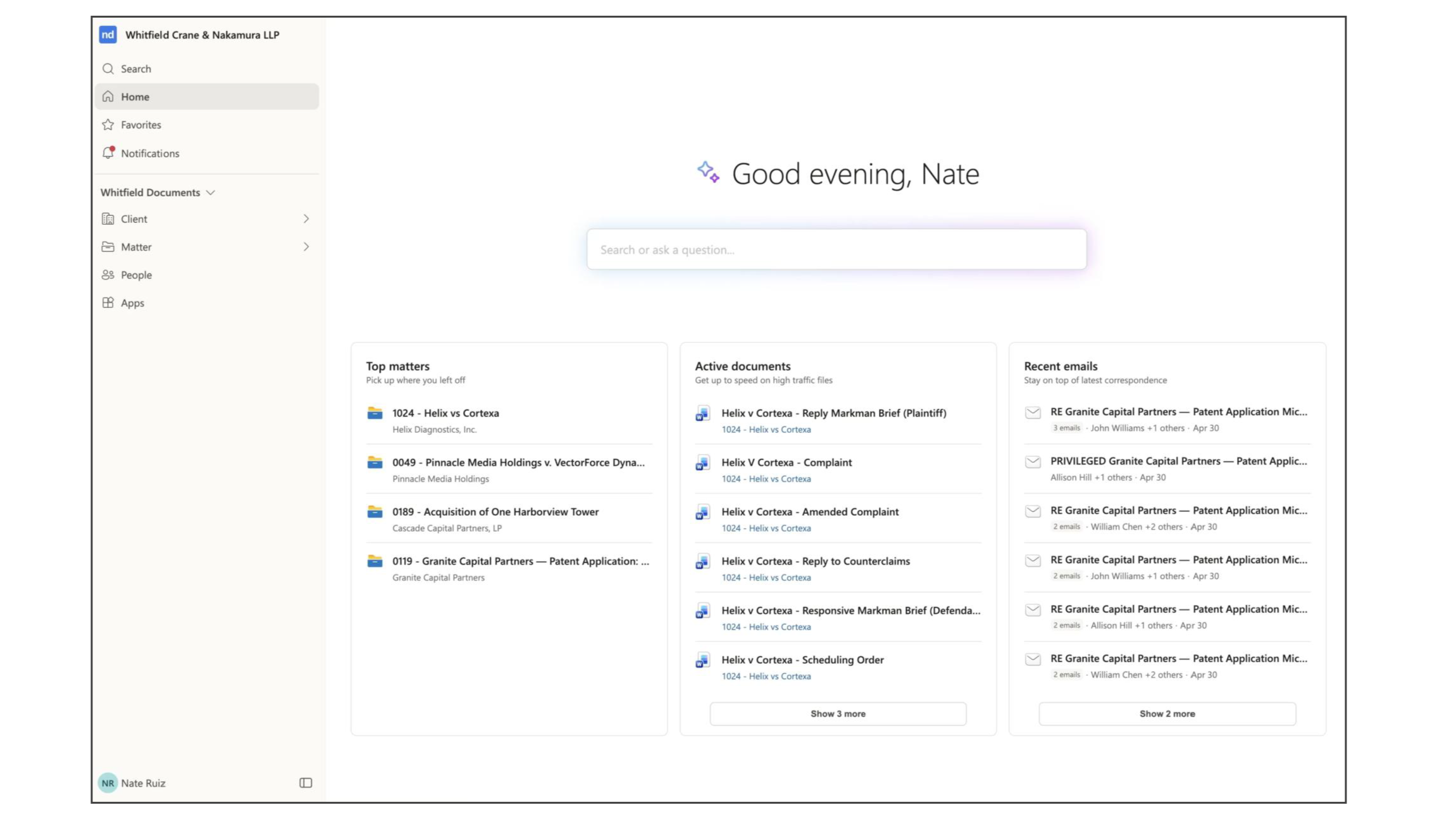


NetDocuments today announced what it calls the first legal context graph — a proprietary knowledge infrastructure that the company says continuously maps the relationships among every matter, document, communication and person across a firm’s entire document repository, while preserving existing permissions and ethical walls.
Alongside it, the company is launching a substantial redesign of its platform’s user interface, including the new home page pictured above.
A private preview of all this opens today for select customers on the company’s enterprise AI tier, with broader public preview expected in the coming months.
At an advance briefing for the press, the company said that the core idea is that legal work is not just a collection of documents, but rather a web of relationships among documents, people, matters, and institutional knowledge that today’s document management systems fail to capture in a structured way that is accessible to AI.
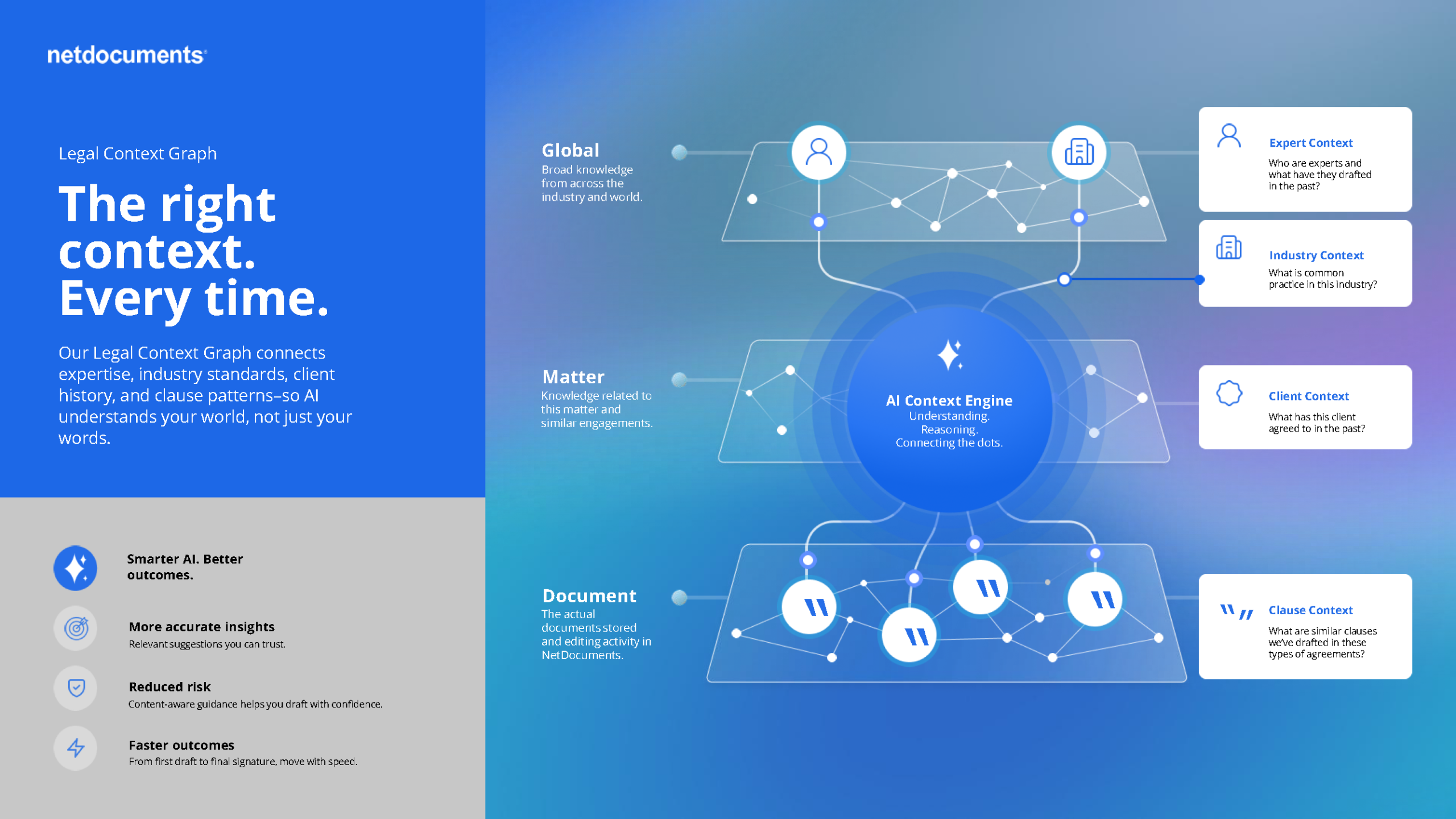
This image provided by NetDocuments illustrates the concept of the Legal Context Graph.
NetDocuments’ legal context graph is intended to change that by continuously indexing and connecting that web at three levels: the document level (classification, extracted entities, version history), the matter level (how documents within a matter relate, what story they tell together), and the global level (firm-wide expertise, experience, and practice patterns).
“This is not a refreshed interface,” the company’s announcement said. “It is a fundamental shift in what the platform is, moving from a system that stores legal work to a system that truly understands it.”
The company said it built the technology in partnership with AWS and Elastic to operate at the scale required by large law firms. It said the platform is model-agnostic, capable of routing queries to different underlying LLMs — including those from Anthropic, OpenAI, and others — depending on the task.
The graph also draws, in part, on the legal data taxonomy standards being developed by the SALI Alliance and the Federated Open Legal Information Ontology (FOLIO).
A ‘Reimagined’ Platform
The new interface, developed over several years and informed by more than 39 design studies involving over 1,500 participants, introduces several notable capabilities:
Matter Overview. When a lawyer opens a matter, the platform automatically generates a summary drawn from all documents and correspondence in the matter, pulls out key parties, dates and team members, and displays an activity timeline. The company says this can dramatically reduce the time a new associate might otherwise spend getting oriented on a complex case.
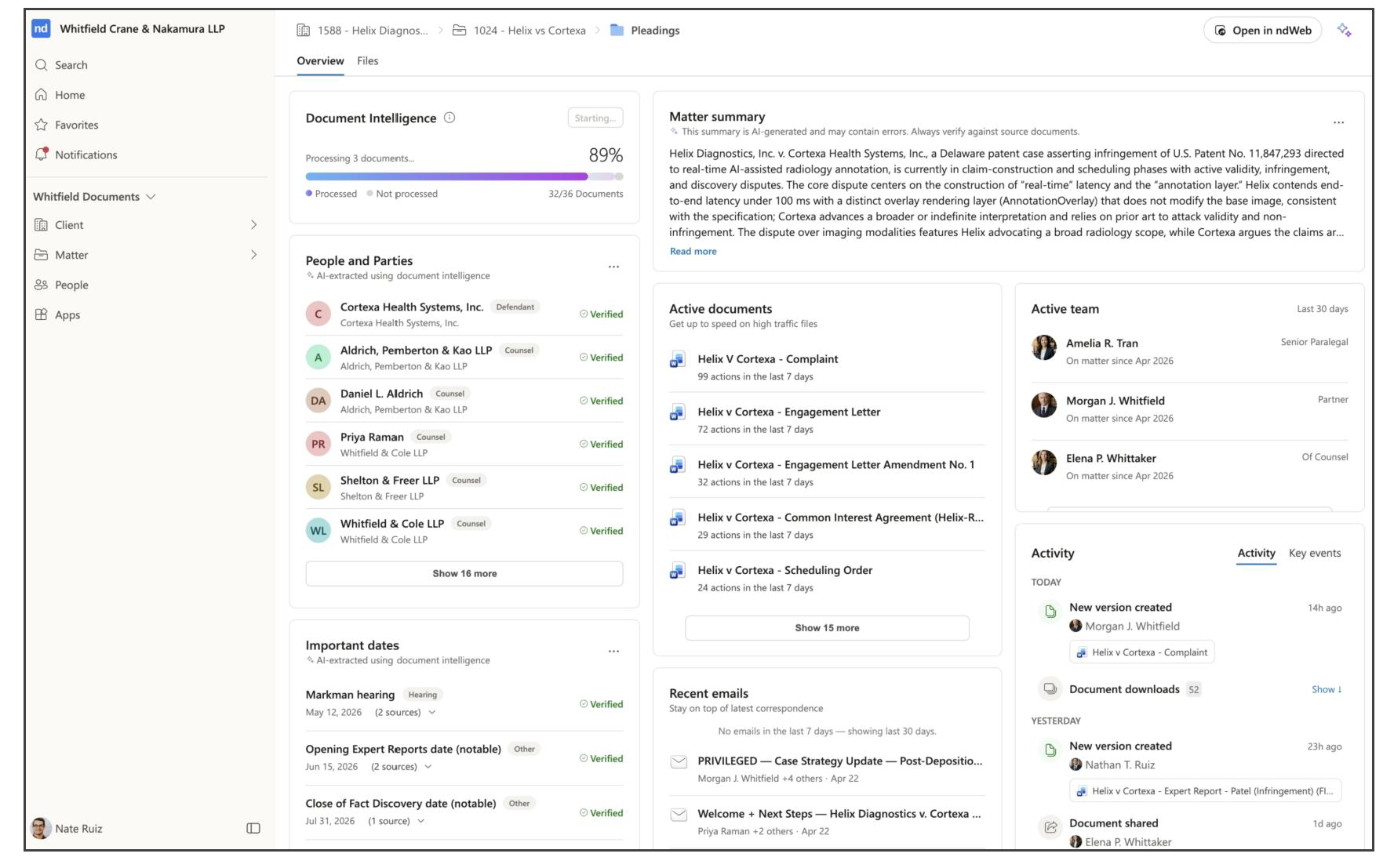
The new matter overview page is designed to give users everything they need to understand and interact with a matter.
SmartSearch. A natural-language search capability lets users ask questions across the firm’s entire repository, with answers citing specific source documents. Results remain subject to each user’s access permissions and ethical walls.
AI-Generated Version History. When a new version of a document is saved, the system automatically generates a summary of what changed and why — capturing the kind of context that, in practice, rarely gets entered manually into version notes fields.
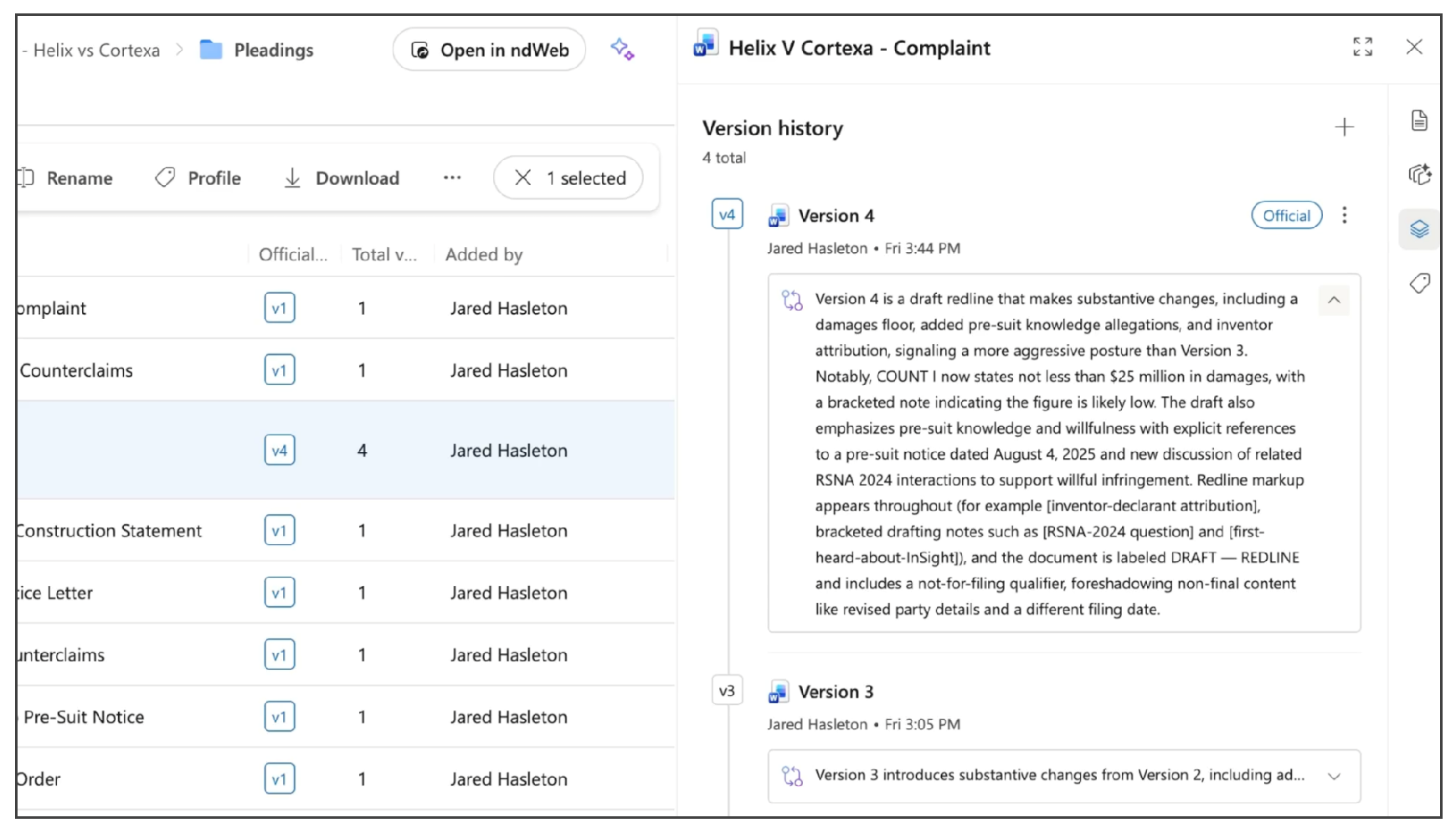
AI-generated version descriptions provide context for what has changed within a document.
Document Intelligence. When a document is added to a matter, the system immediately classifies it, extracts structured data (parties, key dates, relevant clauses), and integrates that information into the matter overview so that subsequent searches and AI-generated summaries reflect the new content.
Co-Authoring and AI Editor. Documents stored in NetDocuments can be opened directly in Microsoft Word for real-time co-authoring. An AI editing tool within Word allows users to issue natural-language instructions — for example, to update specified sections of a brief based on a newly added expert report — drawing on the matter context already in the system.
Notifications. A new notifications feature surfaces activity by both human colleagues and AI agents working on matters.
Context Is Key
NetDocuments says the key to these developments a concept that is gaining increasing traction in the industry, which is that context — not just AI capability — is the limiting factor in legal AI. The press release cites Gartner’s identification of “context engineering” as a strategic priority and Foundation Capital’s argument that the competitive advantage in enterprise AI lies in who can structure and explain institutional knowledge, not just who holds the underlying data.
The company draws a contrast between its legal context graph and other approaches that it describes as relying on “single session uploads” — a reference to the workflow typical of standalone AI tools that do not have deep integration with a firm’s document management system.
By embedding the context graph in the DMS itself, NetDocuments argues, AI agents working inside its platform — or connecting to it via MCP integrations including Claude, ChatGPT, and other legal AI tools through its ndConnect interface — have access to a richer, permission-governed source of institutional knowledge than those tools can access otherwise.
“For thirty years, legal technology has stored what was done,” the company said. “Now, NetDocuments’ reimagined platform understands it, surfaces it, and acts on it.”
During the press briefing, a reporter asked CEO Josh Baxter how this compares to iManage’s recently announced document inference layer. Baxter said he would not comment directly on a competitor’s product, but added that NetDocuments’ approach was the result of years of customer engagement.
Toggle Between Interfaces
The new platform launches alongside the existing NetDocuments interface, not as a replacement. Customers will be able to toggle between the two, and both run on the same underlying data and governance model, with no migration required from one to the other.
The company said customers on the enterprise AI tier can sign up for the private preview waitlist at netdocuments.com, and a public webinar demonstrating the new features is scheduled for June 9.
“One lawyer described it to us as the picture of a matter that has always lived in a lawyer’s head, now made visible, interactive, and ready for an agent to work with,” said Dan Hauck, chief product officer at NetDocuments. “This is the deepest piece of platform engineering we have ever shipped, and it is the one that matters most. You cannot retrofit this. It has to be built into the core.”