 Robert Ambrogi Blog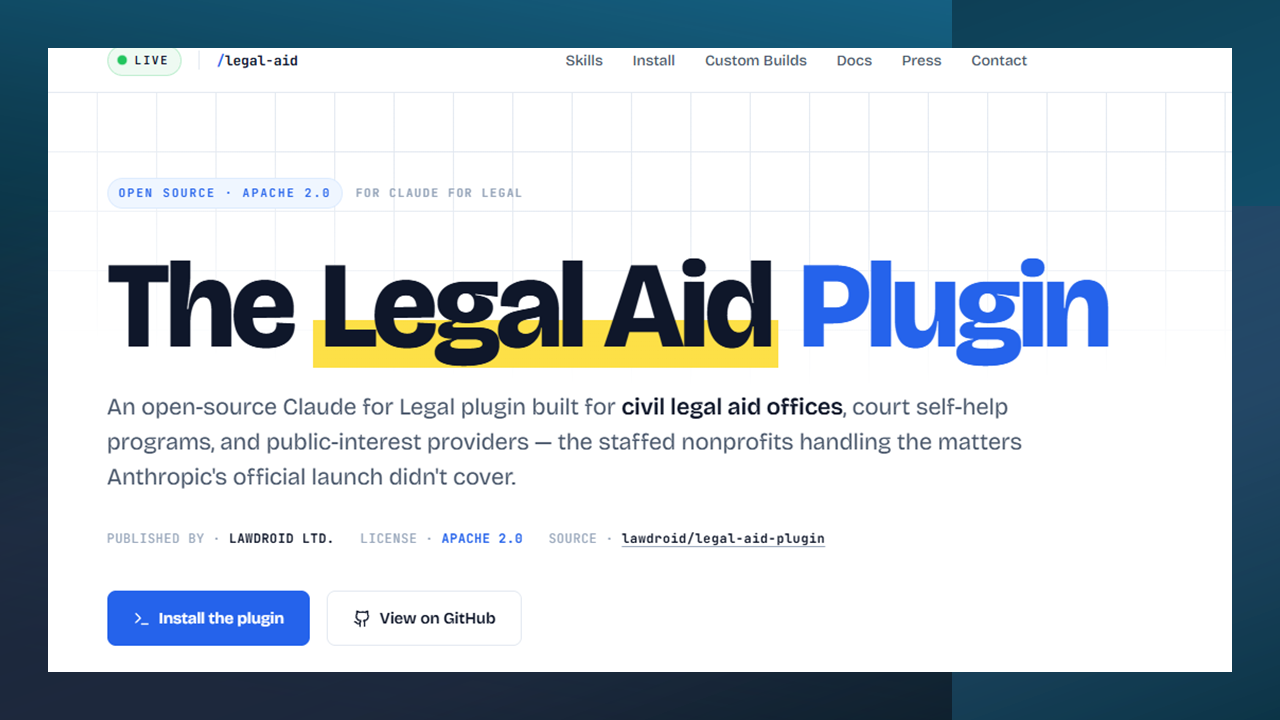


In last week’s Claude-pocalypse, Anthropic, one of the world’s leading artificial intelligence companies, released 12 legal-specific plugins for its Claude AI assistant. It was big news, signalling a frontier AI company’s deeper push into the legal space.
Notably, however, not one of those plugins was designed for legal aid. Rather, they covered legal tasks common within larger law firms and corporate legal departments — M&As, commercial, regulatory, employment, governance, IP and litigation.
To Anthropic’s credit, it did offer a legal clinic plugin for law schools, and it did address access to justice through its partnerships with the Justice Technology Association and the Free Law Project, and its integrations with four companies that serve A2J: Boardwise, CourtListener, Courtroom5, and Descrybe.
Still, as the company LawDroid put it, “The 132 LSC-funded legal aid programs, hundreds of court self-help centers, and public-interest legal providers that serve low-income and vulnerable communities were largely overlooked.”
The Legal Aid Plugin
Aiming to do something about that, LawDroid today announced the release of the Legal Aid Plugin, a free, open-source plugin built specifically for civil legal aid organizations, court self-help programs, and public-interest legal providers using the Claude AI platform.
Available now at LegalAidPlugin.org and GitHub, the Legal Aid Plugin is designed to help ensure that the access-to-justice community is included in the growing legal AI ecosystem, LawDroid says.
“Civil legal aid is not BigLaw on a smaller budget,” said Tom Martin, LawDroid’s founder and CEO. “It is a fundamentally different practice environment with different clients, funding rules, staffing realities, ethical considerations, and operational demands. Legal aid organizations do not need generic AI tools retrofitted to their work. They need infrastructure designed around how legal aid actually operates.”
The focus of the legal aid plugin is not on replacing attorneys or staff, but on helping organizations reduce administrative burdens, improve workflows, and serve more people, LawDroid says. The full list of the 15 skills it offers can be viewed on the GitHub page, but among them are commands for:
- Authoring practice area guides.
- Onboarding staff.
- Eligibility screening of potential clients.
- Client intake.
- Drafting for documents such as protective orders, demand letters, benefits appeals, and more.
- Creating case status summaries.
- Tracking case deadlines.
- Drafting routine correspondence.
And more. The plugin also supports integrations and workflows involving other tools such as CourtListener, Descrybe, Courtroom5, Slack, Google Drive and local file access.
Fully Open Source
LawDroid says the project is fully open-source, requires no separate accounts, does not depend on a SaaS platform, and allows organizations to maintain control over their own systems and data.
Of course, while the plugin is free, a Claude subscription is not. However, Anthropic offers significant nonprofit discounts to eligible organizations.
“What matters about this launch is not just the plugin,” said Sally Chaffin, practice innovation manager at Atlanta Legal Aid Society, in a statement provided by LawDroid. “It’s published openly, free to use, and open to contribution from any legal aid organization, anywhere. The civil legal aid community needs technology built that way.”
Scheree Gilchrist, chief innovation officer at Legal Aid of North Carolina, said that her work has taught her that the justice gap is not going to be bridged though a “business as usual” model and that technology is critical to reducing administrative burdens and freeing staff to spend more time on advocacy.
“It’s encouraging to see developers thinking intentionally about how AI skills and plugins can support legal services and expand access in practical and responsible ways,” Gilchrist said. “It’s even better when legal services programs get to help shape what’s being built.”
If you would like to learn more about the Legal Aid Plugin, LawDroid is hosting a live webinar demonstration and walkthrough on June 1, 2026, at 1 p.m. ET. It will cover installation, setup, workflow examples, and real-world use cases for legal aid organizations. To attend, register here.