 Robert Ambrogi Blog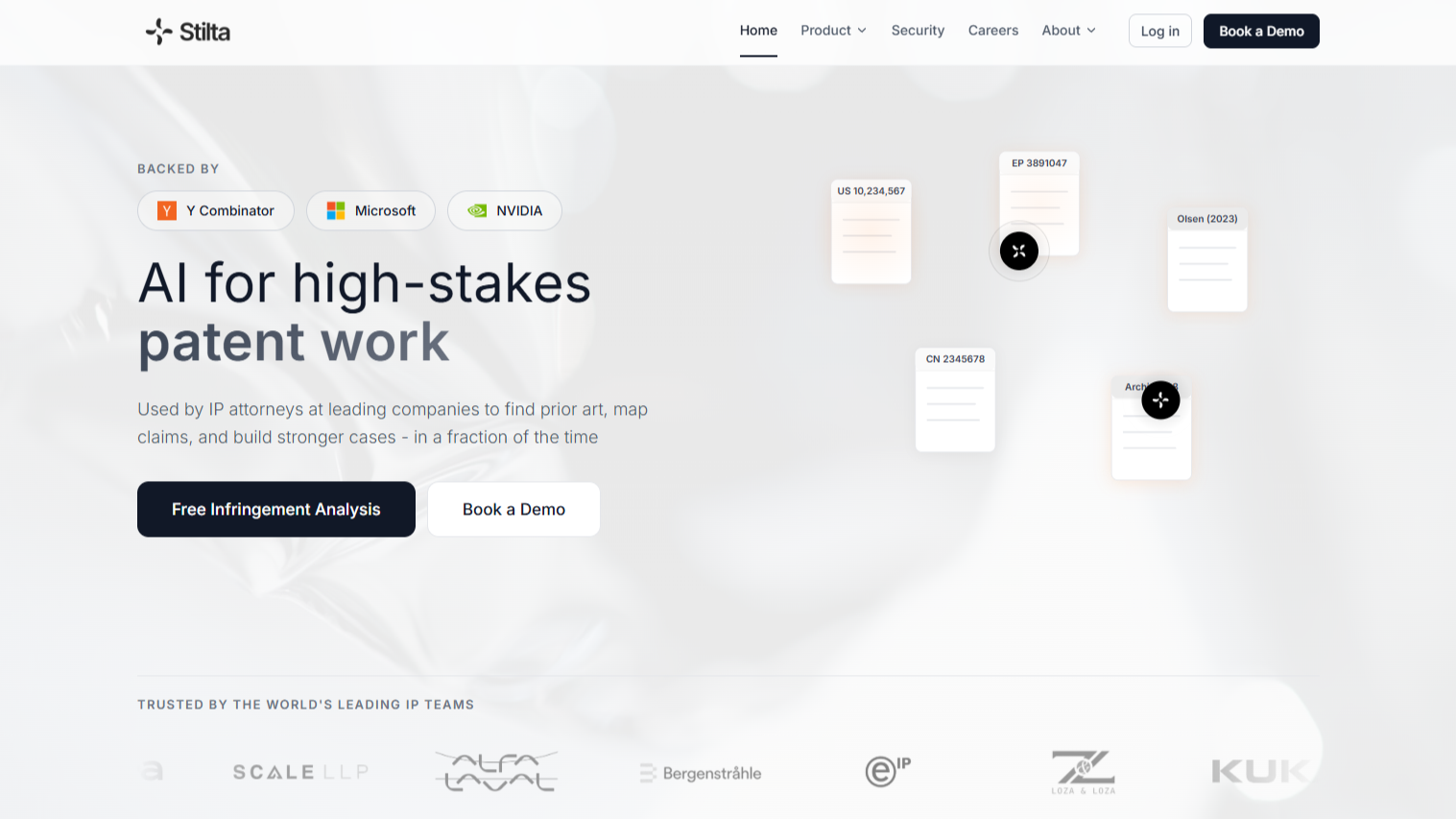


A five-month-old Swedish startup that says its AI agents can do the heavy lifting of patent invalidity and infringement analysis has raised a $10.5 million seed round led by Andreessen Horowitz, one of the world’s most prominent venture capital firms, the company is announcing today.
Stockholm-based Stilta, founded in December 2025 by four former McKinsey engineers, said the round also drew checks from startup accelerator Y Combinator — through which Stilta went earlier this year — and a group of founders and operators from AI companies including Sana, Legora, OpenAI, Lovable and Listen Labs.
The investment is Stilta’s first outside funding. David Haber, the Andreessen general partner who has led other recent legal tech bets for the firm, including the AI-for-plaintiffs platform Eve, led the round for Andreessen Horowitz.
The funding arrives in a category of AI for patent practitioners that has seen notable growth in just the last six months. New York-based Patlytics, an AI platform that spans the entire patent lifecycle, closed a $40 million Series B led by SignalFire in April, bringing its total to roughly $65 million.
And in December 2025, San Francisco and London based Solve Intelligence, which is focused primarily on patent prosecution, raised its own $40 million Series B and launched Charts, a product aimed squarely at the same invalidity, infringement, and freedom-to-operate workflows Stilta is pursuing.
In a briefing yesterday, Stilta co-founder and CEO Oskar Block named Patlytics and Solve’s Charts product as his closest competitors, while arguing that most other patent-AI tools — including the better-known drafting platforms — have so far focused on prosecution rather than litigation work.
What The Product Does
In our briefing, Block demonstrated that, on the invalidity side, Stilta lets a user drop in a patent number and then dispatches a swarm of AI agents to look for prior art across what the company describes as 180 million patents, 250 million scientific publications, and more than a trillion archived web pages — the latter via an integration with the Internet Archive’s Wayback Machine. The agents also pull prosecution history from the USPTO.
During the demo, Block walked through an invalidity analysis the platform had run against a wireless-networking patent. After roughly half an hour, the system had surfaced 868 prior art references — a mix of patents, non-patent literature like product brochures and scientific publications, and archived web pages — and mapped them against each claim limitation in a claim chart that color-coded the strength of each read.
A user can drill into any reference to see the source text or the underlying PDF alongside the claim language, and can prompt the agents to go deeper on a specific limitation. Block also showed multiple agent sessions running in parallel against the same patent, including one tasked with drafting the best invalidity theories — anticipation and obviousness — from the prior art the system had already pulled.
Stilta says it has run an internal benchmark showing roughly three times the recall of general-purpose models like ChatGPT, Claude and Perplexity on the same invalidity task.
Block said the product also handles the mirror-image workflow — infringement and freedom-to-operate analysis on the assertion and commercialization side — and that customers can use the platform collaboratively, with multiple lawyers in the same project.
Customers And Roadmap
According to its press release, Stilta formally launched its product in February and already has notable enterprise customers including Roche, Alfa Laval, and Maersk. The release says the company also has signed three of the world’s five largest IP firms as either customers or active pilots.
In the briefing, Block said roughly two-thirds of Stilta’s customers are corporate in-house IP teams — across pharma, industrials, and high-tech — and one-third are law firms focused on litigation. The customer base is split roughly 50/50 between the U.S. and Europe, he said. Stilta did not disclose revenue, pricing, or customer counts.
The round will fund Stilta’s first hires beyond the four co-founders, with engineering and go-to-market hires in Stockholm and plans for a New York office by year’s end.
Longer-term, Block said, Stilta wants to expand from litigation into adjacent IP workflows and eventually become “the full IP operating system” for both corporate IP teams and law firms — the same kind of platform pitch Patlytics and Solve are also now articulating.
Block said that starting in litigation, where accuracy demands are highest, makes the move into lower-stakes workflows easier rather than harder.
“Patent litigation runs on labor-intensive workflows that haven’t meaningfully changed in decades,” Haber, the Andreessen general partner, said in the press release. “Stilta automates them and, in doing so, becomes the system of record for how enterprises protect and monetize their most valuable intangible assets.”