 Robert Ambrogi Blog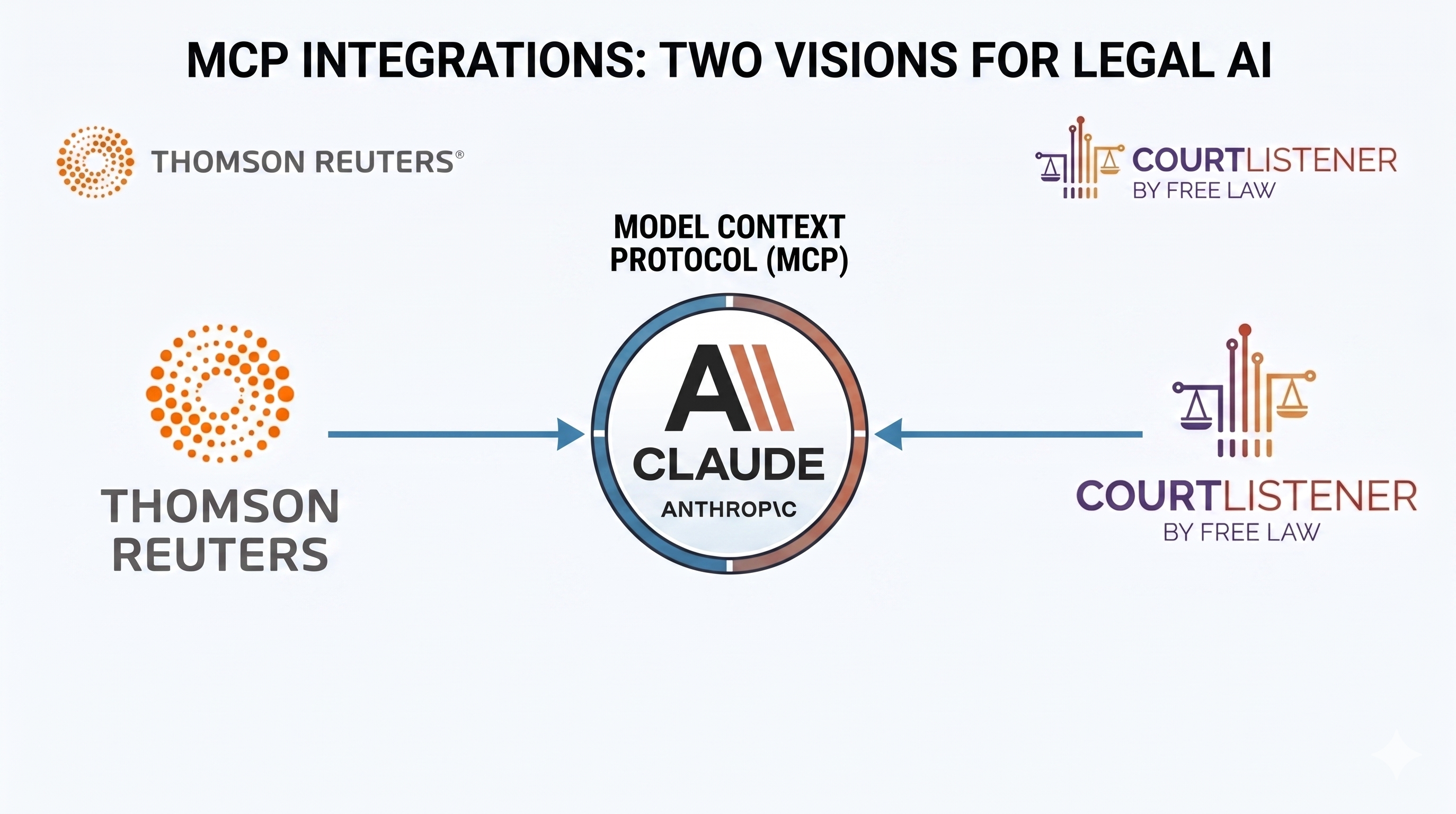


Two legal research providers — one a global publicly traded corporation, the other a relatively scrappy nonprofit — are today both announcing integrations with Anthropic’s Claude that allow the AI assistant to tap directly into their legal databases.
While the announcements from Thomson Reuters and Free Law Project’s CourtListener arrive on the same day and use the same underlying technology, they differ in their visions of who AI-powered legal research can serve and how it should work.
Both come as part of a much-broader announcement by Anthropic of its push into the legal industry, as it just released more than 20 MCP connectors to legal tech products and 12 practice-area plugins for Claude.
And even though I wrote this story in advance about two legal research platforms, the Anthropic announcement includes others: Descrybe, Legal Data Hunter, Midpage and Trellis.
Related to this story:
- Anthropic Goes All-In on Legal, Releasing More Than 20 Connectors and 12 Practice-Area Plugins for Claude.
- Justice Technology Association Named Access to Justice Partner in Anthropic’s Legal AI Launch.
What Is MCP?
Both integrations rely on the Model Context Protocol, or MCP — an open standard developed by Anthropic that allows AI assistants to connect to external data sources and tools in real time.
Rather than relying solely on information baked into their training data, AI models using MCP can query live databases, retrieve current documents, and take actions on a user’s behalf.
MCP integrations have been proliferating across legal tech and other industries as developers recognize that grounding AI responses in live, authoritative data dramatically improves their reliability.
Thomson Reuters: CoCounsel Legal Comes to Claude
Thomson Reuters is announcing an MCP integration that connects Claude directly to CoCounsel Legal, its professional-grade AI system for lawyers.
The integration is designed to let legal professionals move between Claude’s general-purpose AI environment and CoCounsel’s citation-grounded legal workflows without changing tools.
The integration is built on what Thomson Reuters describes as a “fiduciary-grade” standard — the idea that legal AI must meet the accountability demands of professional practice, where, as the company puts it, “almost right is not good enough.”
CoCounsel Legal draws on what Thomson Reuters says is a corpus of 1.9 billion Westlaw and Practical Law documents, 1.4 billion KeyCite validity signals, and a patent-pending citation ledger that makes every source traceable with a single click.
The Claude integration is one piece of a broader strategy to connect CoCounsel Legal to wherever lawyers are working, Thomson Reuters says.
“Thomson Reuters is building CoCounsel Legal to be the fiduciary-grade system at the center of how legal work gets done, connected to the tools lawyers use and built to the standard their work demands,” said David Wong, the company’s chief product officer.
“Today’s integration with Claude is one example of how those connections will continue to grow as we move toward general availability for the next generation of CoCounsel Legal this summer.”
That next generation of CoCounsel Legal is, according to the announcement, being rebuilt on Anthropic’s Claude Agent SDK — a more fundamental architectural change than a simple integration.
Thomson Reuters says the new system will be capable of planning, selecting tools, retrieving authoritative content, and adapting mid-workflow.
Lawyers would be able to describe a matter in plain language and have CoCounsel Legal pursue the right inquiry, draft with citations, and produce validated work product. The next-generation system is currently in beta.
Scott White, Anthropic’s head of product for enterprise, said the partnership is intended to “deliver AI that can operate in high-stakes professional environments,” allowing users to “move from exploration to execution with confidence.”
CourtListener: Free Legal Research, Now Inside Claude
Free Law Project, the nonprofit that operates CourtListener, is also announcing today that CourtListener is now available as an MCP connector inside Claude — and with its focus on providing free, public and permanent access to primary legal materials, there is a striking contrast in potential use cases.
Not only is CourtListener free, but also, as of last week, every CourtListener account comes with free API access, which means the MCP integration is available to anyone who creates an account at no charge. Elevated API access is available through a Free Law Project membership or commercial arrangement, but the basic integration costs nothing.
The data itself is also different in character from what Thomson Reuters offers. The CourtListener MCP provides what the project describes as real primary legal data — not summaries, not scraped text, and not content reconstructed from training data.
The project describes it as grounded access to primary sources at the moment people need them most, inside the AI tools they are already using.
Through the MCP, Claude gains access to:
- Millions of federal and state court decisions going back centuries.
- PACER data from what CourtListener describes as the largest open repository of federal court cases, parties, attorneys and documents.
- Citation networks showing what cases cite and what cites them.
- Oral argument audio and transcripts from federal appellate courts.
- Biographical and financial disclosure data on federal judges.
- Keyword and semantic search across the archive.
- Real-time alerts for new filings, citations and queries.
- Citation verification to reduce hallucinations.
The documentation for the integration, published on the Free Law Project wiki, offers a sense of what the tool is capable of in practice. Among the sample prompts it suggests:
- “Find recent opinions on qualified immunity and identify splits.”
- “Pull the latest filings on docket XYZ and explain what’s happening.”
- “Find the PACER fees class action, tell me the current status, and sign me up for email alerts at the appellate and district level.”
- “Make me an alert any time that Miranda v. Arizona is cited by the supreme court”
- “Verify every citation in this brief and flag any unknown citations.”
- “Review the news article at this link and find the case that’s being discussed: https://local-news-example.com/legal-article.”
I had a brief opportunity to try the CourtListener MCP prior to today’s announcement. In the interest of time, I defaulted to trying variations of CourtListener’s suggested prompts.
As one example of the prompts I tried, I asked Claude to find the federal court copyright litigation between Thomson Reuters and ROSS Intelligence and tell me the current status of the case. It quickly gave me a narrative overview of the case’s background and significance, drawn in part from Court Listener, but also other sources on the web.
I next asked it to list the five most recent docket entries, which it pulled from CourtListener and immediately listed.
Although I have so far used it only briefly, I am impressed with the potential ease and power of combining Claude with CourtListener’s free research and docket data.
Still, CourtListener’s announcement is cautious about what this is and what it is not. “The MCP server is infrastructure,” CourtListener says. “It connects a powerful AI model to a high-quality legal data source.”
Access-to-Justice Implications
That combination of powerful AI and high-quality legal data, CourtListener says, “has genuine potential to support access to justice work, and we are committed to building toward that.”
“For self-represented litigants and legal aid organizations in particular, grounded access to primary legal data makes AI legal assistance meaningfully more reliable. A response built on verified CourtListener data is categorically different from one built on even the best model alone.”
But “the MCP itself is a technical tool,” CourtListener cautions, and “Claude is not a lawyer. Nothing produced through this integration is legal advice, and human judgment remains essential, especially for high-stakes decisions.”
Needless to say, that framing of this integration within the access-to-justice context is a key distinction from the Thomson Reuters announcement, which is aimed squarely at legal professionals at law firms, corporate legal departments and government agencies.
Using the Integration
To get started, users go to Settings > Connectors > Browse in Claude on web, desktop, or mobile, find CourtListener in the directory, and connect it to their CourtListener account.
Instructions for connecting to ChatGPT and other AI assistants are also available on the Free Law Project wiki. The CourtListener MCP can also be installed locally using a JSON configuration file with an API token.
Looking ahead, Free Law Project says it is working on two additional projects worth watching: Citator, described as a free open tool for checking whether a case is still good law, which the project plans to integrate with the MCP; and a Scanning Project aimed at digitizing American case law to make the corpus complete.
Where Work Begins vs Where It Ends
Thomson Reuters used the occasion of today’s announcement to publish a companion blog post by Joel Hron, its chief technology officer, offering a broader argument about the direction of legal AI.
Hron contends that as AI tools proliferate, a key distinction is emerging between where legal work begins and where it finishes. General-purpose AI tools, he argues, are increasingly becoming the starting point, useful for acceleration and early exploration, while professional systems such as CoCounsel are where work must ultimately be validated, grounded and completed.
“AI can now draft, summarize, and analyze in seconds,” Hron writes. “But legal work does not end with a draft. It ends when someone can put their name on it.”
He points to Freshfields as an example of a sophisticated law firm already operating this way, using general AI for early thinking and professional systems for high-stakes completion.
Needless to say, Hron’s argument conveniently positions Thomson Reuters’ products as the indispensable final layer in any AI-assisted legal workflow.
The argument does, however, reflect a genuine concern in the industry about hallucinated citations and AI-generated filings that have failed professional scrutiny.
Two Visions, One Protocol
What’s notable about these two announcements landing on the same day is less the coincidence than what it says about the range of possibilities MCP opens within the legal profession.
The same technical standard is enabling a global content company to extend its premium professional platform into new AI environments while also enabling a nonprofit to give anyone with an internet connection real-time access to the primary law of the United States.
For lawyers and legal professionals who already subscribe to Westlaw or CoCounsel, the Thomson Reuters integration should prove a valuable extension of tools they already rely on.
For researchers, legal aid organizations, self-represented litigants, developers, journalists, and anyone else, CourtListener’s free MCP integration represents a genuinely new and more powerful way of accessing the law.
As Hron of Thomson Reuters observed, the question with any AI-assisted legal workflow is ultimately “where it resolves, and what system ensures it is right.”
The two announcements today offer different answers to that question — and serve differentn segments of the legal AI market.