 Robert Ambrogi Blog


As legal AI company Harvey kicks off the two-day Harvey Forum today in New York City, it is announcing the launch of Command Center, a new product designed to help law firms and legal teams manage, measure, and optimize enterprise AI adoption.
In addition, Harvey today announced a partnership with legal AI company DeepJudge designed to bring the expertise and institutional knowledge of law firms and corporate legal teams directly into AI-powered legal work.
Both announcements were made at the Harvey Forum, a two-day event at Hall des Lumières in New York that the company says convenes legal-industry leaders to discuss how AI and new operating models are reshaping legal work. The Forum is split into a Law Firm & Innovation Day today and an In-House Day tomorrow.
Taken together, the two announcements signal Harvey’s effort to expand beyond AI workflow tools — drafting, research, due diligence — into two adjacent areas: the management layer firms use to oversee AI deployments, and the institutional knowledge layer that determines how useful those deployments actually are.
Command Center: Analytics and Benchmarking
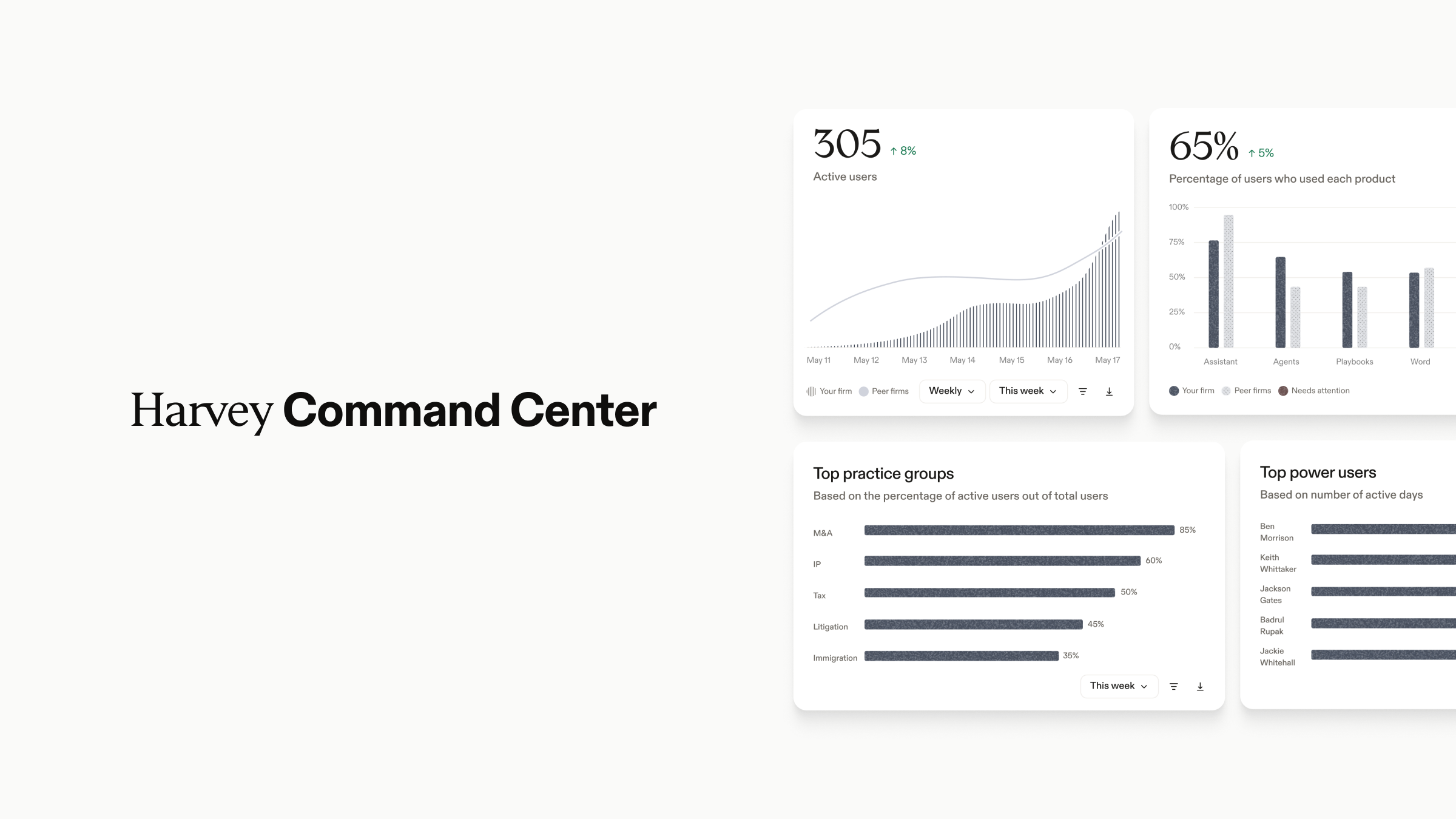
Command Center, according to Harvey, gives organizations visibility into how the platform is being used across practice groups, offices, product areas, and user cohorts, with the aim of helping firms spot adoption trends, usage concentration, and groups that may need additional training or support.
The company says the product was built with design partners at Haynes Boone, Foley & Lardner, Clayton Utz, Rajah & Tann, and dentsu. Harvey opened a waitlist for early access today and says general availability will follow in the third quarter.
Three capabilities anchor the product, according to Harvey:
- Usage analytics and peer benchmarking. Beyond a firm’s own internal analytics, Command Center introduces benchmarking that draws on anonymized, aggregated usage data from more than 1,500 Harvey deployments globally, allowing an organization to compare its adoption and usage patterns against similar firms and legal teams.
- An agentic analytics layer. Command Center includes an agentic layer that lets users query deployment and usage data in natural language — for example, asking how adoption differs across practice groups, how partner usage compares to associate usage, or which workflows are driving adoption. Users can also generate reports for internal leadership and AI governance stakeholders directly from the platform.
- Intelligent recommendations and release tracking. A recommendations feature is designed to surface Harvey features that peer organizations have already enabled, which is intended as a way to help innovation teams prioritize rollouts. A dedicated releases section tracks newly launched features and updates.
Command Center is primarily intended for innovation, knowledge management, and legal operations leaders — the people inside firms and legal departments responsible for AI governance, adoption, and return on investment — and Harvey says it built the product in response to growing demand for more structured oversight of enterprise AI.
“Command Center helps solve a real need for firms adopting AI at scale: better visibility into usage, value, and where users need support,” said Tony Capecci, director of practice innovation at Haynes Boone, in a statement provided by Harvey. “We had already built some of this internally, so having Harvey bring it into the platform lets us spend less time maintaining custom infrastructure and more time on adoption, governance, and higher-value innovation.”
DeepJudge Partnership: Institutional Knowledge
Today’s second announcement is a partnership with DeepJudge, which describes itself as an institutional intelligence platform for legal AI.
The two companies say the integration will bring an organization’s past work, decisions and expertise into Harvey’s workflows, while also respecting existing access permissions and ethical walls, so that legal teams can research, draft and analyze with AI grounded in their own institutional knowledge.
Work product generated within Harvey is reflected back in DeepJudge, the companies say, so that each matter feeds the organization’s collective knowledge base.
The partnership targets the “context tax,” the companies say — the idea that even capable AI systems produce generic output when they lack access to a firm’s fragmented, hard-to-reach institutional knowledge.
DeepJudge, founded by former Google researchers with AI doctorates from ETH Zurich, is backed by investors including Coatue and Felicis and is used by law firms and in-house teams across North America and Europe.
DeepJudge CEO and co-founder Paulina Grnarova said the partnership brings past work and institutional expertise into AI’s reasoning so that outputs reflect the standards and ways of working unique to each firm.
Harvey CEO and co-founder Winston Weinberg described the partnership as closing the gap between the expertise embedded in a firm’s prior work and a legal team’s ability to apply it consistently.
Bottom Line
Both of today’s announcements build on a common theme: As the underlying AI models become more of a commodity, vendors are increasingly competing on the surrounding layers — the management tooling that makes deployments governable and the institutional knowledge that makes outputs firm-specific.
Whether Command Center measures value as well as usage, and whether the DeepJudge integration delivers grounding in practice rather than in principle, are questions the early-access firms will begin answering between now and general availability.