 Robert Ambrogi Blog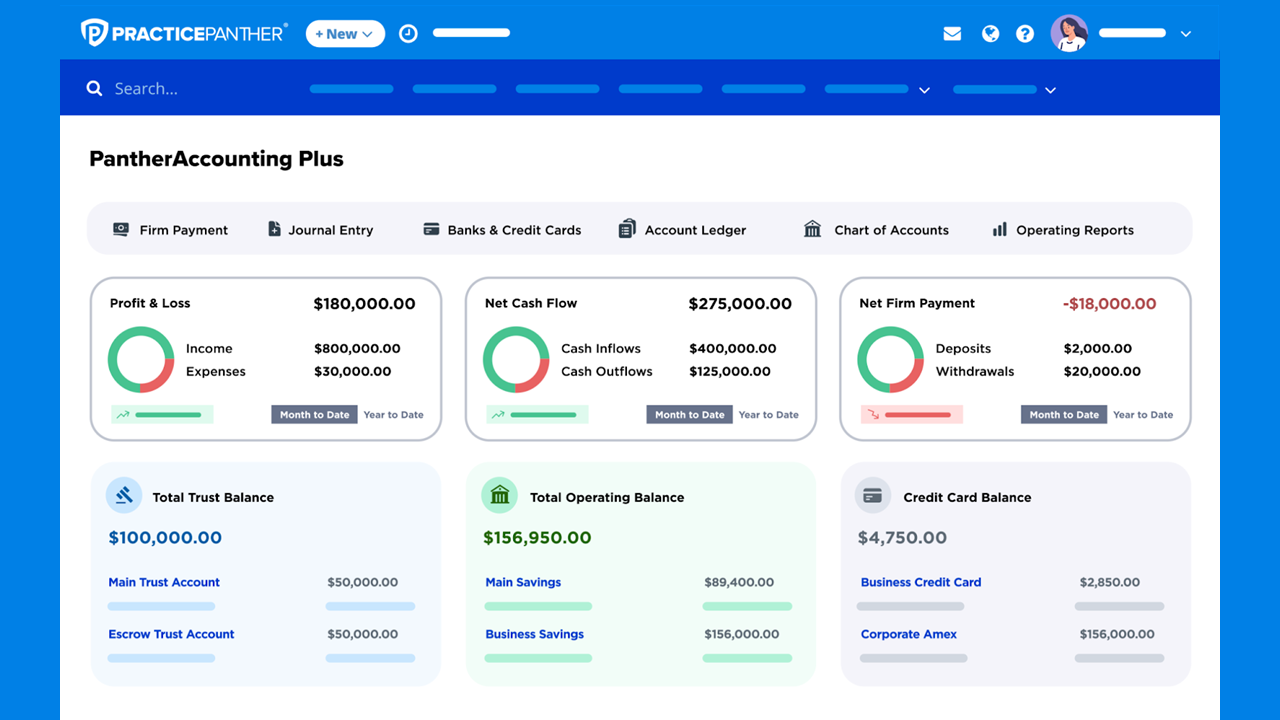


PracticePanther, the cloud-based legal practice management platform that is part of Paradigm’s suite of legal software products, today launched PantherAccounting Plus, a comprehensive trust and operating accounting feature set built natively into its platform.
The new capability enables law firms to manage the full lifecycle of their financial operations – from client retainers to month-end reconciliations to year-end tax reporting – without ever leaving PracticePanther.
The launch represents a significant expansion of PracticePanther’s financial management capabilities, building on its existing billing, invoicing, time tracking and PantherPayments features. PantherAccounting Plus is available to PracticePanther users on its new Business Pro plan, at an additional $25 per user per month above the standard Business plan.
“For years, law firms have had to stitch together their practice management software with separate, often generic accounting solutions – creating data gaps, double entry, and compliance risk,” said Soumya Nettimi, CEO of Paradigm, in a statement. “With PantherAccounting Plus built natively into PracticePanther, law firms now have a single platform that handles everything from client intake to financial close.”
Last week, I was given an exclusive pre-launch demonstration by Colin Li, Paradigm’s president, chief financial officer and chief revenue officer, and Chad Todd, the cofounder of the trust accounting platform TrustBooks, which Paradigm acquired in 2022. They walked me through the product’s features in detail.
What permeated their presentation was a picture of an accounting system designed with a clear guiding philosophy – that legal accounting should be simple enough for any member of a law firm’s staff to handle, yet robust enough to fully replace standalone accounting tools such as QuickBooks.
A Ground-Up Build
Todd, who has spent over a decade focused on accounting for law firms, emphasized that PantherAccounting Plus is not simply a re-skin of the TrustBooks product.
TrustBooks – which was a contestant in 2016 at the inaugural ABA TECHSHOW Startup Alley that I run – was a standalone trust accounting application built around the principles of simplicity and bar compliance. Those principles carry over, Todd said, but the product itself is entirely new.
“We took all the lessons learned from building out that little niche and from talking to thousands of attorneys, and we wired that straight into Practice Panther,” Todd said. “Instead of just rushing TrustBooks and dropping it in and saying, ‘Hey, we’re done,’ we’ve taken a couple of years, and we rolled this out in phases, and we’ve talked to hundreds of law firms.”
The result, he said, is an accounting system that extends workflows attorneys and their staff already know within PracticePanther, rather than requiring them to learn a separate system.
“Our philosophy is that accounting in your LPM shouldn’t be big or scary or difficult,” Todd said. “It shouldn’t feel like learning something new. It should be an extension of what you’re already doing.”
Full Replacement for Standalone Software
PantherAccounting Plus covers both trust accounting and operating accounting – the two essential pillars of law firm financial management.
On the trust side, the system provides full IOLTA and trust ledger functionality, client and matter-level tracking, safeguards against co-mingling of funds, and a guided three-way reconciliation wizard.
On the operating side, it offers a general ledger, a customizable chart of accounts, expense tracking and full financial reporting including profit-and-loss statements, balance sheets and cash flow statements.
Asked whether PantherAccounting Plus is a full replacement for a product such as QuickBooks, Todd was unequivocal.
“It’s a full replacement. Our Panther product as a whole has everything you need around invoicing, collections, reporting, clients and matters. And the additional accounting stuff we’ve layered on top gives you an end-to-end solution just as good, if not more robust, than QuickBooks, but in the way that it speaks to the normal person that’s going to be using it.”
“You don’t need another accounting solution,” Li added. “You can get rid of everything except for your bank.”
Addressing Competitors’ Shortcomings
Li and Todd said they deliberately studied the shortcomings of accounting features in competing practice management platforms to avoid repeating those mistakes.
The most common complaints they heard from attorneys were that competitor products felt like two separate systems awkwardly stitched together, and that they were written in accounting jargon that made them inaccessible to non-accountants.
“A lot of the competitors, it feels like two systems, not one,” Todd said. “The bookkeeper feels okay in one system, but not the other. The paralegal feels okay in one system, but not the other. And you can literally feel the friction as these two systems try to sync and pretend to be one. So that was a deal killer for us.”
The solution, he said, was to build accounting directly into PracticePanther’s existing workflows. When a staff member records a payment, for example, the only additional step required for accounting purposes is selecting the appropriate chart of accounts category.
“If you build accounting into your LPM correctly, one feeds the other,” Todd said. “It’s just one simple workflow.”
Streamlined Onboarding
During the demo, Todd walked through the product’s onboarding process, which he described as one of its most important features. For a trust account, the onboarding requires just three steps: enter the date of onboarding, enter the ending balance from the firm’s bank statement, and identify any uncleared transactions.
The system is designed to accommodate firms whatever their state of bookkeeping readiness. Firms with clean records from a prior system can import their balance sheets and chart of accounts via CSV. Firms with messier records – or no prior accounting system at all – can still onboard without friction.
In those cases, PantherAccounting Plus uses placeholder entries for retained earnings and deferred revenue to balance the books, allowing the firm to clean things up later with the help of a bookkeeper.
“It’s important to us that anybody can onboard,” Todd said. “A lot of other systems, you get here, and if you don’t have the perfect technical understanding, you don’t have a financial background, if anything is off at all, you’re toast.”
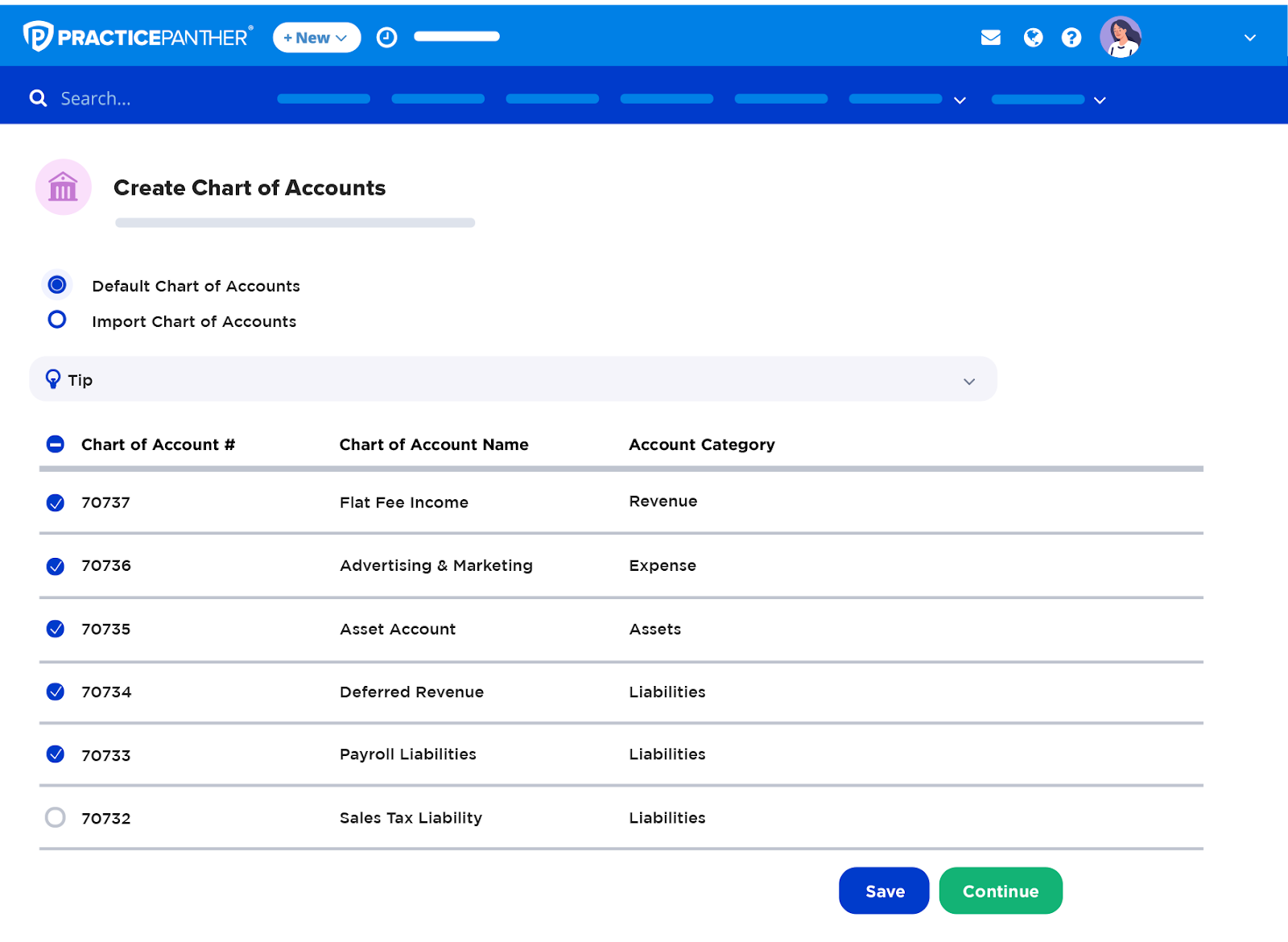
For operating accounts, the onboarding follows the same workflow, with one addition, which is setting up a chart of accounts. PracticePanther provides a default chart of accounts tailored to law firms, built from data gathered from thousands of firms. Firms can also import their existing chart of accounts or customize the defaults, toggling categories on and off before importing.
Todd said he has personally walked hundreds of customers through the onboarding process and that it typically takes about seven minutes – far less than the 45 minutes he typically schedules for the call.
Built-In Compliance Guardrails
In designing the trust accounting features, Todd and Li said, compliance was a central concern. The system requires that every trust transaction be assigned to a specific client and matter – a core requirement for IOLTA compliance that some generic accounting tools fail to enforce. The system also prevents users from taking a client’s trust balance below zero.
PantherAccounting Plus maintains two separate ledgers for trust accounts. A bank ledger tracks the financial activity at the bank level, and a client-matter ledger tracks funds at the individual client level. Todd emphasized the importance of this separation, noting that misappropriation of client funds remains the number one cause of attorney disbarment.
“We don’t leave it to chance,” Todd said. “We don’t co-mingle funds. We don’t muddle accounts.”
Li added that the system provides full traceability from the moment a client payment is entered through to where it appears on the ledger, enabling firms to trace the origin of any transaction if questions arise during a reconciliation or audit.
Three-Way Reconciliation Made Simple
One of the most important capabilities of legal accounting software is three-way reconciliation – a procedure that most state bars require but that many attorneys find intimidating.
In PantherAccounting Plus, the process follows the same simple workflow used during onboarding. Enter the statement ending date, enter the bank balance, and check off which transactions have cleared.
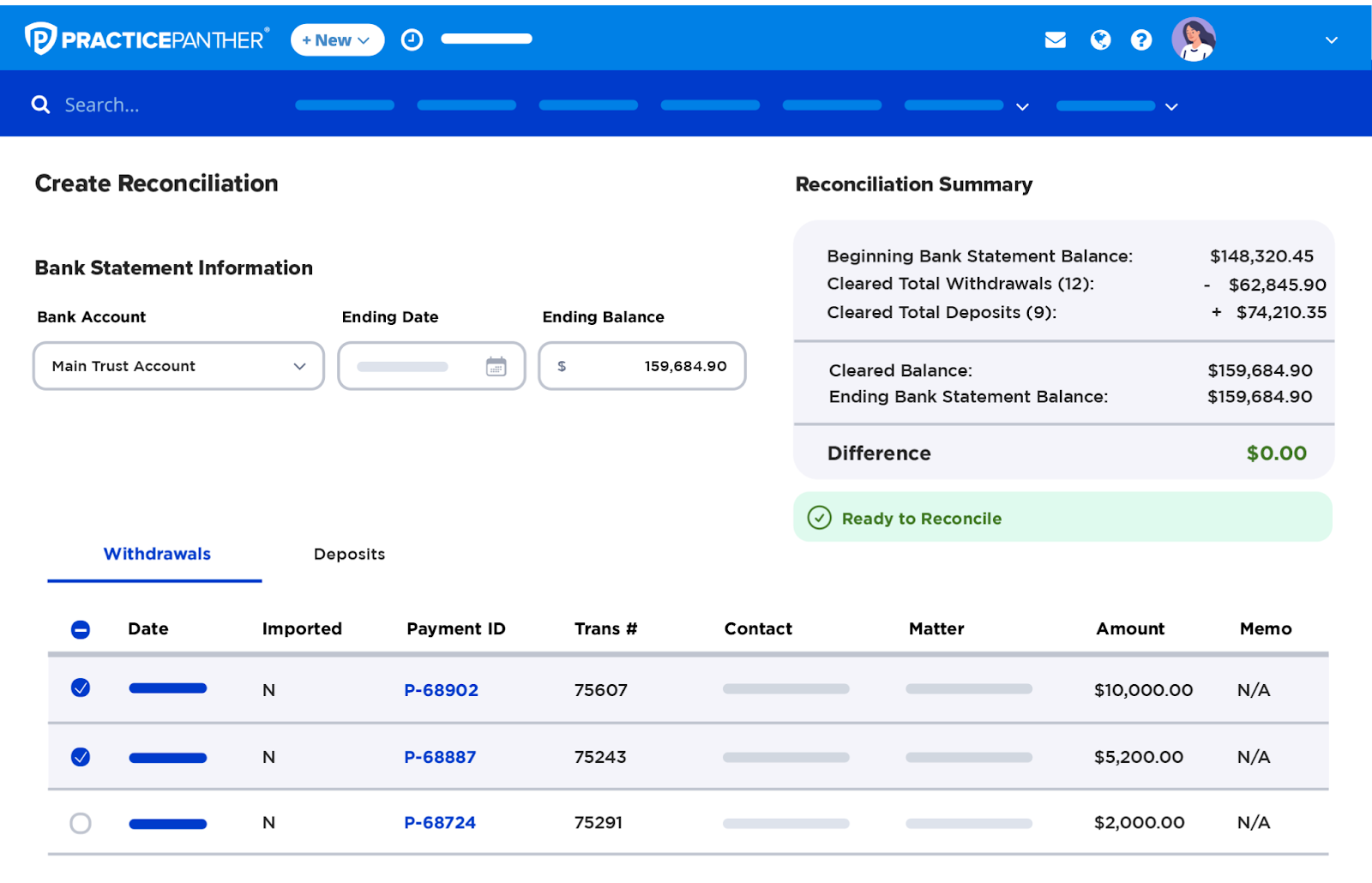
The system performs the math and will not allow a user to finalize a reconciliation unless the numbers balance to the penny.
“You will never find yourself in a situation where you have done a reconciliation, you feel good, you put it under your pillow, and it’s wrong,” Todd said. “It’s right or it’s wrong. There is no gray when it comes to a three-way reconciliation.”
The resulting reconciliation report includes three components: the bank records (showing the ending bank balance minus uncleared items to arrive at an adjusted bank balance), a summary of all client balances, and the trust ledger balance. All three must match.
The report also includes detailed client-level breakdowns showing individual balances, zero-balance clients, and the age and detail of uncleared transactions – each tagged with the associated client and matter.
Todd said this level of detail is important because many competing products either skip the client detail section of the three-way reconciliation or fail to show the client and matter associated with each uncleared transaction.
The system also allows firms to upload and store bank statements alongside their reconciliations – a requirement of certain state bars, including Florida, which mandates that bank statements be stored in the same location as reconciliations.
Bar Compliance Across All States
The system is designed to comply with trust accounting requirements in every U.S. state, Todd said, noting that PracticePanther has worked with state bar member-benefits programs across the country.
The only state with a noteworthy exception is North Carolina, which requires a separate, one-page “attorney review” document that is independent of the reconciliation process itself – a procedural requirement outside the scope of any accounting software.
Li added that PracticePanther ran a dedicated beta period of over a year with several dozen firms, representative of every U.S. state, working through a full annual cycle of reporting and reconciliations to identify and resolve any compliance issues before today’s general launch.
Operating Accounting and Financial Reporting
On the operating accounting side, PantherAccounting Plus provides the same one-workflow approach. Daily activities involve recording deposits and withdrawals, each assigned to a chart-of-accounts category. Monthly reconciliation follows the same process as trust accounting.
The system generates standard financial reports including profit-and-loss statements, balance sheets, cash flow statements and trial balances – all exportable to CSV and PDF for sharing with CPAs and bookkeepers.
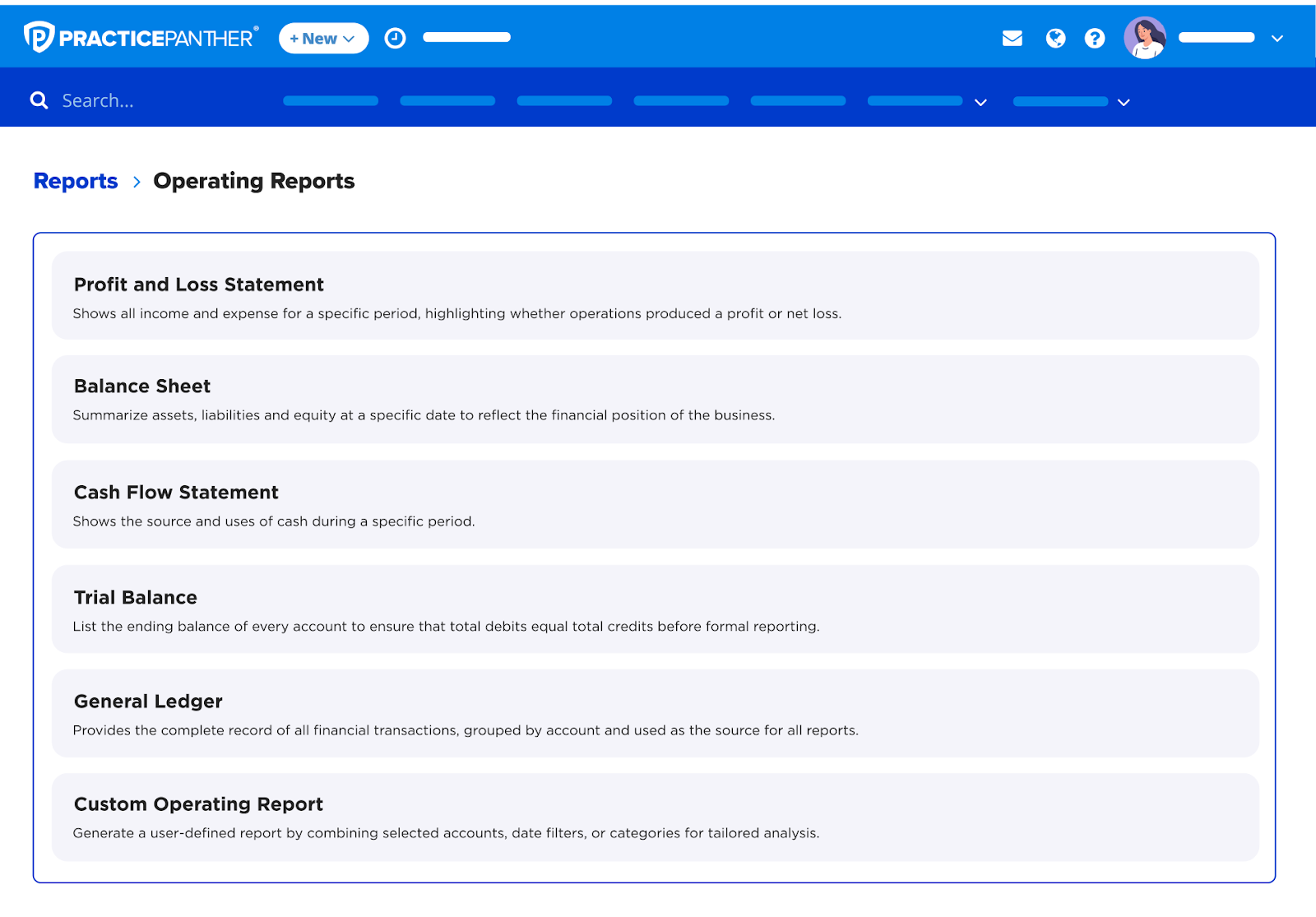
While the day-to-day workflows are simplified for non-accountants, Todd said, the reports themselves follow industry-standard formats that any financial professional would recognize.
“Panther Accounting Plus is end-user easy and simple, but our reporting is industry standard and world class,” Todd said. “We didn’t want to dumb down our financial reports at all.”
A custom report builder allows users to filter transactions by account (with multi-select), date range, client, matter, payee, reconciliation status, check number and other criteria. Todd said this was built from direct feedback from customers and internal accounting staff who identified the specific data they most frequently needed to locate.
Financial Snapshot Dashboard
The product includes a financial snapshot dashboard that updates nightly, providing attorneys with a morning overview of their key financial metrics. The dashboard displays the firm’s latest P&L summary, cash flow statements, net income and expenses, account balances, and any flagged items requiring attention.
“It’s the one comfort zone that busy attorneys can hit first thing in the morning to get their arms around their accounting and then move on for the rest of their day,” Todd said. He noted that the dashboard’s contents were designed based on feedback from roughly 100 attorneys during the beta period.
Bank Feed Integration and Permissions
The system also integrates with banks and credit cards through Plaid for direct bank feeds, allowing firms to import transactions automatically rather than entering them manually. This accelerates the reconciliation process by reducing the need to switch between the bank’s website and PracticePanther.
PantherAccounting Plus includes granular, role-based permissions that extend PracticePanther’s existing security controls. Administrators can control who can view specific reports (such as P&L statements or balance sheets), who can perform reconciliations, and for which accounts.
The system also supports external access for CPAs and bookkeepers, who can be added as users with restricted permissions limited to the accounting functions they need.
As for security, PracticePanther follows the same security standards used in online banking and is PCI compliant – a certification required by its native PantherPayments system. The platform includes multi-factor authentication and user-access controls at the administrative level.
A Decade in the Making
For Todd, the launch of PantherAccounting Plus represents the culmination of more than a decade of work focused on a single problem.
From the early days of TrustBooks at ABA TECHSHOW in 2016 to PracticePanther’s acquisition in 2022 and the subsequent multi-year development effort that followed, the throughline has been consistent, he said: Legal accounting should be simple, compliant and accessible to everyone in a law firm – not just the bookkeeper.
“After talking to thousands of customers and rolling this out with hundreds of firms, we nailed it,” Todd said. “It’s easy. It’s simple. It’s intuitive. It’s accounting that doesn’t feel big or scary. It saves everyone time, energy, and worry.”