 Robert Ambrogi Blog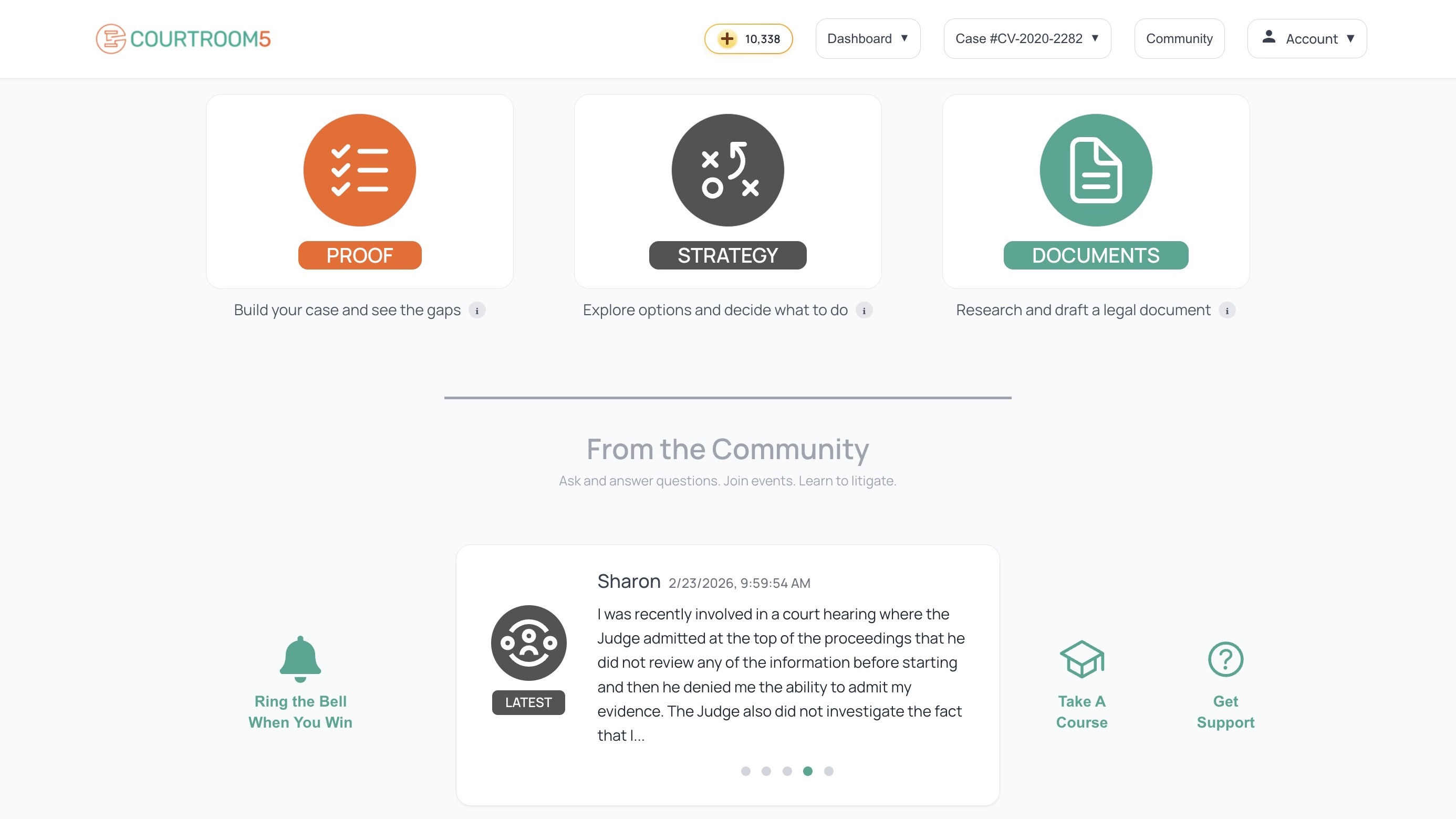


It is estimated that more than 75 percent of civil litigants in U.S. state courts have no legal representation. In eviction proceedings, the figure exceeds 90 percent. For decades, the primary response to this explosion of self-represented litigants has been to provide them with information, such as court websites, self-help centers and legal forms.
Unfortunately, none of that has moved outcomes, says Courtroom5, the Durham, N.C., company that has been building tools for self-represented litigants since 2017. The problem, it says, is not a shortage of legal information, but a shortage of structured preparation.
To address that, it has launched The LAW Accelerator, a program it describes as the first structured platform for self-represented civil litigants, combining AI-powered litigation tools, a step-by-step curriculum, and a peer community — modeled on the startup accelerator programs that have helped entrepreneurs compress the time it takes to become competent in a new domain.
“The justice gap is not a resource problem — it’s a structure problem,” said Sonja Ebron, CEO and co-founder of Courtroom5. “People who can’t afford lawyers don’t need more Google results. They need the same kind of structured program that accelerates startup founders and small business owners.”
Ebron knows that framework firsthand. Courtroom5 has been through Techstars, Google for Startups, and the LexisNexis accelerator, among others, and she sees the same core ingredients in all of them: a curated curriculum, access to experts, and peer support — all aimed at compressing the time to competence.
(Side note: Ebron will be discussing the new platform next week on a panel I will moderate as part of LIT Con, the annual conference and showcase of legal innovation and technology put on by Suffok Law School. The conference is Monday, April 13. If you are in the Boston area, join us.)
What It Does
The LAW Accelerator is built around what Courtroom5 identifies as three simultaneous dimensions of competent litigation, each supported by a dedicated AI tool.
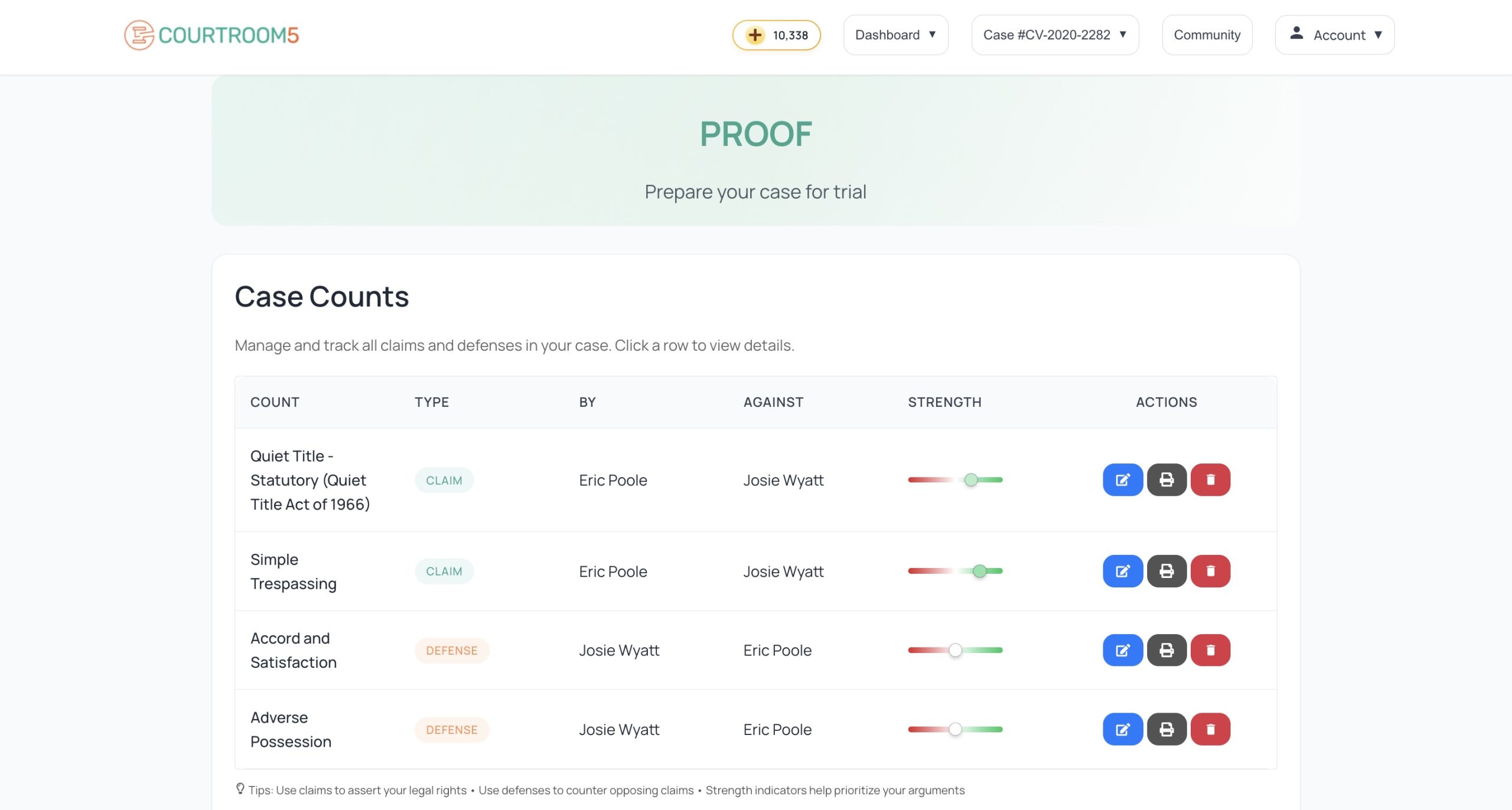
Proof helps users translate their narrative — their story of what happened — into the structural hierarchy of a legal case: claims or defenses, the legal elements of each, the facts supporting those elements, and the evidence proving or disproving those facts.
Users can upload a complaint or other pleading and have the system extract the relevant facts and map them to legal elements. They can also simply describe what happened in plain language, and the system will suggest reasonable claims or defenses, or they can select from a jurisdiction-specific library of legal claims and defenses.
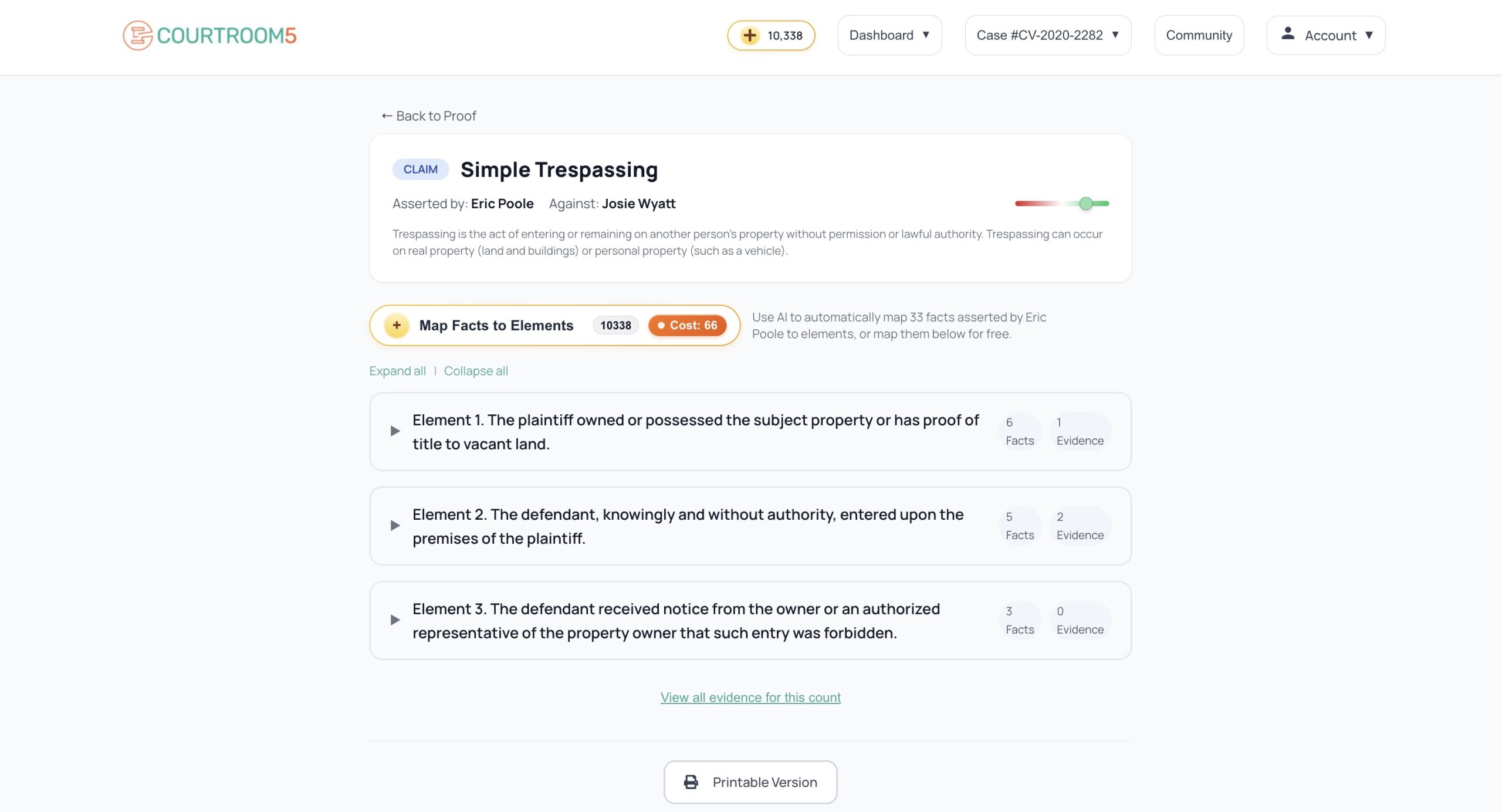
As the user builds the evidentiary record, a strength meter tracks how well-supported is each claim or defense. Elements without supporting facts are flagged.
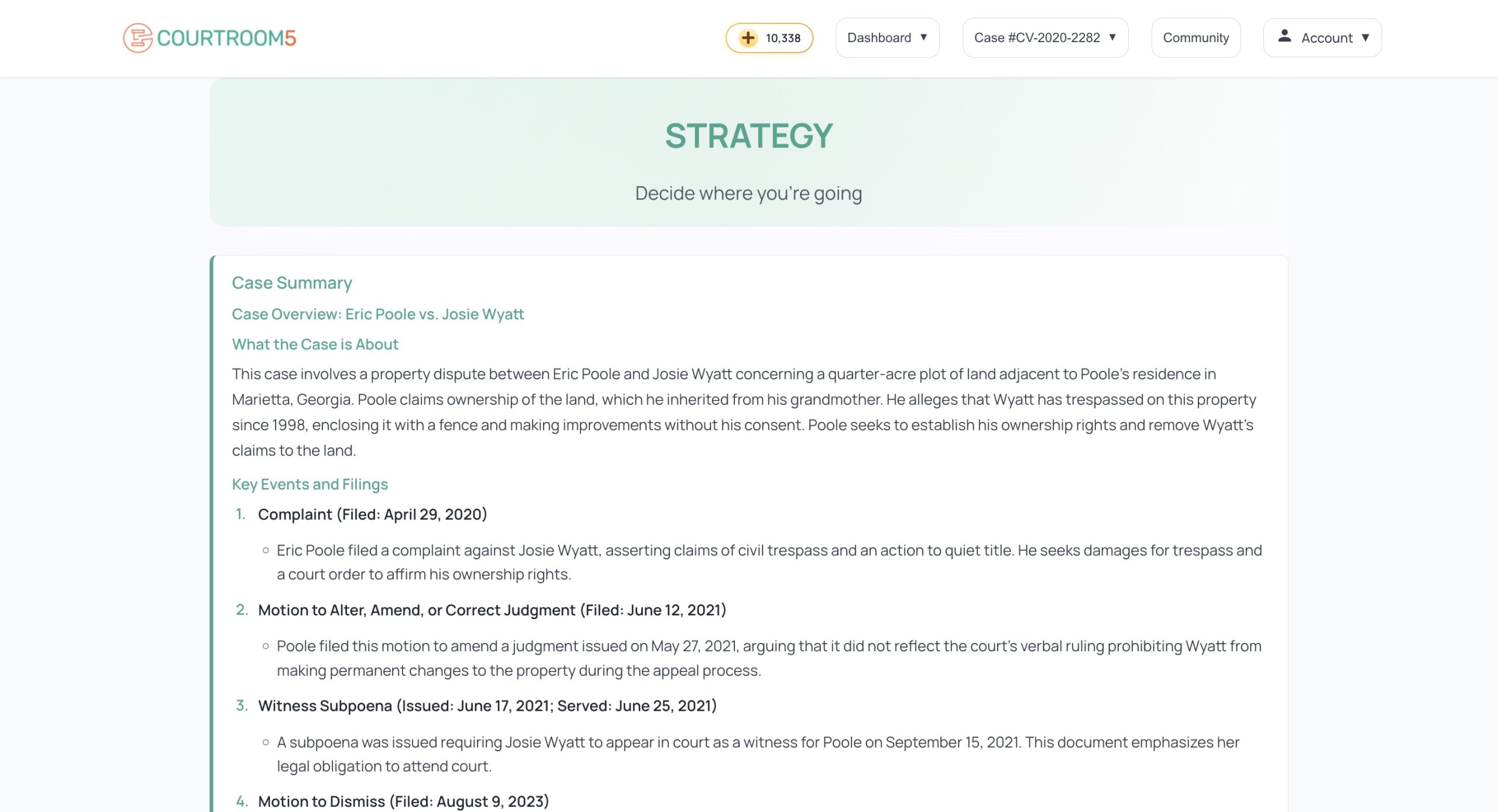
Strategy maintains a running record of the case. Users upload the court filings, and every uploaded filing gets summarized in plain language and stored in a chronological case record.
As filings are added, the system synthesizes the case history and current status and engages the user in a conversation about reasonable next steps.
It might, for example, flag that a motion to dismiss needs preparation, or suggest that the user consider filing an answer or a counterclaim, depending on the procedural posture.
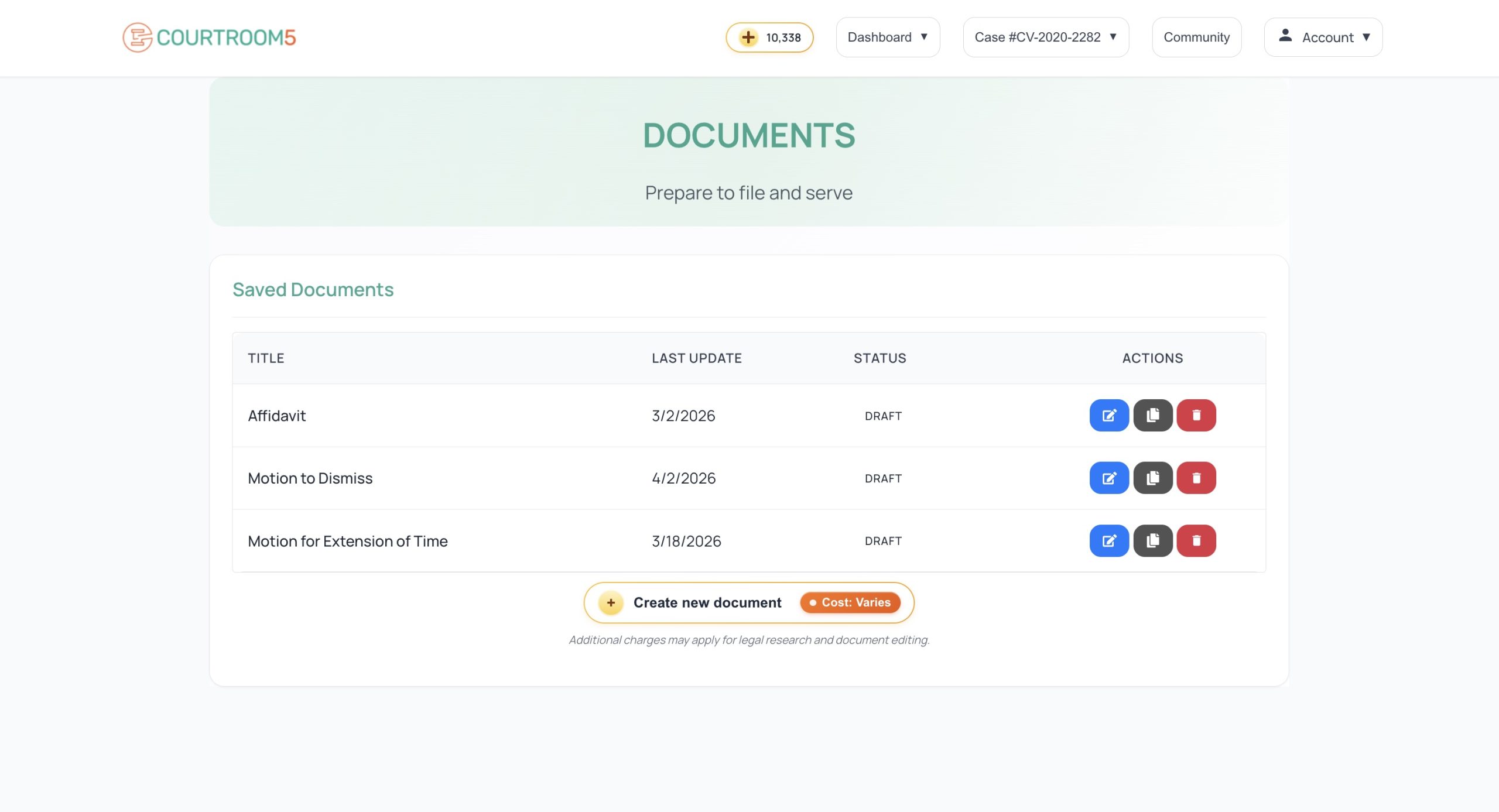
Documents provides a structured workflow for generating filings. This is not just a simple document generator.
In a recent demonstration, Ebron walked me through a seven-step process for a motion to dismiss that includes an intake conversation with a simulated judge (who checks whether the user has chosen the right procedure), a review of the applicable jurisdictional rules, a quiz to confirm comprehension, fact selection, legal research with a case law tool, and document generation grounded only in bookmarked case law and confirmed facts.
Notably, the platform also includes an oral argument simulator where the user can practice arguing the motion before a simulated judge.
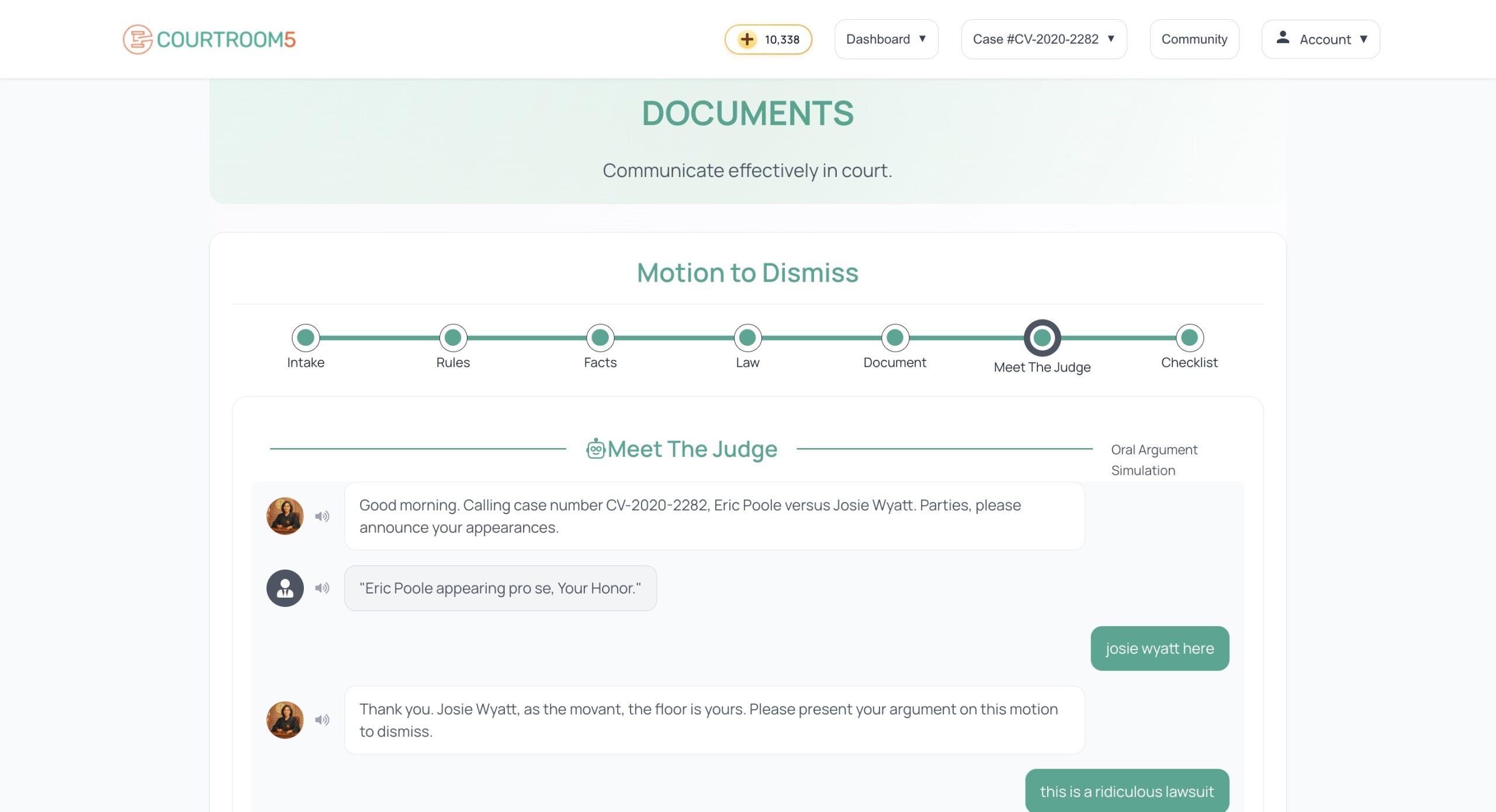
Ebron declined to elaborate on how the oral argument simulator was trained, calling it a trade secret, but the execution is surprisingly realistic, with the simulated judge calling the case, hearing the user’s argument, pressing with questions, then turning to the opposing side before rendering a practice ruling.
As a guardrail within the platform, no document is generated from sources the user has not reviewed. Case citations come only from cases the user has bookmarked after reviewing them through the platform’s legal research tool, which provides case briefs written in layman’s terms.
As Ebron put it, the approach is “law first, argument second” — an intentional contrast with generic AI tools that have generated filings with fabricated case citations, resulting in what the press release says are more than 300 documented sanctions since 2023.
The Community Element
Beyond the AI tools, the Accelerator includes a peer community that Ebron says is an important part of the overall experience. The process of representing oneself in court can be emotionally overwhelming and can interfere with the substantive work required for their cases, she said.
The community provides a social layer — a chat feed, member support spaces, and the ability to connect with peers at the same stage of litigation. Courtroom5 also runs weekly expert office hours and monthly workshops covering topics like motions, discovery, and trial preparation.
Unlike startup accelerators that run in fixed cohorts, the LAW Accelerator runs as long as the case runs. Members enter on a rolling basis. When a case resolves, members are encouraged to “Ring the Bell” to let others know and to contribute their story to a community library.
Pricing and Access
Access starts at $1 for community membership and 100 credits. After that, users buy credits as they go, at 15 cents each, or subscribe at $150 per month.
Activities throughout the platform consume credits — mapping facts to legal elements costs two credits per fact, a strategy conversation costs 10 credits per exchange, generating legal research keywords costs 15 credits, and a deep-dive keyword analysis costs 50 credits.
Ebron estimated that a user could get close to trial on roughly $1,500 worth of credits, and would be unlikely to spend more than $3,000 — a fraction of the cost of hiring a lawyer for civil litigation. The platform covers more than 140 U.S. state, federal and territorial jurisdictions.
Background
Courtroom5 was founded by Ebron, who holds a doctorate in electrical engineering, and Debra Slone, who holds a doctorate in library and information science.
Both successfully represented themselves in serious civil matters before building the platform. Ebron forced the company suing her to hire three law firms over three years before they met her settlement terms. Slone secured an appellate reversal so decisive that the original judge recused himself.
The company has served more than 12,000 self-represented litigants across all 50 states. It reports that 73 percent of members who resolve their cases through Courtroom5 win or settle.
The LAW Accelerator went live in early March and has been taking new users on the redesigned platform since then. It completely replaces the company’s earlier product — an evolution, not an add-on, Ebron says.
Courtroom5 is a Delaware public benefit corporation and is not a law firm.