 Robert Ambrogi Blog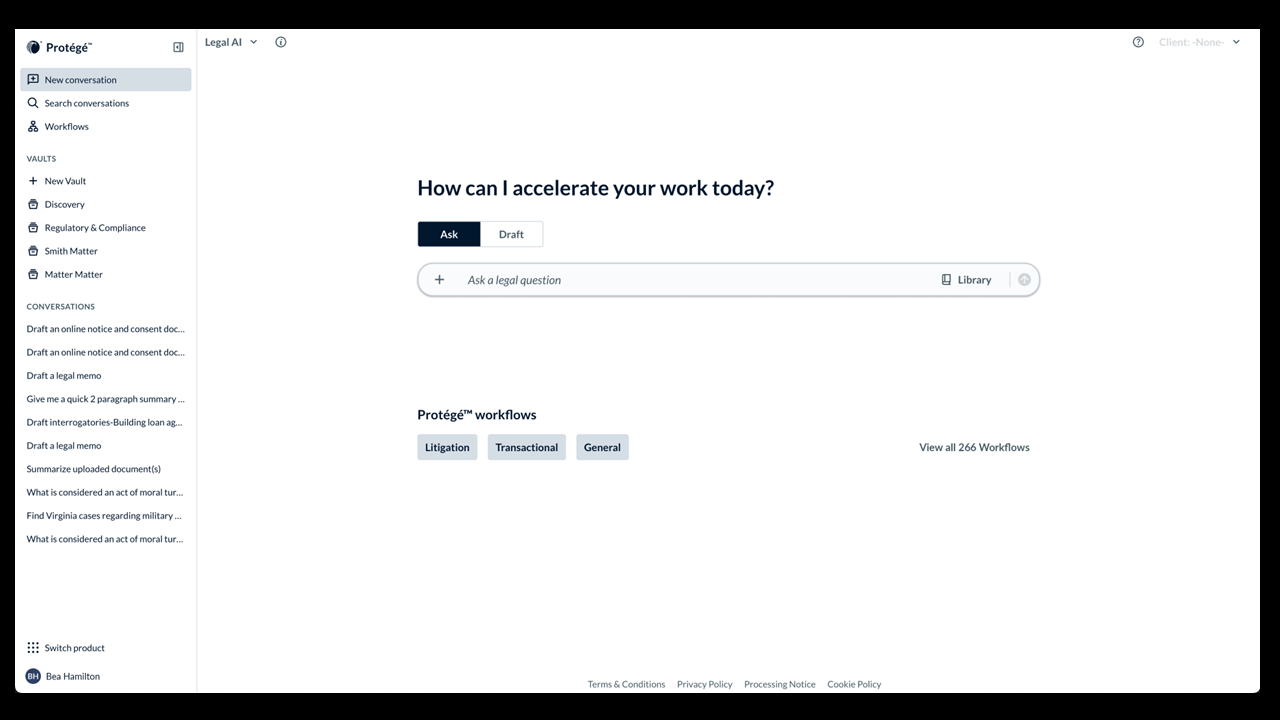


You can bid adieu to Lexis+ AI. LexisNexis is today announcing the general availability in the United States of Lexis+ with Protégé, an integrated flagship platform that fully replaces Lexis+ AI — which the company now describes as its “first-generation AI experience” — and brings a significantly expanded set of AI workflow capabilities to legal professionals.
LexisNexis says that the launch, which follows a commercial preview rollout in January, is not just an enhanced Lexis+ AI under a new name, but a new integrated flagship platform that builds on Lexis+ AI’s conversational research, drafting, document upload, summarization and analysis capabilities, and then extends them with a significantly expanded workflow layer.
The rationale behind Lexis+ with Protégé is consolidation. Rather than switching among multiple AI tools, attorneys can access everything through a single, conversational prompt box that combines LexisNexis’s legal content library, Shepard’s Citations-grounded verification, and integrations with general AI models from Anthropic, Google and OpenAI.
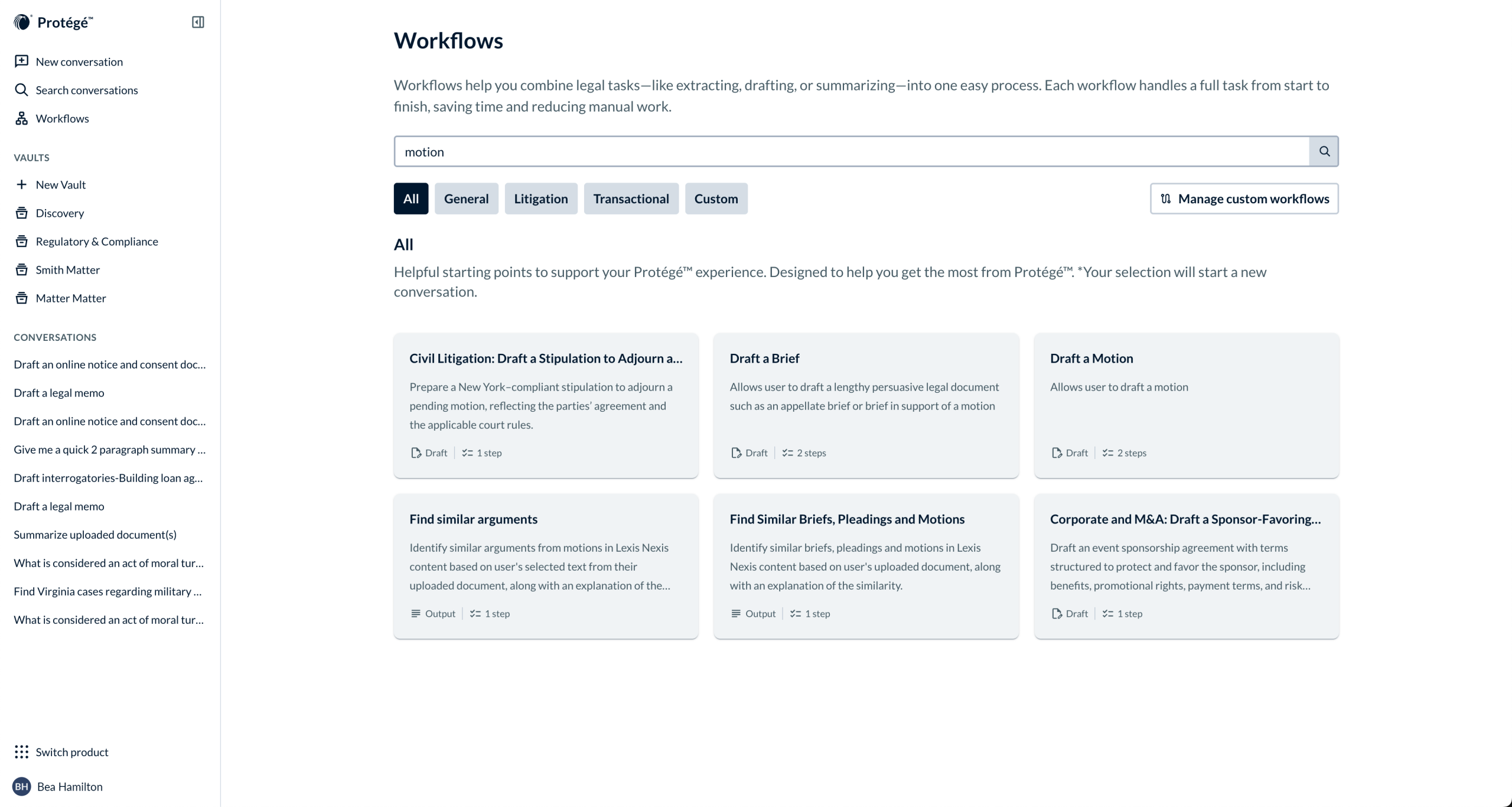
The platform launches with a library of more than 300 workflows, with new ones to be added daily, as well as the capability for customers to customize their own workflows, either on their own or with the assistance of a new LexisNexis “white glove” workflow service.
“Legal professionals are increasingly seeking integrated legal AI work environments,” said Sean Fitzpatrick, CEO global legal at LexisNexis Legal & Professional. “Lexis+ with Protégé brings together the most comprehensive legal content, verifiable and citable sources, trusted legal workflows, and access to leading general AI models in a single, secure workspace.
“With a purpose-built AI infrastructure designed for legal practice, Protégé enables teams to complete their legal work end-to-end with confidence that outputs are validated and consistent wherever they work.”
What’s Available Now
With today’s launch of general availability, the platform ships with three core capabilities:
- Pre-built, configurable workflows that cover a broad range of litigation, transactional and everyday legal tasks. Examples include drafting motions to dismiss, generating discovery and deposition documents, redlining agreements against internal standards, analyzing key provisions and identifying high-risk clauses, and summarizing interviews. These can be run as-is or adapted to firm and department standards.
- A no-code custom workflow builder that allows law firms and legal departments to design, test and share their own multi-step workflows without writing code. This enables customers to essentially codify their institutional knowledge, turning a firm’s preferred contract standards and playbooks into repeatable processes that can be consistently executed.
- A new white glove workflow service that provides a high-touch program in which specialized LexisNexis teams help customers build custom workflows, migrate existing ones, standardize across organizations and onboard staff.
All of this runs on what LexisNexis describes as a living legal knowledge graph spanning more than 200 billion interconnected documents, with more than 4 million new documents added daily and continuous citation, trust and validity signals — a foundation the company argues cannot be replicated by competitors.
Coming Soon
Two additional workflow categories are on the roadmap but not yet available at launch:
- Advanced practice-area workflows will extend the platform with domain-specific tooling for civil litigation, mergers and acquisitions, real estate, and labor and employment matters.
- New agentic and persona workflows that build on agentic capabilities LexisNexis previewed in 2024 and that will enable Protégé to plan and execute complex, multi-step legal work autonomously while remaining anchored in LexisNexis content and user context.
Following today’s launch of U.S. general availability, Lexis+ with Protégé will roll out across global markets throughout 2026, the company said.
The launch comes at a time when many legal AI platforms are racing to move beyond single-task tools toward broader end-to-end work environments.
And at a time when many legal professionals remain reluctant to use gen AI because of its tendency to hallucinate, LexisNexis has a core differentiator, which is the ability of its Shepard’s citations service to verify outputs and citations.
More information is available at lexisnexis.com/protege and lexisnexis.com/ai.