 Robert Ambrogi Blog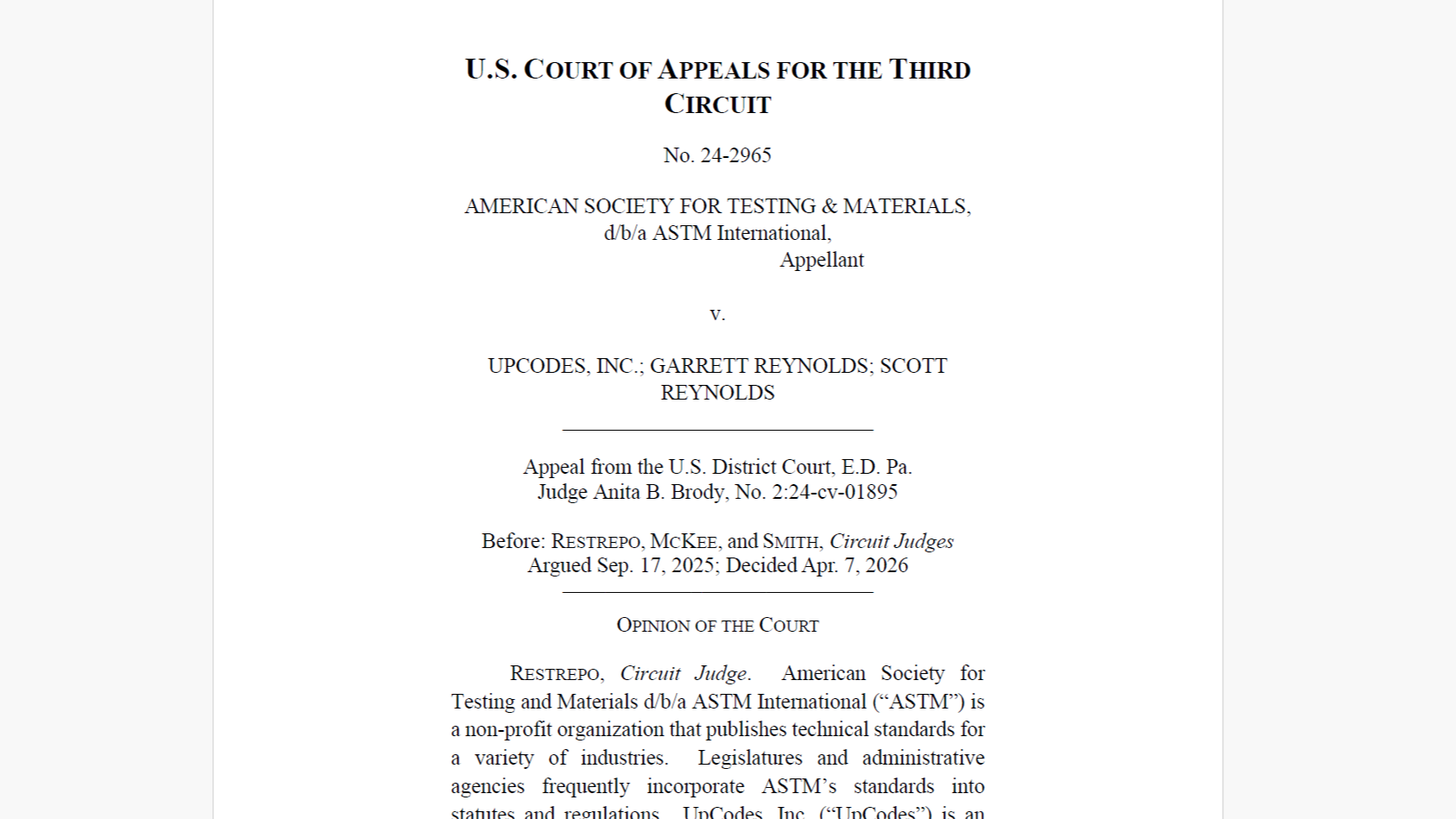


A federal appeals court has handed a significant win to UpCodes, a legal tech startup that publishes building codes and technical standards online, ruling that its posting of copyrighted standards likely constitutes fair use — at least for now.
In a decision issued April 7, the 3rd U.S. Circuit Court of Appeals affirmed a lower court’s denial of a preliminary injunction sought by ASTM International, the non-profit standards organization that had sued UpCodes for copyright infringement.
The ruling in American Society for Testing & Materials v. UpCodes, Inc. adds another chapter to a long-running legal saga over who controls access to technical standards that have been incorporated into law — and whether the public has a right to read the laws that govern it.
Background of the Case
ASTM is a non-profit organization that publishes technical standards widely used by engineers, architects, manufacturers and construction professionals. Legislatures and regulatory agencies frequently incorporate ASTM standards into law by reference, meaning a statute or building code will simply cite a standard by name without reproducing its text.
This saves government resources and draws on private-sector expertise, the 3rd Circuit notes in its opinion, but it also raises notice and accountability issues, where regulated entities may face legal consequences for violating rules they cannot freely read.
UpCodes, a for-profit startup founded in 2016, operates an online searchable library of building codes. Its stated mission is to “help members of the public access and comply with the laws that govern their built environment.”
In April 2024, UpCodes began publishing 10 copyrighted ASTM standards on its website without a license. These standards related to steel and aluminum used in construction, all of which are incorporated by reference into the International Building Code (IBC), which Philadelphia and many other jurisdictions have adopted.
ASTM sued for copyright infringement and moved for a preliminary injunction to get the standards taken down. The district court denied the motion, concluding that ASTM was unlikely to succeed because UpCodes’ copying was likely protected as fair use. ASTM appealed.
The Third Circuit’s Analysis
Writing for a three-judge panel, Circuit Judge L. Felipe Restrepo affirmed the district court, concluding that three of the four statutory fair use factors favor UpCodes and the fourth is equivocal.
On the critical first factor — the purpose and character of the use — the court found UpCodes’ copying transformative because it serves a fundamentally different purpose than ASTM’s. While ASTM publishes standards to inform industry of current best practices, UpCodes publishes them to convey what the law actually is, posting only the historical versions that are incorporated into law, not the newer versions that ASTM has since released.
The court followed the D.C. Circuit’s 2023 decision in ASTM v. Public.Resource.Org in reasoning that this “fundamental distinction” renders the use transformative, even though UpCodes republishes the standards without alteration.
ASTM argued that verbatim copying can never be transformative. The 3rd Circuit disagreed, joining the D.C., 2nd and 4th Circuits in holding that a secondary work “can be transformative in function or purpose without altering or actually adding to the original work” (quoting prior precedent).
The court also noted that UpCodes has a particularly compelling justification for copying, which is that it cannot disseminate the law without reproducing it.
The court rejected ASTM’s analogy to Hachette Book Group v. Internet Archive, last year’s 2nd Circuit ruling against the Internet Archive’s digital lending program. There, the court found the use non-transformative because digitizing books served the same purpose as the originals — making authors’ works available to read. UpCodes’ purpose, to disseminate the law, is distinct, the 3rd Circuit said.
On the second factor — the nature of the work — the court found it strongly favors fair use. Technical standards sit at the factual end of the fact-fiction spectrum, and their incorporation into law moves them further from copyright’s core protections.
The third factor — the amount of copying — also favored UpCodes, even though it copied the standards in their entirety. Because the IBC incorporates the standards fully, the court reasoned, reproducing them completely is reasonable in relation to the purpose.
Notably, the court also rejected ASTM’s argument that non-mandatory portions of the standards — such as explanatory notes, appendices and annexes — should be treated differently, finding that these materials aid in understanding and complying with legal requirements.
The fourth factor — market harm — was the closest call. The court acknowledged that UpCodes’ free copies could substitute for ASTM’s paid offerings, and that ASTM derives roughly 70% of its revenue from standards sales.
But it also noted that the incorporated versions in question are largely outdated — nine of the 10 standards have since been updated by ASTM — and that there is limited evidence of how much revenue ASTM actually derives from incorporated standards specifically.
Weighing that against the substantial public benefit of free access to the law, the court found the fourth factor equivocal.
Why This Matters
This ruling is the latest development in a line of cases examining the tension between private copyright in legal materials and the public’s right to know the law. The Supreme Court addressed a related question in 2020, when it held in Georgia v. Public.Resource.Org that the state could not claim copyright in the annotations to its official legal code, applying the government edicts doctrine.
But that doctrine, which holds that works created by government officials in their official capacity are not copyrightable, does not directly resolve the question presented here, since ASTM is a private organization, not a government actor.
Rather, the UpCodes case turns on fair use, and the 3rd Circuit’s ruling aligns it with the D.C. Circuit’s 2023 decision in the Public.Resource.Org litigation involving the same plaintiff.
Taken together, those decisions suggest that courts are increasingly receptive to the argument that publishing incorporated technical standards for public access constitutes fair use, even when done by a for-profit company, and even when the copying is verbatim and complete.
The court was careful to note the limits of its ruling. This was a preliminary injunction appeal based on an incomplete record. The court acknowledged that unfettered copying could, if it caused significant economic harm to ASTM, threaten the organization’s capacity to produce new standards, which would undermine copyright’s broader goal of promoting creativity for the public good. Many factual questions remain open for further development on remand.
But for UpCodes, at least for the time being, the ruling means its service can continue operating as litigation proceeds. For the broader public access to law movement, it is a significant, if not final, victory.
“This is a good result that will expand the public’s access to the laws that bind us — something that’s more important than ever given recent assaults on the rule of law,” wrote Mitch Stoltz, IP litigation director at the Electronic Frontier Foundation, which filed an amicus brief in the case.