 Robert Ambrogi Blog


Josef, the Australia-based legal automation platform, has launched a new capability it is calling the Rapid Ingestion Engine, which uses AI to convert unstructured business inputs — such as email threads, meeting notes and term sheets — into the structured data that legal workflow templates require.
The idea, according to Josef CEO and cofounder Tom Dreyfus, is that most legal teams are applying AI at the wrong point in their workflows. Rather than using AI to generate legal documents — an approach that raises concerns about reliability and control — Josef is using it to handle the messy front end of the process, extracting and organizing the commercial information that feeds into templates legal teams have already built and approved.
Dreyfus calls it “the death of the intake form.”
“The right place is ingestion,” he said. “AI should read the mess that arrives before the template runs. The output should remain deterministic, controlled, and reliable.”
It is an interesting framing, and one that goes against the grain of much of the current conversation around AI in legal, where the focus tends to be on AI-assisted drafting, contract review and research. Josef is arguing that the bigger pain point — and the safer application of AI — is upstream, at the point where business teams are trying to communicate their needs to legal.
How It Works
The Rapid Ingestion Engine accepts the kinds of unstructured materials that typically arrive from the business side of an organization, such as email chains, meeting notes, term sheets and draft summaries. It extracts the key commercial terms, mapping them into structured workflow fields.
It then flags any gaps and prompts the user only for what is missing. From there, the system routes approvals based on workflow logic that the legal team controls and generates documents from legal-approved templates.
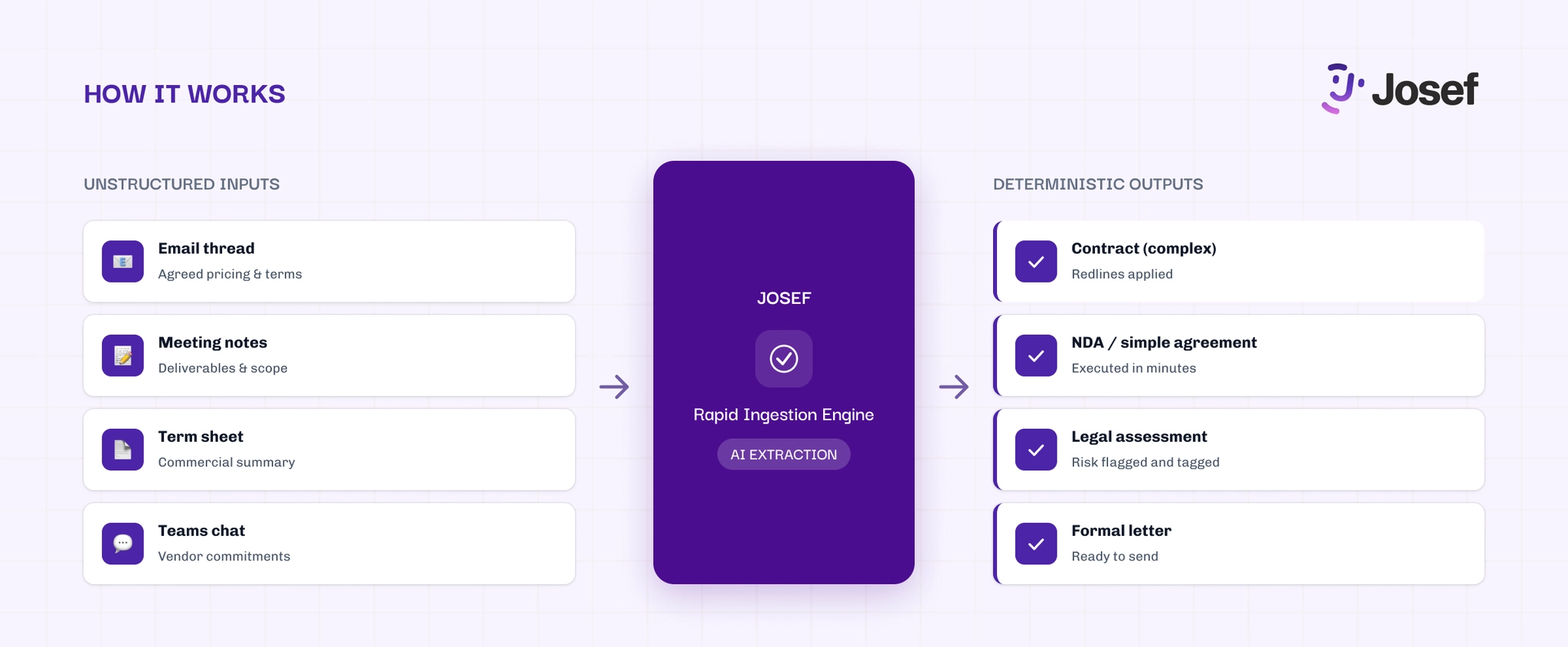
The outputs, Josef emphasizes, are deterministic, meaning they come from pre-approved templates and logic, not from open-ended AI text generation.
Josef illustrated this with a practical example. Imagine a marketing team negotiates a sponsorship arrangement over email, agreeing on pricing, branding rights, and deliverables. Traditionally, that email thread would be forwarded to legal to sit in a queue, or the marketing lead would be asked to fill out a lengthy intake form, re-entering information that already exists in the email chain.
With the Rapid Ingestion Engine, the marketing lead simply uploads the email thread. Josef extracts the commercial terms, maps them into the sponsorship agreement workflow, flags any missing information, and prompts the user to fill in only what is needed. Once the user reviews and confirms, the agreement is generated from legal’s approved template, with all of legal’s standards intact.
Context and Background
For those who have been following Josef, this launch fits neatly into the company’s broader trajectory. Founded in Australia in 2017 by Dreyfus, COO Sam Flynn, and engineer Kirill Kliavin, the company started as a no-code platform for building legal automation tools — chatbots, document generators, and workflow tools that legal professionals could create without any coding skills.
The company then expanded into AI with the 2023 launch of Josef Q, its product developed in partnership with OpenAI that enables legal and compliance teams to turn policies and regulations into self-service Q&A tools. That product gained rapid traction, leading to an additional funding round announced in late 2024.
Josef has raised a total of at least $7 million across multiple rounds, from investors including OIF Ventures, Carthona Capital, and The LegalTech Fund. Its customer base includes law firms such as Orrick, Gunderson Dettmer, and Clifford Chance, along with in-house legal teams at companies including Bupa, L’Oréal, and Bumble.
The Rapid Ingestion Engine represents a further expansion of where Josef applies AI within its platform, moving from knowledge management (Josef Q) to the intake process itself.
“UX expectations have changed,” Flynn said. “People don’t want to retype information they already have. We’re using AI to make ingestion effortless while keeping outputs deterministic — so the business experience feels modern without Legal giving up control.”
The launch comes at a time when legal teams are wrestling with how and where to deploy gen AI. Many organizations have experimented with AI-assisted drafting and review, but concerns about reliability and auditability persist, particularly when contracts and approvals must follow established policies.
Josef’s approach sidesteps that tension by confining AI to the data extraction and structuring phase, while keeping the document generation firmly within the legal team’s existing template framework.