 Robert Ambrogi Blog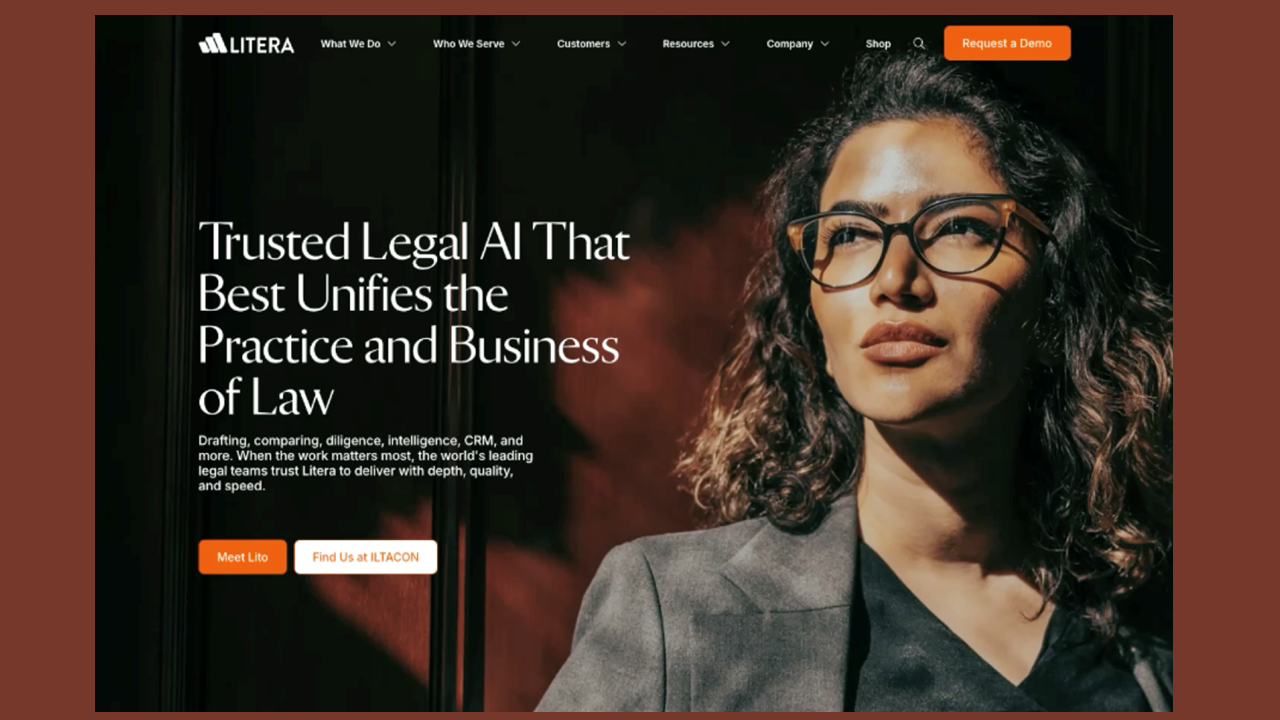


Litera, one of the most broadly deployed technology companies in the legal industry, is today unveiling a company-wide relaunch that positions it as the legal AI platform unifying the practice and business of law through one AI agent and one dataset.
The relaunch — going live today at litera.com — includes a new brand identity, the tagline “Raise The Bar,” an advertising campaign and a redesigned website.
It also sets the stage for ILTACON 2026 in Nashville next month, where Litera plans to showcase the next version of Lito, its legal AI agent, across Foundation, its GrowthTech stack, and the company’s broader product portfolio.
To be clear, today’s announcement is a rebranding, not a product launch. In an interview Monday, Avaneesh Marwaha, Litera’s chief executive officer, described it as “a branding relaunch and a statement of all the work we’ve done in Lito” during the past 18 months.
“Some organizations lead with brand and marketing splash first and then build their technology behind it,” Marwaha said. “Litera always has to deliver. We don’t get the luxury of being 80% good. So we’ve been building and delivering for the last 18 months … and I felt the brand is ready to match where we are as a business.”
One Agent, One Dataset
At the core of the new positioning is Litera’s claim that it is uniquely situated at the intersection of the practice of law — drafting, document comparison and contract review — and the business of law, including the institutional knowledge and client relationship data housed in its Foundation platform.

Litera’s new logo.
“Every AI startup in legal is selling a feature,” Marwaha said in the announcement. “We’re selling the platform those features run on. The practice of law and the business of law have run on separate systems for as long as firms have existed. That ends here: one agent, one dataset, every partner, associate, and business development lead working from the same intelligence.”
Related: On LawNext: Litera’s Avaneesh Marwaha: The CEO Who Left Before AI and Returned to Lead Through It.
Few legal technology companies can match Litera’s reach. The company says it has more than 15,000 customers and more than 1 million daily users, performs 10 million document comparisons a month, and serves 99% of the Am Law 100.
Litera also says Foundation 365 — its institutional knowledge and CRM platform built natively on Microsoft Dynamics 365 — is now deployed at five of the 10 largest law firms in the world, while 70% of active Litera One accounts use Lito.
In our interview, Marwaha described the end-to-end workflow the company is building toward: A partner could move from identifying a potential new matter, to pursuing and winning it through an RFP, to doing the work, and then to feeding the resulting experience data back into Foundation for reuse — all powered by Lito.
That workflow is now in an early-adopter program, Marwaha said, and customers will begin seeing it in the market “in the coming month or so.”
Deterministic vs. Probabilistic

A new ad takes a poke at probabilistic AI.
A central theme of the new messaging — running through the press release, advertising campaign and video spots — is trust, particularly the contrast between Litera’s deterministic, rules-based engines and the probabilistic outputs of large language models. One new ad declares, “Because probably isn’t good enough.”
“AI is table stakes. Trust is the moat,” Adam Ryan, Litera’s chief product officer, said in the announcement. “You can’t retrofit years of deterministic accuracy, and you can’t pilot your way into the Am Law 100.”
Of course, Lito itself is an LLM-based, probabilistic tool, so I asked Marwaha how he reconciles those approaches within a single platform. His answer was that they occupy different zones of risk.
He is comfortable using probabilistic AI for certain workflows and automations, but actual client work product — including document creation, proofreading, comparison and metadata cleaning — “has to be as close to 100% accurate all the time.”
He pointed to the risk illustrated by court sanctions against lawyers who fail to verify AI-generated work. A contract “latent with a 10% error rate,” he said, may not create an obvious problem at closing. But if a dispute later arises, “that’s a material issue and ripe for malpractice and risk.”
Lito, he said, can call on Litera’s rules-based engines when running automations. On the business-of-law side, it can query a firm’s curated Foundation data rather than the public domain, which he argued narrows the window for error.
Although Lito offers full model selection, Marwaha said, “we still think it needs to be bound and protected by some rules and algorithms that have been around for a while.”
A Response to Harvey?
Given the timing, it is hard not to view the relaunch against the backdrop of heavily funded AI-native startups — Harvey and Legora chief among them — that have dominated legal AI headlines. When I asked whether the rebranding and repositioning were a response to those companies, Marwaha equivocated.
“I’ve never felt I needed to respond to anybody,” he said. “But I do think this is our positioning statement.”
Litera, he said, has a “better with” story alongside Microsoft Copilot and Anthropic’s Claude — and even, he suggested, alongside the startups themselves. But he argued that workflows inside Litera’s ecosystem are “just as good, if not better,” because of the deterministic engines beneath them.

Another of Litera’s new ads.
He was also direct about where he believes the market is heading. Use cases for which firms have paid vendors $3 million to $4 million, he predicted, “are going to be out of the box from the frontier models at some point,” meaning those vendors will need to offer other advantages.
Litera, he argues, already has such advantages: its rules-based engines and its presence in the applications and systems where lawyers already work.
Notably, one selling point frequently cited by AI-native startups — integration with a law firm’s technology stack — is something Marwaha regards as table stakes for vendors that have served the market for decades.
What Else Is Changing
Separate from the rebrand, but unfolding at the same time, Litera has been simplifying its sprawling product catalog. Marwaha said the company began consolidating its drafting products into strategic bundles in spring 2025 and is now taking a similar approach to workflow tools such as Kira and Transact. It is centering its go-forward strategy on three pillars: practice, manage and grow.
As a result, he said, the redesigned website should present a cleaner and simpler view of the company’s products.
On pricing, Marwaha reaffirmed his commitment to keep Lito included for drafting and Kira customers. He said he sees no near-term change to that approach, particularly as model costs continue to fall.
Over time, he added, new workflows developed with customers could be offered as optional, separately priced skills. But those would be handled case by case, and, he said, “it’s too early to call the commercial aspects of Lito.”
I also asked whether the rebrand signals that Hg, the private equity firm that has backed Litera since 2019, is positioning the company for a sale or an IPO. Marwaha said no and noted that Litera received no new capital for the relaunch.
“We self-fund everything here,” he said. “We’re not VC-backed. We don’t have just endless bank accounts to go after.”
Asked about Litera’s relationship with Microsoft as Microsoft pushes Copilot deeper into the legal market, Marwaha said it is “tighter today than it was 10 years ago.”
He said Litera will spend considerable time over the coming quarters talking about both Copilot and Anthropic. “That is something where I’m placing my chips where I think the future of work is.”
My Take
Having followed Litera for many years, what strikes me about this relaunch is what it is not. It is neither a radical reinvention nor a pivot. Rather, it modernizes the company’s visual identity and, more importantly, sharpens its value proposition — or at least how it articulates that value proposition.
During Marwaha’s first stint as CEO, from 2016 to 2022, he oversaw a sweeping transformation of the company. Through some 14 acquisitions, Litera expanded from an exclusive focus on document productivity tools into a much broader portfolio spanning transaction management, due diligence, litigation and firm intelligence.
Since his return as CEO in October 2024, the company has continued making acquisitions while aggressively extending its Lito agentic AI across the portfolio.
While that acquisition spree transformed and expanded the company, it also left some observers wondering whether Litera had become fragmented. Just navigating its product list could be downright daunting.
This relaunch pulls those pieces into a single, unified message. The company that is already embedded in the daily workflows of nearly every large law firm says it is also best positioned to provide the AI layer running through those workflows.
The company is also smart to emphasize trust — the contrast between Litera’s deterministic, rules-based engines and the probabilistic outputs of large language models. It is easy to forget that, in much of the mechanical work of law, there is one correct result.
Marwaha may say he feels no need to respond to the Harveys and Legoras of the world. But his underlying argument — that incumbency in firms’ technology stacks and decades of deterministic accuracy are assets no startup can replicate overnight — seems squarely aimed at a market enamored of shiny new things.
How will the rebrand land with customers? Litera plans to make it a major focus at ILTACON next month, providing the first real test.