 Robert Ambrogi Blog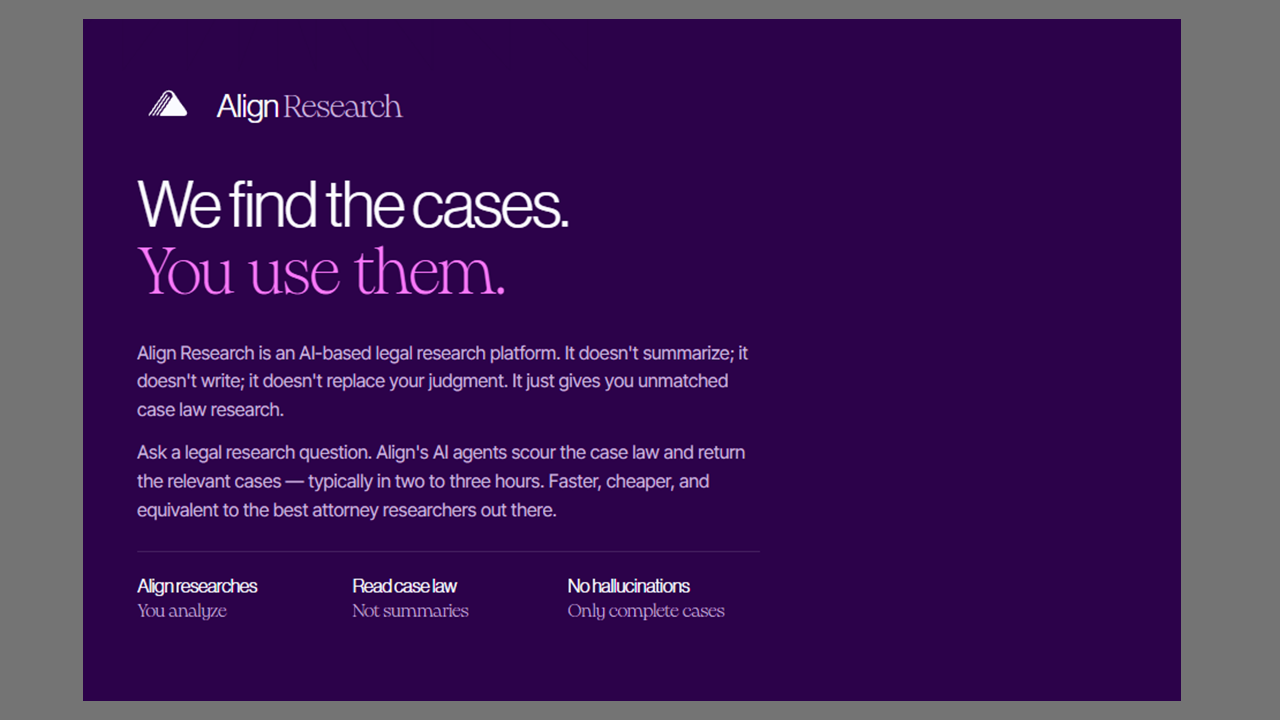


At a time when virtually every major AI legal research product is moving toward delivering a single, synthesized answer to your research question, a new product launching today is based on the premise that many litigators want something that sounds almost old school – just the cases.
Align Research, released to general availability this morning by the litigation technology company Align, takes a research question in plain language, goes off for a few hours, and comes back with a set of relevant court opinions, with the key passages highlighted, and nothing else.
There is no memo, no summary, no answer. As the company’s press release puts it, the product “retrieves rather than generates.”
Align founder and CEO Sam Davidoff, a former litigation partner at Williams & Connolly, said the product’s design is in part an answer to the hallucination problem that has plagued the use of generative AI in law, and in part a return to what he believes is the actual task litigators most often want done.
“It’s not telling you anything, it’s just showing you,” Davidoff told me in an interview about the launch on my LawNext PR podcast. “If all the AI is doing is essentially pointing you to pre-existing things, as opposed to writing some narrative for you, it actually can’t hallucinate. It could miss something, it could highlight something that you don’t agree with, but it can’t make something up.”
‘Get Me the Cases’
Davidoff said he had long resisted entering the legal research market, which he considered well saturated. What changed his mind was a gap he perceived in the current crop of AI research tools, rooted in his own years of practice.
The research task he most often performed as an associate, and most often assigned as a partner, was not, “Answer this question,” he said, but, “Get me the cases. Find me every district court that has ever ruled this way on a motion to dismiss.”
Most AI legal research products these days are built around the opposite model, where you ask a question and get back a researched and validated answer. “That’s a little different than what, at least a lot of times, litigators want,” Davidoff said.
When I observed that this sounds, in a way, old school – closer to how we used to do research – he readily agreed. “There’s no secret where I get my ideas from. I was practicing law and this is how we used to do it, and there’s a little part of me that says, ‘Hey, some of our old tricks still kind of work.’”
In a LinkedIn post ahead of today’s launch, Davidoff listed some of the ideas that went into the product relating to the proper division of labor between lawyers and AI. Among them are, “Don’t delegate what you should learn,” and, “AI should show, not tell.”
Give the AI the uninteresting work of churning through thousands of cases, he said, and keep the interesting work of reading and analyzing the few dozen that matter for the lawyer to do.
“If you give to AI the job of actually reading the cases and distilling the final analysis, it means you’re not doing it,” he told me. “That’s both sometimes the fun of being a lawyer, but also sometimes the strategic advantage of being a lawyer – that I’ve read the cases and I see a new angle for how we could argue this in front of this judge.”
How It Works
As Davidoff describes it, Align Research is an agentic pipeline. One model analyzes the question and breaks out the legal research issues. Another decides what searches to run. Others read the retrieved cases, classify them, make relevance decisions, and determine whether more searching is needed. A final stage decides which passages to highlight.
That is why a research job in Align can run for a few hours before returning a result. Rather than work like a chatbot, Davidoff said, the product works more like a researcher on your staff. You submit a question, go do other work, and the system emails you when the results are ready.
The cases then appear on the website in a binder-like format, with highlights you can click through, and can be downloaded as PDFs.
While it is still possible that the product “may, under the hood, hallucinate,” Davidoff said, it does not matter, because the product returns only actual court opinions with relevant text highlighted. The worst that can happen, he said, is a missed case or an off-target highlight, but not a fabricated citation.
For now, a user has no ability to follow-up in a conversational way with a research result. If the results raise a new question, you run another job. Alternatively, Davidoff suggested, you can download the cases and load them into some other AI tool for further interrogation.
Coverage spans U.S. federal and state case law, drawn from the Free Law Project’s CourtListener database. Align is building out additional case law databases of its own, but Davidoff said the company intends to contribute those cases back to the CourtListener opinion database, reflecting his view that the underlying case law corpus should not be the differentiator among legal tech companies.
Pricing Based on Use
Another way Align Research departs from the market norm is pricing. There is no subscription. A free tier provides three research jobs per month, with no expiration. Beyond that, the company charges a flat $100 per job.
Part of the rationale for that is practical. Align is bootstrapped and self-funded, Davidoff said, and every search costs the company real money in AI tokens.
But he also believes that per-job pricing is an inevitability for the industry at large, arguing that the all-you-can-eat subscription pricing now common in legal AI reflects vendors subsidizing token costs to build user bases.
“I don’t think it can last,” he said. “These token costs are real. The amount of money that every legal tech AI provider has to pay to Anthropic, OpenAI, Gemini – that’s real money and it’s per token.”
He sees law firms passing this fee through to their clients. The math should be easy to explain to them, he said. A research task that once consumed a couple of associate hours at a couple hundred dollars or more per hour becomes a $100 flat fee.
In developing this product, Davidoff told me, he is not gunning for Westlaw or Lexis: “They have amazing databases that they’ve built up. But I think that our tool can save you a lot of time and attorney hours in terms of finding those initial sets of cases.”
But Align Research is clearly staking out an approach at odds with where most of the market is heading.
Davidoff invites the argument. Whether users like the product or not, he said, he wants to hear from them: “No one’s going to be annoying me by sending me their suggestions.”
[Disclosure: The LawNext PR interview cited in this article is a paid product for which Align paid LawNext an advertising fee.]