 Robert Ambrogi Blog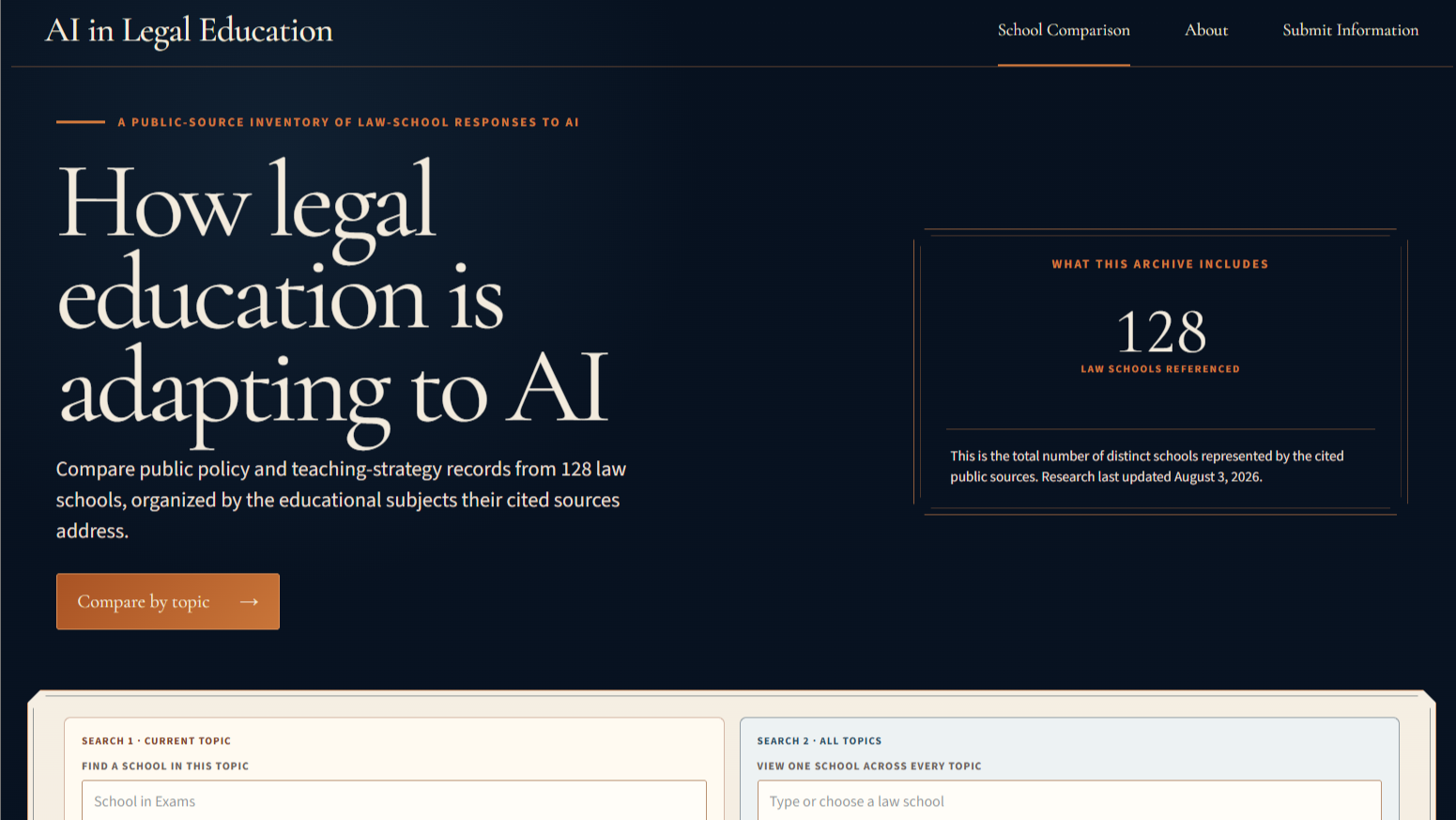


When law school AI policies have made news, it has usually been because they were controversial. UC Berkeley School of Law’s restrictive policy, which I wrote about in May, drew national attention for barring generative AI from nearly every stage of producing graded work.
But a new website launched by Andrew Perlman, dean of Suffolk University Law School, reveals how widespread and varied these policies have become. The site, AI in Legal Education: Law School Policy Archive, catalogs public AI policies, teaching strategies, and curricular programs from 128 of the 196 U.S. law schools, organized into eight topic areas and derived from the schools’ own published documents.
For each school, the archive links to the underlying source, including student handbooks, honor codes, dean’s memoranda, strategy statements and program pages. Each source is also labeled by its status: in effect, interim, pilot, proposed, guidance, or completed/limited.
The full dataset is downloadable as a spreadsheet, and Perlman invites readers to submit policies, corrections and omissions.
Perlman, long one of legal education’s most prominent voices on innovation and technology, is transparent about the site’s scope and limitations – and about how he built it.

Andrew Perlman
The site’s methodology section says that ChatGPT Sites was used extensively to research and construct the archive, with ChatGPT locating many of the public sources, organizing them into topic categories, and helping draft the summaries
Perlman, the site says, has not manually reviewed or independently confirmed every reference or summary, and readers should consult the linked original sources.
It is, in other words, an AI-assembled archive documenting how law schools regulate AI.
The site notes that a school’s absence from a topic does not mean it lacks a policy, and schools governed by university-wide AI rules may not appear at all.
The inventory excludes generic university policies, individual syllabi, admissions-only rules, and journal policies.
What the Data Shows
The site makes all of the underlying data downloadable. So, in keeping with the meta-ness of an AI-generated inventory of AI policies, I downloaded the data and asked AI to help me analyze it. Since Perlman used ChatGPT to create the site, I enlisted its competitor Claude to evaluate it.
The spreadsheet I downloaded, current as of Aug. 2, 2026, contains 279 topic records spanning eight subjects at 128 law schools. Here is how the subjects break down, showing the number of schools catalogued in each:
- Optional AI curriculum and opportunities: 66.
- AI use in submitted and graded work: 58.
- AI use on exams: 53.
- Faculty teaching guidance and support: 37.
- Mandatory AI curriculum and literacy: 26.
- Course-level AI policy disclosure: 20.
- AI use for studying and learning: 16.
- Uploading course materials to AI: 3.
Several findings jump out.
- Prohibition is the default.
With regard to AI use for submitted and graded work, of the 58 schools catalogued, the majority prohibit AI by default unless the instructor expressly authorizes it, usually in writing.
The ways they do this vary. Some schools treat unauthorized AI use as cheating, others as plagiarism, others as “unauthorized assistance.” But the basic rule is remarkably consistent, with schools such as Stanford, Northwestern, Virginia, Michigan (proposed for 2026-27), North Carolina, Wisconsin, and dozens of others all requiring some version of instructor opt-in.
The same is true for exams, with nearly all 53 catalogued schools prohibiting AI use during an examination absent instructor permission. Columbia’s rule is typical: Students must not prompt or engage with AI during an exam, and every word of the answer must be the student’s own.
Considered in this context, Berkeley’s policy – which generated headlines and criticism (including from me) looks less like an outlier. Its basic structure, a default prohibition from which instructors can deviate in writing, is the majority approach.
That said, Berkeley’s policy is still unique for its breadth, in that it enumerates prohibited AI use at every stage from conceptualizing to editing, limits permitted research use to identifying sources, and bars students from uploading any course materials into AI systems.
On that last point, Berkeley has little company. Only three schools in Perlman’s inventory have rules on uploading course materials to AI: Berkeley, St. Mary’s and Suffolk itself, where Perlman’s own July 27 memo proposes prohibiting students from uploading class recordings or other students’ identifiable contributions to third-party AI services without permission.
- Mandatory AI instruction is spreading.
Notably, even as law schools are restricting AI use, they are mandating its training. Twenty-six schools have mandatory AI curriculum or literacy requirements, and the list is growing semester by semester. For example:
- Case Western Reserve requires all first-year students to complete its Introduction to AI and the Law certification, launched in February 2025 and described by the school as the first required legal-AI certification of its kind nationally.
- Mississippi College adopted the same certification requirement for its 1Ls beginning this past spring.
- UC Law San Francisco will require every J.D. student, starting with the Class of 2029, to complete an AI-enabled lawyering lab.
- UNLV’s Boyd School of Law adds a required course in responsible AI use this fall.
- Texas maps AI learning objectives across all three years of its J.D. program.
- Ohio State runs a mandatory three-part AI workshop series for all 1Ls.
- Penn, Santa Clara, DePaul, George Washington, Albany, and others embed required AI instruction in their first-year skills sequences.
With regard to optional training, the numbers are even larger. Sixty-six schools offer elective AI courses, certificates, concentrations, clinics or labs.
Drake and Rutgers offer AI law certificates. St. Thomas (Minnesota) offers a 12-credit AI concentration. Emory launches an AI and the Law concentration this academic year. Boston University debuts an AI for Law Practice certificate this fall.
Taken together, the data suggests law schools are converging on a common approach, which is to restrict AI in graded work and exams, but teach it everywhere else.
- Assessment is changing.
Some of the more interesting entries in Perlman’s inventory are not about whether students may use AI, but how schools are redesigning assessment because of it:
- The University of Texas reports the near-elimination of take-home exams, a sharp increase in secure in-class exams, and growing interest in class participation, live presentations and even oral exams.
- Chicago is piloting device-free classrooms and no-access exam conditions across all of its required first-year courses for 2026-27.
- Suffolk’s memo proposes interim requirements for secure summative assessments in foundational courses.
These moves echo the broader trend I noted in May, when Princeton reinstated universal in-person proctoring for the first time in 133 years.
- Syllabus disclosure of AI.
According to Perlman’s inventory, 20 schools have rules requiring instructors to disclose their course-level AI policies in writing, typically in the syllabus.
Wisconsin, for example, requires every faculty member to establish and clearly communicate a course AI policy. Suffolk’s interim measure for 2026-27 would require every syllabus to state what AI use is permitted, prohibited and conditional.
For law students, that means they will now have to be prepared to navigate a patchwork of instructor-by-instructor rules on using AI.
The Bottom Line
In compiling this inventory, Perlman is careful to note that he is dean of one of the schools represented, and the archive is comparative, not a ranking. He is equally careful about the archive’s provenance, disclosing that it was constructed using AI and inviting corrections. A school can even request that its entry be removed or linked rather than hosted.
Those caveats aside, the site clearly addresses a gap in understanding how legal education is responding to AI, providing greater detail than had been available through scattered news stories or high-level surveys.
For law schools that have policies, let us hope they will support and contribute to this effort. For those that are in the process of drafting or revising their own policies, this may now be the first place to look.