 Robert Ambrogi Blog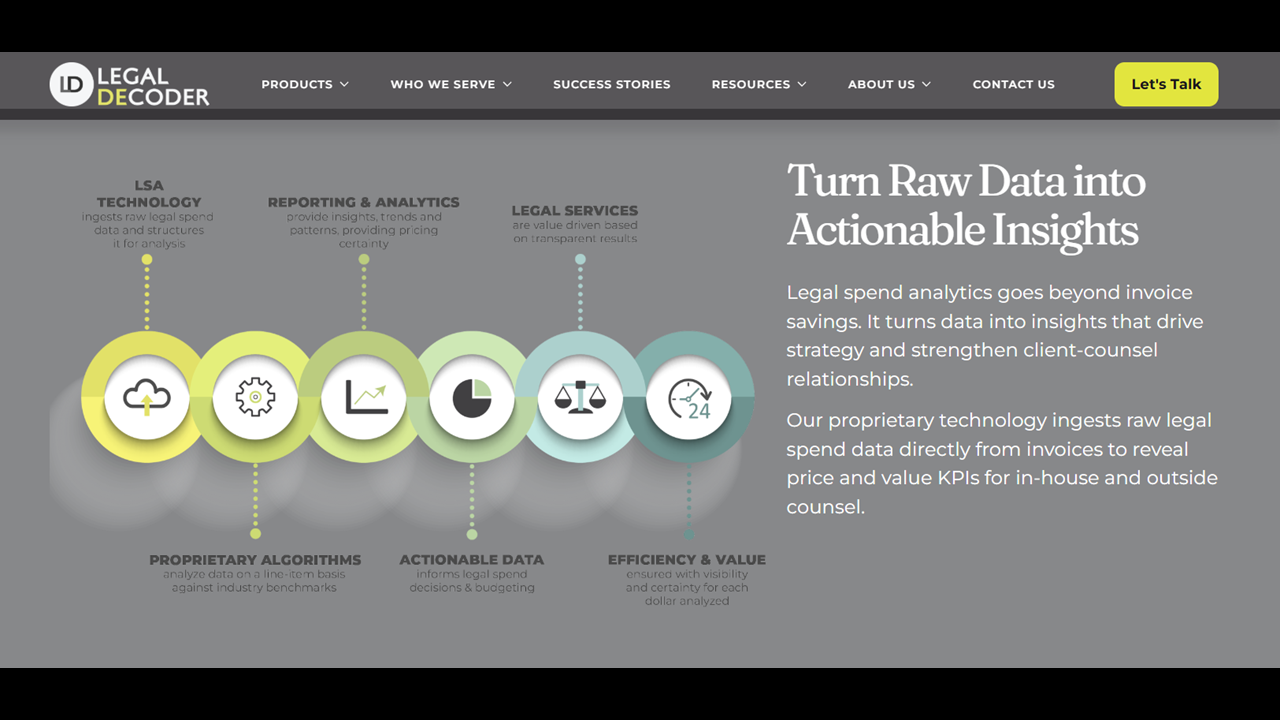


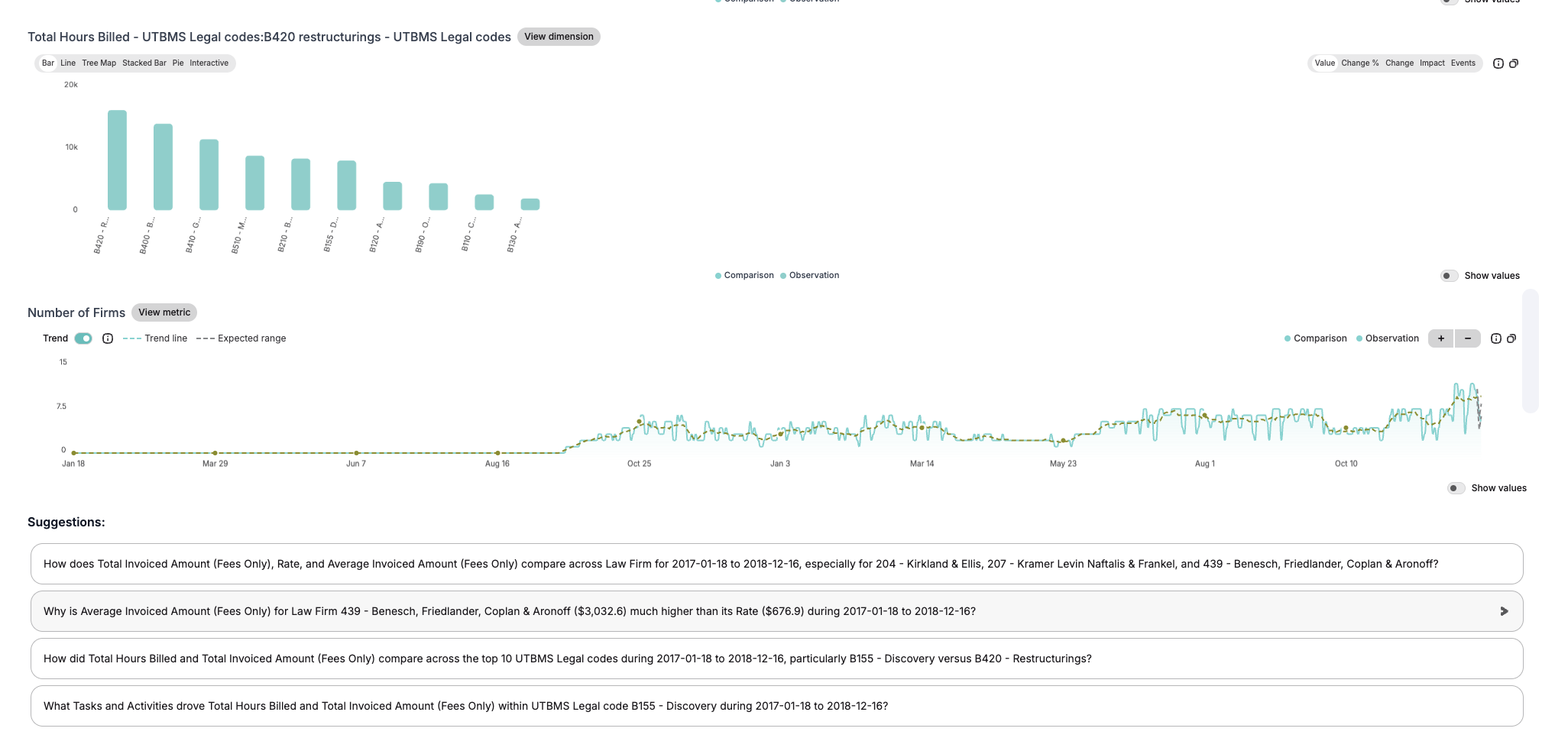
Legal Decoder, a legal spend analytics company whose billing-review technology has been relied on by Fortune 500 companies and Am Law 100 firms, as well as fee examiners in major federal bankruptcy cases, is today launching Aperture, a natural language interface that lets law firms and legal departmentss conversationally query legal billing and spend data — while promising that no identifiable client data ever reaches the underlying large language model.
The launch marks the most significant product development at the company since Trajectory Capital took a controlling investment last September and installed David Solomon, formerly general manager and global head of GLG Law and, before that, director of financial services at Axiom, as CEO.
In an interview ahead of today’s launch, Solomon told me that Aperture grew directly out of feedback from the company’s clients, who valued the depth of Legal Decoder’s analysis but chafed at its Tableau-based delivery.
While financial analysis professionals were comfortable with Tableau, other legal professionals wanted a simpler way to be able to query the data.
“I don’t want to have to go and do like 20 dropdowns to try to get to this data,” he said, characterizing what customers told him. “Is there a way I can just ask a question?”
AI Layered on Machine Learning
Aperture does not replace the machine-learning engine at the core of Legal Decoder’s platform. Rather, the LLM sits on top of that engine as an access layer, helping users query, summarize and act on the analysis, while the numbers themselves come from the underlying schema.
That architecture, Solomon says, solves a problem that has dogged conversational AI tools in analytics, which is that if you ask the same question twice, you will get two different answers.
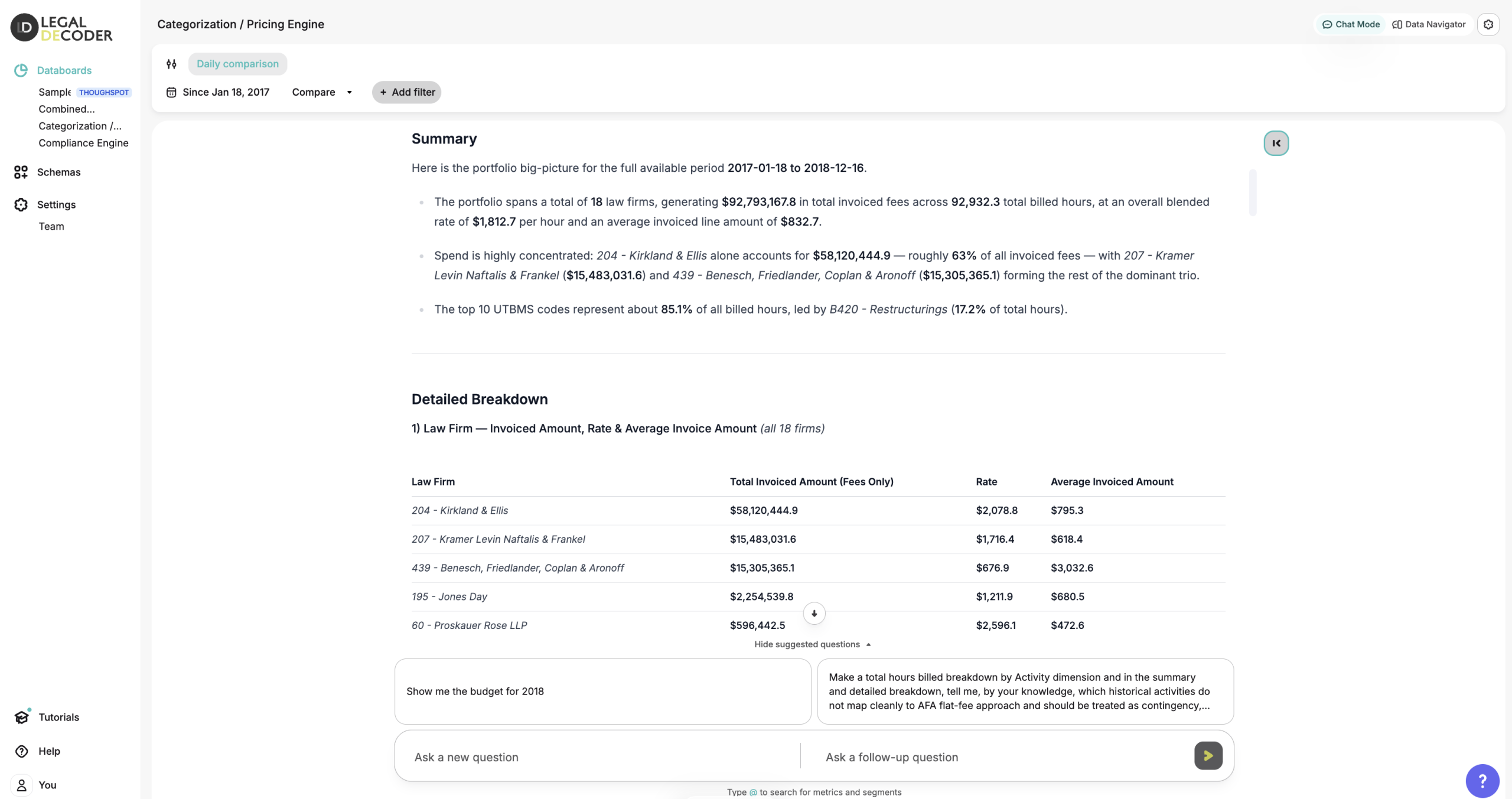
With Aperture, “you might get a slightly different answer in terms of what the talking points should be, because LLMs notoriously will give you slightly different answers, but you’re never going to get different numbers,” Solomon said. “The numbers are always going to be the same.”
The engine beneath Aperture was built over roughly a decade by the company’s founders, Joseph Tiano, a former Pillsbury partner and now the company’s president, and Chris Miller, now chief operating officer and chief technology officer. a technologist, longtime friends who met as undergraduates at Georgetown.
As Solomon tells it, the idea was born when Tiano was doing write-offs late one night at Pillsbury and concluded there had to be a better way.
The company they founded in 2014 built a library of more than 411,000 legal concepts and action words which Legal Decoder uses to disaggregate line-item narratives in legal invoices.
Rather than rely on UTBMS codes — which Solomon called “notoriously very unreliable” — the system disregards the timekeeper’s own categorization, recategorizes each line item based on its narrative, and then classifies the work four layers deeper than the UTBMS code level.
The platform applies 45 proprietary analytics flags to identify issues such as block billing, skill-set mismatches, multi-staffed meetings, excessive time, and vague entries.
Tokenization Before the LLM
One notable feature of Aperture relates to data security. Before any customer data interacts with the LLM, Legal Decoder’s engine strips identifying markers — law firm names, timekeeper names, matter names, client names, and proper nouns within narratives — and replaces them with secure tokens. The LLM sees “prepare for [token] deposition,” not “prepare for John Smith deposition.”
The company also resets tokens at the session level, so the same underlying value is never represented the same way across tokenization runs.
“Most token systems map values the same way every time, which means that mapping itself becomes something to protect,” Tiano said in the company’s announcement. “We reset tokens at the session level, so the underlying data is never represented the same way twice.”
In our interview, Solomon contrasted that approach with what he sees as the prevailing practice in legal tech, where vendors rely on enterprise agreements with LLM providers to protect data rather than structural controls.
“A lot of our clients said we don’t like using some of the tools on the market because it just feels like they’re a wrapper around an LLM,” he said. “So can you figure out a way that we can get AI-grade responses without exposing our data?”
The results are also designed to be auditable. Any finding — say, that 8% of line items were block billed — can be exported to CSV down to the underlying line items, so a skeptical user can check the work against the actual invoices.
Court-Validated Analytics
Legal Decoder’s press materials say that its analytics engine “has been validated in federal court proceedings.”
What it means by that is that it has been approved for use by fee examiners in major bankruptcies, including PG&E, Toys “R” Us, Spirit Airlines and Purdue Pharma. In those engagements, fee examiners disclose in publicly filed court documents that Legal Decoder’s tool is the methodology underlying their fee-application analysis.
“Federal bankruptcy courts and their trustees and their appointed fee examiners have not only accepted our methodology, they are relying on our methodology,” Solomon said.
The company has gained recognition in other ways, as well. It won the Association of Corporate Counsel Value Champion award in 2025 for its partnership with UnitedLex to help UBS consolidate legal operations following its acquisition of Credit Suisse, conducing an in-depth review of its highest-cost matters, identifying inefficiencies, and realigning staffing models.
In addition, in both 2025 and 2026, it won the Legal Pricing Vendor of the Year award from the True Value Partnering Institute, an organization whose members include pricing professionals from Am Law 100 and global law firms.
Complement to E-Billing
Solomon was explicit that Legal Decoder is not trying to displace enterprise legal management platforms such as Brightflag or Legal Tracker, and that most of its customers run it alongside such systems.
Legal Decoder does not ingest invoices and process payments. Rather, it takes LEDES data exports and, in Solomon’s phrase, goes “five miles deep” on analysis — down to the timekeeper level, across 6-, 12- or 24-month periods, surfacing patterns in billing hygiene, staffing leverage and workflow efficiency.
Because the platform sits outside a customer’s firewall and needs only LEDES data exports — via secure FTP or API — Solomon said infosec review is typically fast, and new customers can be up and running within a couple of weeks.
What’s Ahead
Two related products are slated to roll out in the coming weeks. The first, which the company calls AI Replaceability, or AIR, sorts legal work into eight archetypes and applies expected AI-driven compression ratios to each — by type of work rather than practice vertical — so a law firm can model how much of its work may be compressed by AI, or an in-house team can assess what it should no longer expect to pay for.
The second is an AFA builder that constructs alternative fee arrangements around work clusters rather than crude averages — recognizing, for example, that 20 depositions do not cost the same, but cluster into low, medium and high complexity.
“Our goal with Aperture,” Solomon said, “is to give legal professionals the speed and simplicity of natural language without asking them to compromise on transparency or confidence in results.”