 Robert Ambrogi Blog


Supio, the AI platform built for plaintiffs’ personal injury firms, has hired Melissa Graham, chief operating officer of Nevada’s Richard Harris Law Firm for the last 15 years, as its vice president of industry, a newly created role aimed at narrowing the gap between the people who build legal technology and the people who actually run law firms.
The company, which has raised over $90 million in venture funding, describes the hire as reflective of a shift underway in PI law, with firms no longer questioning AI’s place in their practices but rather how best to build it into the way they operate so it delivers direct value to legal teams as well as client cases.
As both a longtime COO and a Supio customer, Graham, who will start at Supio on July 27, has seen that shift firsthand and is joining Supio to help firms navigate the opportunity, the company says.
‘Closet Tech Fanatic’
In an exclusive pre-announcement interview with LawSites, Graham described herself as “a bit of a closet tech fanatic.”
In the interview, also joined by Supio CEO and co-founder Jerry Zhou, both described the hire as driven by their belief that the next phase of AI adoption in personal injury will be won less on raw technical capability than on whether firms can figure out how to put that capability to work.
Graham started working in a law firm at 19 as a photocopy clerk, she said, and has since “done everything from copy room to paralegal, to case manager to intake accounting.” She has spent the bulk of her career at Richard Harris, which describes itself as the largest PI firm in Nevada and one of the largest in the western U.S.
Graham said the firm, a Supio customer since early last year, employs roughly 180 people, including some 30 lawyers, handling auto, workers’ compensation, medical malpractice, nursing home and other personal injury matters.
Zhou said it is exactly that operator’s vantage point that Supio was looking for in bringing Graham aboard.
“We needed the expertise,” Zhou said, describing Graham as a “thought partner” in helping to drive the company’s evolution from generative AI with a human in the loop to completely agentic AI.
Encoding that kind of operational knowledge “into the feet of agents,” he said, is “so incredibly important, and you’re just not going to be able to replicate that without having kind of world-class operations expertise.”
Graham described her role as “bridging the gap.” The recurring problem in legal tech, she said, is that vendors “have built tech, but they’ve never run a law firm, and you’ve run a law firm, but you’ve never built tech,” leaving each side unsure what questions to ask the other. “Now being able to speak both languages is what’s super exciting to me.”
PI Firms Came Late to AI
Graham sees PI law as one of the last corners of the legal profession to modernize. “Although AI and tech has been around for years,” she said, “when you talk to PI firms and operators, we feel like it came in like a wrecking ball.”
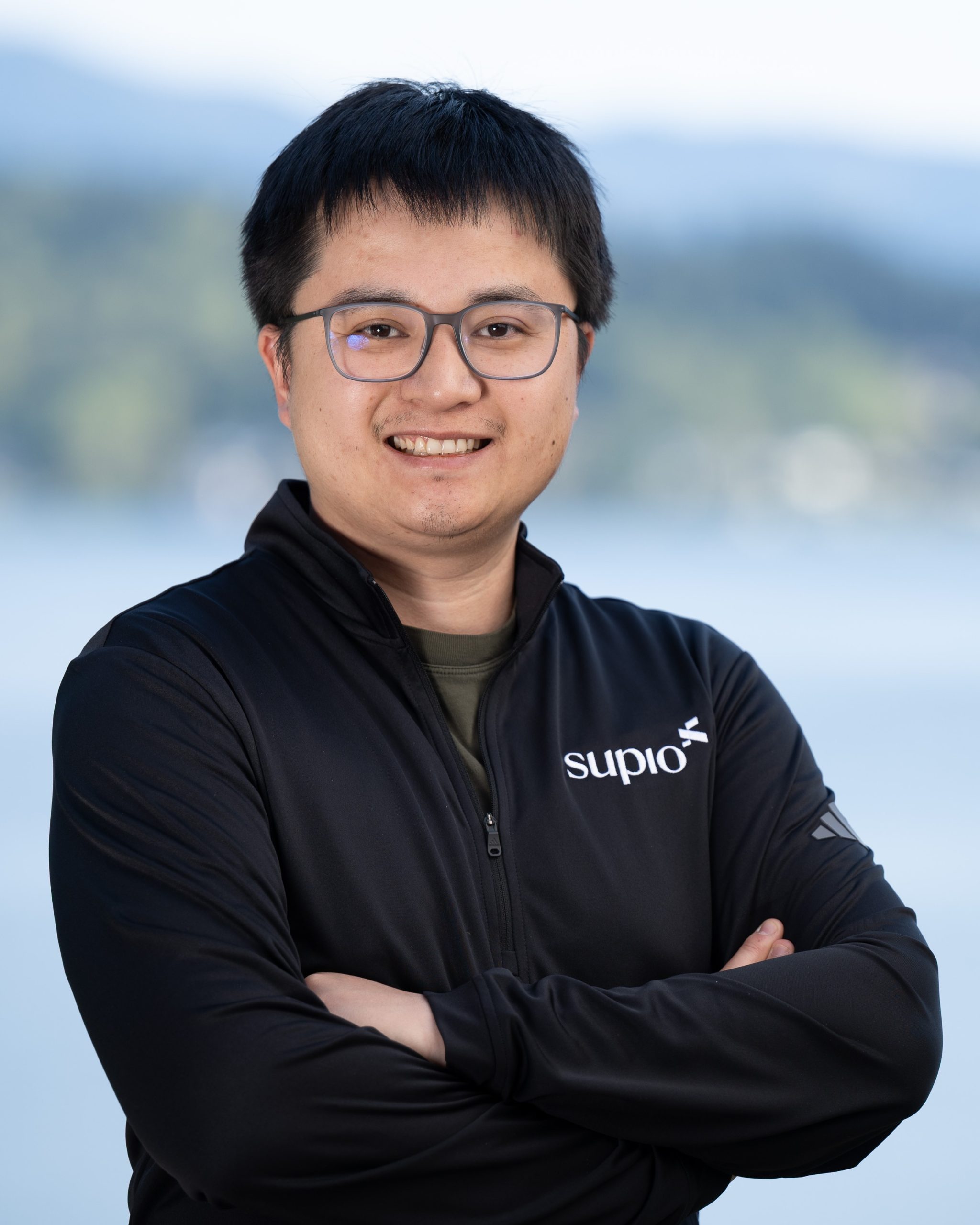
CEO and cofounder Jerry Zhou
The reason, she believes, is structural. High-volume plaintiffs’ firms are built for rapid growth and “never wanted to slow down long enough” to adopt new tech, which is also “why there’s a lot of challenge in our space with execution and adoption.”
Zhou said the company came out of stealth roughly two years ago as the first to bring generative AI to personal injury, and that as of this quarter it is the first to ship “a truly agentic product” for the industry.
He said its Supio Agent, launched last month, moves “beyond tools that make individual tasks faster toward a system that makes entire firms smarter.”
Asked about AI adoption — and specifically about studies showing that even firms that are buying AI are not using it to its full potential — Zhou pointed to a timing mismatch. PI firms “have embedded so much process into their systems” that two years “is like probably a very short amount of time to digest technology,” even as the underlying tools change at the pace of “dog years.”
Graham’s perspective from inside a firm was that resistance breaks down socially. There are always a few skeptics, she said, but adoption tends to spread by a “domino effect” once colleagues start comparing notes — and the greater hesitancy, she added, often sits with staff rather than lawyers.
An Opportunity to Make a Difference
Graham, who remains with the firm until she starts with Supio next month, said her first weeks at Supio will be spent listening rather than going in “guns a-blazing.”
Beyond law firms such as Richard Harris, she pointed to the mastermind groups and conferences where PI operators compare notes as the biggest opportunity she looks forward to. “The best part about it is I get to really make a difference, not only here, but across the industry.”
In addition to her COO role, Graham is co-founder of Ascend Consulting and sits on Supio’s customer advisory board. Supio is backed by Sapphire Ventures and Thomson Reuters Ventures, among others.
“Melissa has spent her career inside the firms we exist to serve, which means she understands what this work actually demands of the people who do it,” said Zhou. “She has lived the high-stakes reality of plaintiff law, and has seen what is possible when firms have better access to their firm’s knowledge and expertise at scale.”