 Robert Ambrogi Blog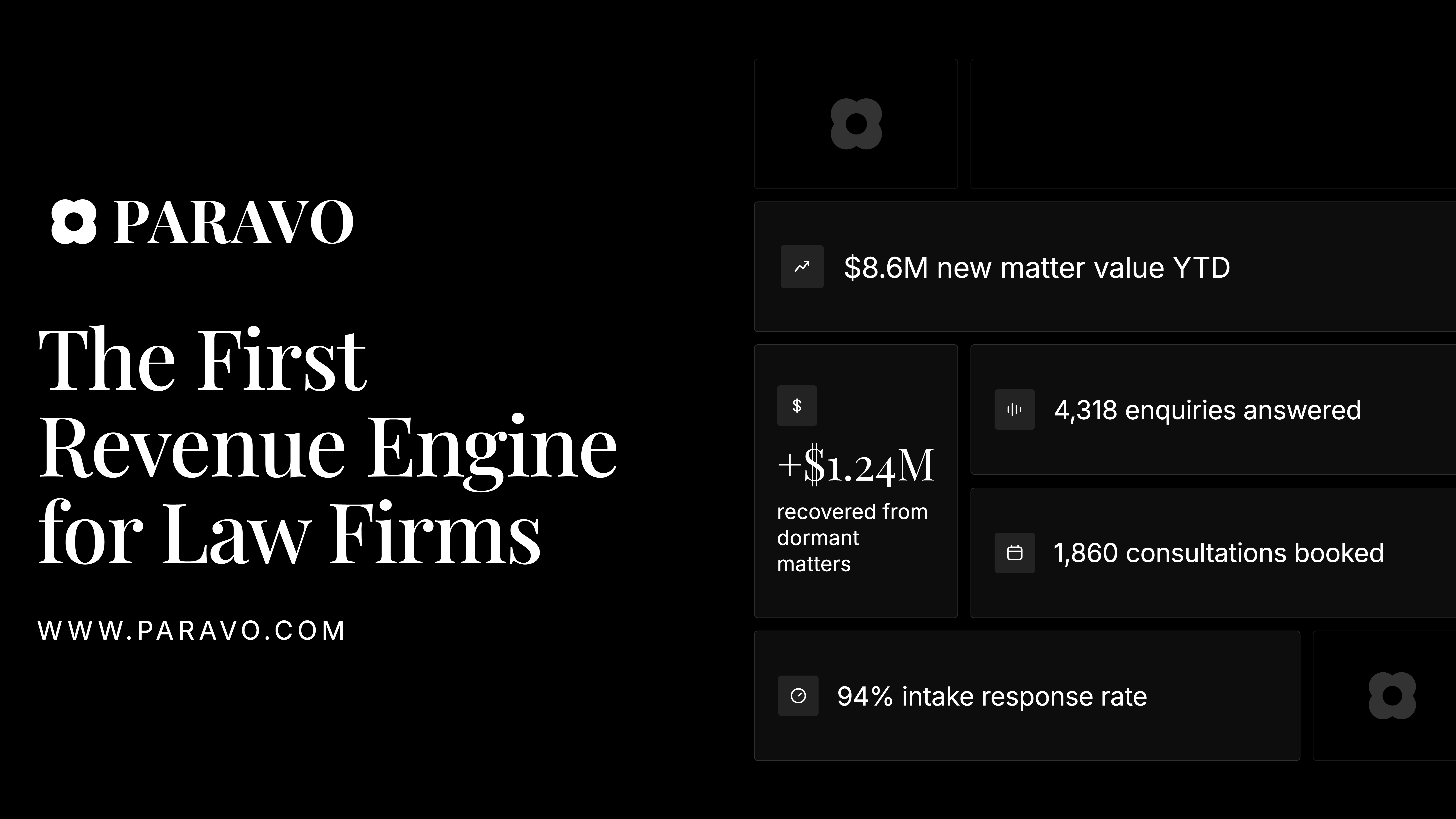


Rarely do law firms lose clients on merit, argues Cesar Tapia. They lose them before intake ever happens – to missed calls, slow follow-up and dead voicemail.
Today, Tapia and his cofounder Eslam Odeh are launching their answer to that problem – Paravo, a startup emerging from stealth with what it describes as the first AI “revenue engine” for law firms.
It is a platform that combines lead generation, AI-powered intake and follow-up, and automated client reactivation, all in a single product aimed at flat-fee practices.
In an exclusive interview with me ahead of the launch, Tapia said the company built the product around its observations of how consumer-facing lawyers spend their days.
“Many of the flat-fee firms, most of the lawyers, they spend 70% of the time focused on non-billable work,” Tapia told me.
In contrast to legal AI companies such as Harvey that apply AI to substantive legal work, he said, “our take is quite different, in the sense that we are focused on the part that we believe the lawyer shouldn’t be doing – which is not solving the case, it’s managing the client.”
With footholds in London and New York, the company is targeting both the U.S. and U.K. markets.
Three Components
Paravo’s model of a revenue engine for law firms is built on three connected components.
The first is generating clients. Leads can come through Paravo itself – the company runs ads and is in talks with lead marketplaces – or from any source the firm already uses, including its own Google Ads campaigns, which Paravo can also help firms run.
The second is converting those leads to revenue, and this is where the platform’s AI does most of its work. For inbound leads from sources such as Google, the platform focuses on what Tapia called “speed to lead” – responding immediately by SMS and email, with AI voice calls in development.
For organic inbound calls, an AI receptionist answers, screens the caller, and either transfers the call to the firm or books a consultation directly onto the firm’s calendar, with connections to Google and Outlook.
Tapia said call transfers can be to a virtually unlimited number of people across a firm’s departments, based on the firm’s preferences.
The third component is predicting a client’s next legal need. Tapia offered the example of an immigration client whose spouse visa or K-1 visa will expire in two or three years.
“The law firm shouldn’t be the one actually thinking, or entering into a CRM, ‘This visa is going to expire,'” he said. “Through AI, we should be able to know, ‘OK, we have to send a reminder whenever this person’s visa is going to expire.’”
The same outreach tools can be used to drive reactivation campaigns aimed at cold leads and former clients.
That third step feeds the first, Tapia said, which is why the company calls it an engine. “You can generate more clients, you can convert more to revenue, and you can predict the next need. It’s basically a compounding effect.”
Within the platform itself, those steps appear as four modules – Leads, Intake, Outreach and Insights. The Insights module is an analytics dashboard that tracks calls, appointments and estimated consultation value.
The product’s typical user depends on firm size, Tapia said. At smaller firms, it is a managing partner or owner. At firms above roughly 40-50 employees, it is the marketing or intake manager.
Why Flat-Fee Firms
Paravo is targeting law firms that deliver services by flat, fixed or contingency fees, including immigration, personal injury, employment, family and similar practices.
These firms, Tapia said, are more fragmented and competitive than those serving the corporate market, and more likely to be smaller firms with sharper incentives to move fast on cases and leads.
“When you are flat fee, you are way more incentivized to actually be faster solving that case for the client, and also closing the client,” he said. “If you’re going to get $10,000 from a case, you’re incentivized to close it in one day if you can, rather than spending an entire month.”
In founding the company, Tapia drew on his and his cofounder’s personal experiences. The two met while working at a venture capital firm in London, where they both had to navigate a series of immigration visas in order to work there. Talking to their own law firms convinced them the firms had problems technology could solve.
Customers, Pricing and Competition
Although today is the formal launch, Paravo already has paying customers, with more than 60% of revenue coming from the U.S., Tapia said.
One early client tripled consultations in 90 days with no new marketing spend and no new hires, he told me.
Pricing is customized to each firm, but the model is a SaaS subscription based on call volume for the intake product and on the number of contacts for the outreach product.
Paravo handles setup itself, which Tapia said takes about a week for larger firms with complex processes and as little as a day for smaller ones.
The platform integrates with practice management and other software via Zapier, connects with Google and Outlook calendars, and works with Clio. Tapia said Paravo is in discussions with Clio to join its app directory.
Tapia readily acknowledged that intake and lead-generation tools are not new to legal. What is new, he argued, is stitching together the full loop into a cohesive “revenue engine.”
He pointed to Netic.ai and Avoca.ai, which have built similar revenue-engine products for the trades industry, as proof the model works in other verticals.
“There is no one doing exactly what we are doing, in the sense of creating the entire revenue engine” for legal, he said, adding that depth in the vertical matters because of the integrations legal requires.
As the product launches today, Tapia said its development roadmap is focused on continuing to enhance its predictive capabilities. That means using AI to anticipate client needs and automate the entire non-billable part of a firm’s day — CRM updates, follow-up emails, chasing down invoices.
“The people that are in the [legal] team, they should be the ones actually talking to the clients,” he said. “All that is happening in the background — sending an invoice, chasing that invoice, and so on — has to be automated, because actually AI is better than a real person to do it.”