 Robert Ambrogi Blog


Recently I sat through a demo of a product unlike anything I’d seen before, aimed at a segment of the legal profession that legal tech companies have largely ignored – the fractional general counsel, lawyers who serve as outside in-house counsel for multiple companies too small to have their own legal departments.
The product is called Sapphire Legal and its founder, Brett Wilson, is a one-man shop who has built and bootstrapped the product himself and who, as of last week, had all of two customers, one of whom, a U.S. lawyer who represents multiple companies out of his home in Portugal, I also spoke to in a separate interview. (More on him below.)
What makes the product unique is not just the market it is going after, but also the design premise that underlies it. It is a structure Wilson calls “private legal intelligence” for its ability to isolate each of the lawyer’s clients within a proprietary, private-tenant large language model (LLM).
“Sapphire Legal is the first Legal Operating System purpose-built for the fractional GC operating model,” the company’s website proclaims. “Portfolio-level visibility, per-client memory, and AI that drafts in each client’s voice – without the tab chaos.”

Founder Brett Wilson
Wilson’s premise is that a fractional GC’s central problem is not drafting or research. It is that the fractional GC (FGC) is holding confidential information for five or 10 companies at once, some of which might even compete with one other, and that almost every legal AI tool on the market pools that data on shared infrastructure.
“Every major legal AI platform – Harvey, CoCounsel, Legora – operates on shared infrastructure,” Wilson says. “Your client data trains or touches a model that other firms’ data also touches.
“For a fractional GC managing five client matters simultaneously, that’s not a nuance. It’s a disqualifying architecture” – one that leaves the lawyer “one data leak away from a bar complaint.”
By contrast, when an FGC onboards a client in Sapphire, the system spins up a separate database, storage bucket, encryption key and search index for that client. Wilson says it is a true architectural wall, not simply row-level security or access permissions that someone can misconfigure.
“Sapphire Legal is built from the ground up on that premise: a dedicated private LLM per client firm, zero cross-contamination, full data sovereignty,” he said. “That’s what ‘Private Legal Intelligence’ means – intelligence that is, and remains, exclusively yours.”
The Fractional GC Market
The UK-based Wilson’s background is not in law. He spent 25 years in enterprise IT, most recently at VMware. After Broadcom bought the company, he was laid off, and so he started doing some work as a fractional chief technology officer.
That led him to assignments helping with legal operations, and then to connections with several FGCs. The more he knew about their work, the more he felt they were poorly served by existing legal tech.
There is no hard data on the size of the FGC market. Wilson estimates the number in the U.S. and U.K. (where they are called “consulting solicitors”) at roughly 50,000, but he admits he has no definitive data to back that up.
I asked ChatGPT to research it. It reported that it could find no authoritative data on FGCs or even a consistent definition of the term. It concluded:
“Based on U.S. lawyer population data, U.S. in-house counsel estimates, and global flexible-lawyer platform rosters, a reasonable rough estimate is 5,000–10,000 core fractional GCs in the U.S. and 10,000–25,000 globally, with a broader adjacent market of 30,000–60,000 lawyers worldwide doing some form of outsourced, flexible, interim, or part-time in-house counsel work. Confidence is low-to-moderate because the category is not separately tracked and terminology varies.”
Whatever the precise number, Wilson’s position is that the segment is too small for the Harveys and Legoras of the world to bother with and too sophisticated for consumer apps. That leaves a market gap that he is happy to fill.
‘Better Tools for Managing Clients’
One FGC who is a Sapphire customer – in fact, he was customer number one – is Andrew Friedman, a U.S. lawyer and chief compliance officer who serves banking, fintech and payments clients from his home in Portugal.
 After he and Wilson came to know each other through a shared client, Wilson showed him an early build, and Friedman signed on – partly because the product’s value was immediately apparent to him, and partly for the chance to have a hand in shaping the product’s further development.
“The security and the privacy were very attractive to me, that it is designed to have these walls and separations of the clients,” Friedman told me.
He also praised the platform’s ability to consolidate his daily operations. Instead of piecing together separate applications for billing, time-tracking, research, and generative drafting, Sapphire brings it all under one roof, he said.
He particularly liked the ability to toggle among specific practice area modules, letting him use only what matters to his practice and ignoring the rest, which keeps the interface clean and focused.
Before Sapphire, Friedman says, he was not shopping for a technology platform. He had been running his practice on spiral notebooks, Google Drive folders and a pile of email inboxes. But when Wilson introduced him to Sapphire, he realized its potential for helping him better organize his practice.
In a case study on Sapphire’s site about Friedman, he says he recovered about 10% of his working time in three weeks and felt confident enough to take on another client. The platform, he says, treats fractional GCs as the main event rather than as a small fish in a big pond.
“I now have better tools for managing multiple clients,” he said in the case study. “I’m more confident taking new ones on.”
Not Just An AI Wrapper
Wilson emphasizes that Sapphire Legal is not simply an AI wrapper functioning on top of Claude or ChatGPT.
To build and fine tune the platform’s inference engine, he spent months parsing and indexing 12 million cases and documents from Court Listener. He also configured automated systems to continually pull down updated cases and statutes from all 50 states.
 Running his own model, he says, is what lets him stay independent of both the cost and the data exposure of routing everything through a third party.
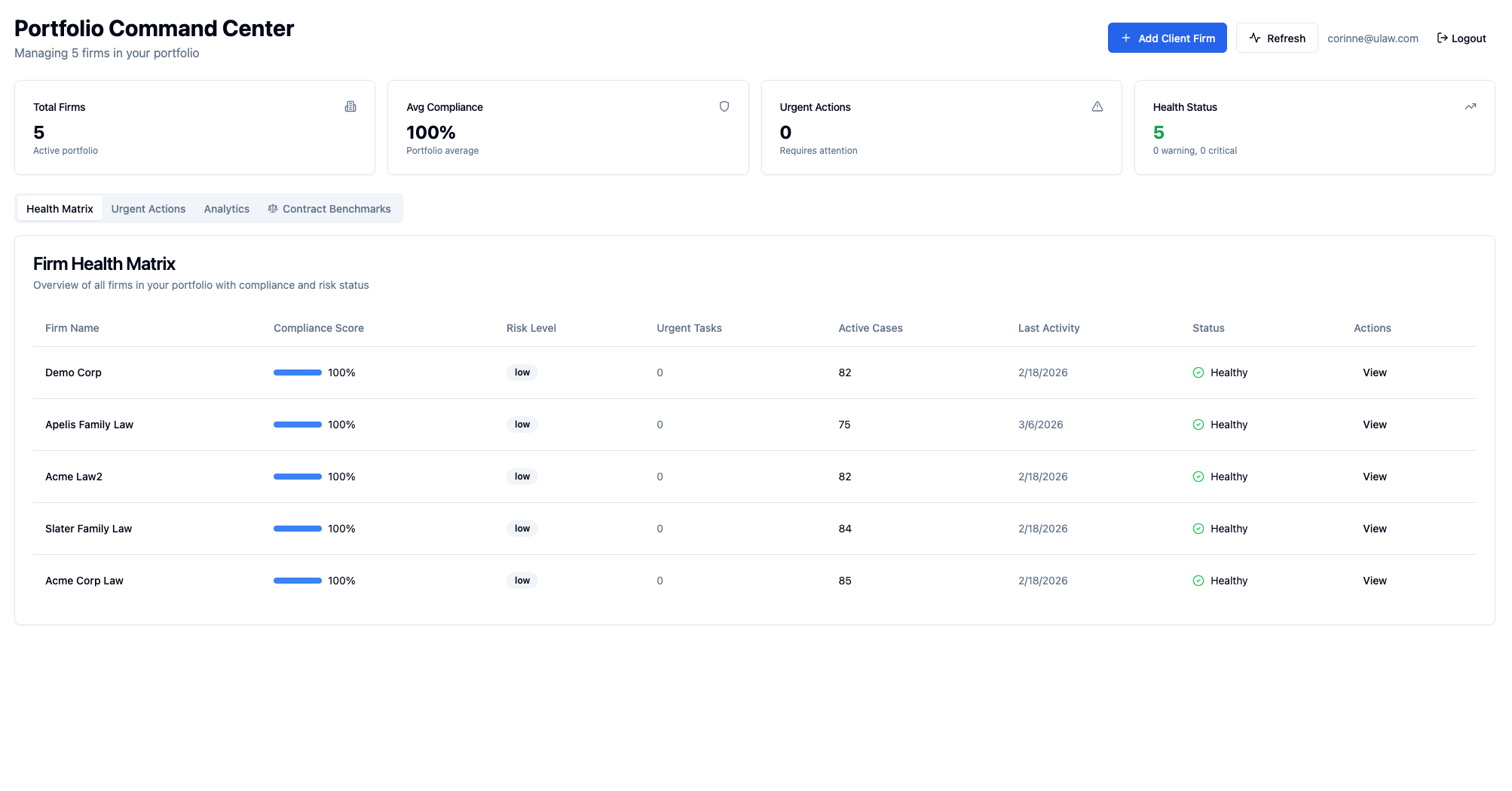
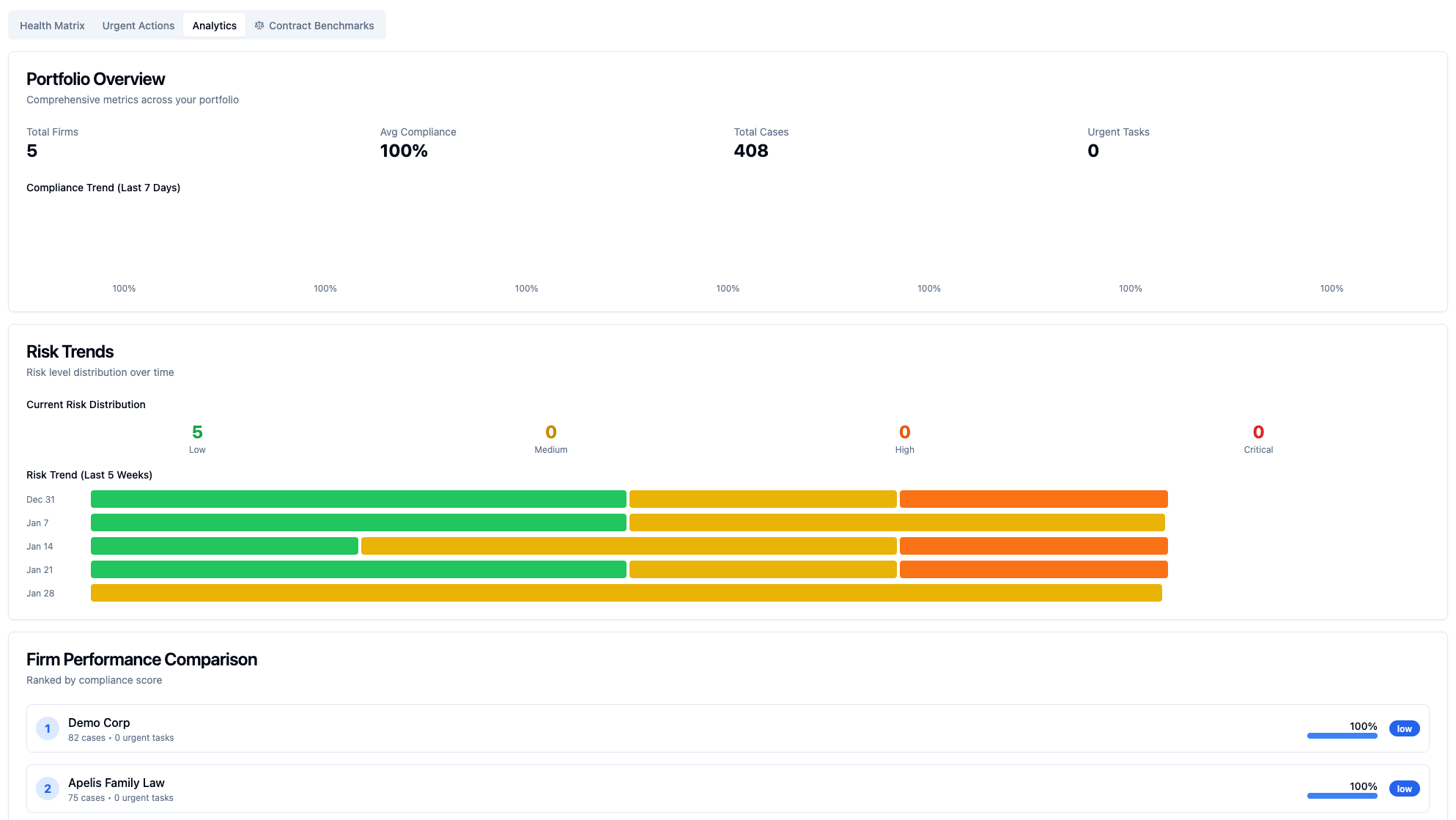
The platform’s hub is a “portfolio command center,” a dashboard across all of a FGC’s clients from which the FGC can drop into any one client’s context and get a menu shaped to that client’s practice area. The practice areas come in pre-configured modules covering corporate, family, immigration, IP and others.
When an FGC provisions a new client, the client’s specific AI index starts with this massive baseline of legal data. As the attorney uploads documents, drafts contracts, and reviews matters for that specific client, the platform’s algorithm begins to heavily weight the client’s own index. This allows the AI to learn and adopt the distinct “voice” and specific context of that individual business, Wilson says.
Beyond that, the platform functions as a full legal operating system, offering an array of tools that include:
- Document Intelligence. The system handles document generation, risk assessment, contract benchmarking, anomaly detection, and summarization.
- Client Intelligence. The platform can evaluate a case’s current posture and, based on its index of millions of cases, predict chances of success.
- Call Analysis. Sapphire treats call transcripts as a “first-class citizen,” running sentiment analysis that can automatically surface action items from board meetings or client calls.
- Validation. Any citations generated by the AI are strictly validated against the internal index or an integrated Westlaw license to mitigate hallucinations.
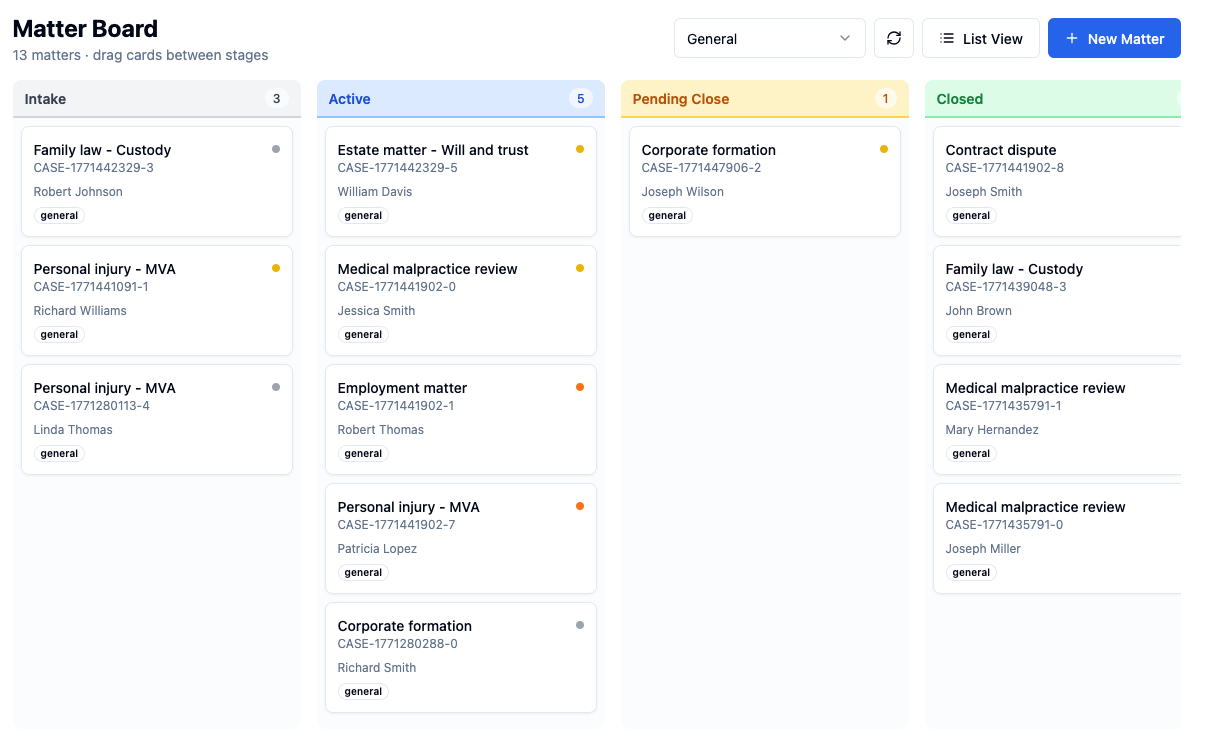 It also includes the practice-management basics such as contacts, time tracking, billing, a client portal and e-signatures.
There is an iPhone app, with an Android version awaiting approval.
Pricing is structured differently based on the lawyer’s country, to account for distinct infrastructure costs and market rates:
- United States: The command center costs $499 a month, with an additional $999 a month per managed customer. (Wilson says that FGCs can simply pass this cost through to their clients as a line-item expense).
- United Kingdom: The base fee is £499 a month, which includes one customer, with each additional customer costing £250 a month.
Although Wilson has just two customers so far, he hopes to see that number reach 25 in a year.
I asked Wilson why an FGC would want his product over simply running multiple clients through a practice management platform such as Clio.
His answer focused on Sapphire’s ability to offer clean context switching and client isolation rather than on anything Clio cannot do. In fact, he said, he would gladly integrate with Clio.
Wilson may have invented his tagline of “private legal intelligence,” but it makes a lot of sense, particularly for FGCs who juggle multiple corporate clients, each of which has unique legal needs, unique data needs, and unique cultural and stylistic needs.