 Robert Ambrogi Blog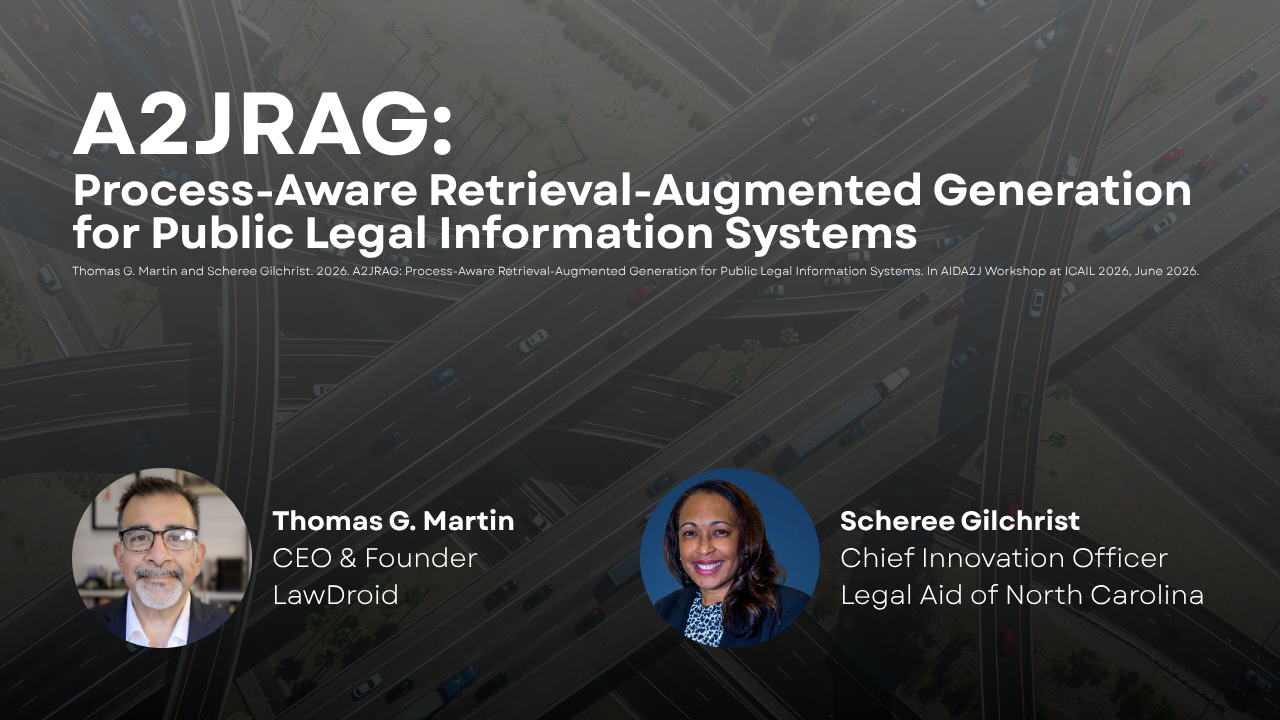


New research from LawDroid and the LANC Legal Innovation Lab explores how artificial intelligence can help people receive the right legal information at the right stage of a legal problem.
VANCOUVER, BC – June 10, 2026 — LawDroid and the LANC Legal Innovation Lab today announced the publication of A2JRAG: Process-Aware Retrieval-Augmented Generation for Public Legal Information Systems, a new research paper introducing a framework designed to help legal information systems provide information that is not only accurate, but also appropriate to a person’s stage in a legal process.
The research paper, authored by Tom Martin, CEO of LawDroid and Adjunct Professor at Suffolk University Law School, and Scheree Gilchrist, Chief Innovation Officer at Legal Aid of North Carolina, was presented at the AIDA2J Workshop at ICAIL 2026 on June 8, 2026.
The AIDA2J Workshop (Artificial Intelligence for Access to Justice, Dispute Resolution, and Data Access) was held at the Singapore Management University Yong Pung How School of Law as part of the 21st International Conference on Artificial Intelligence and Law (ICAIL), the leading international academic conference at the intersection of AI and legal scholarship. Acceptance to AIDA2J places A2JRAG alongside research from the world’s leading institutions working on access to justice and legal technology.
As courts, legal aid organizations, and other providers of public legal information increasingly explore artificial intelligence, much of the conversation has focused on accuracy and reliability: Can AI provide the correct legal information?
As many lawyers know, the answer to a legal question is many times, “It depends.” The answer to a legal question depends on the context, which includes many factors, like legal issue, amount claimed (if any), urgency, and at what stage in the legal process the individual finds themselves. This is what the authors address in their A2JRAG paper and solution.
According to the Legal Services Corporation Justice Gap Report, 92% of low-income Americans either do not receive any legal help or receive insufficient assistance for their civil legal problems. At the same time, legal aid organizations across the country continue to face rising demand, staffing pressures, and funding uncertainty.
For people navigating legal problems without an attorney, understanding where they are in a legal process can be just as important as understanding the law itself. Information that applies after a court hearing may not be helpful before a case is filed. Similarly, information relevant after a judgment may not be relevant at an earlier stage of a matter.
The paper identifies what the authors call a procedural relevance problem: an AI system may retrieve information that is legally accurate and topically related to a user’s question, but procedurally misaligned because it applies to a different stage of the legal process.
For example, a tenant who has just received a notice from a landlord may be shown information about appealing an eviction judgment or responding to a sheriff’s lockout. While that information may be legally correct, it is not what the tenant needs at that moment. The result is not misinformation—it is simply mistimed information.
A2JRAG was developed to address that challenge.
The framework builds on Retrieval-Augmented Generation (RAG) by adding what the authors describe as a procedural and temporal dimension. Rather than focusing only on the content of a user’s question, A2JRAG attempts to estimate where a user is in a legal process and condition retrieval on that stage.
In practical terms, A2JRAG asks two questions:
What information is relevant?
What information is relevant at this stage in the process?
To support this approach, A2JRAG introduces a Procedural State Graph, a structured representation of legal stages, transitions, contextual factors, guardrails, and escalation triggers that help guide retrieval and response generation.
“Standard RAG retrieves what’s topically relevant but cannot distinguish what’s relevant to where the user actually is in their legal matter. Agentic systems layer on reasoning loops that add latency, cost, and hallucination risk without solving the underlying problem; they still have no model of the user’s procedural state. A2JRAG adds that missing dimension architecturally, so the system delivers information that’s not just accurate but timely. For self-represented litigants, this is the difference between getting an answer and getting the right answer at the right moment,” stated Tom Martin, CEO and Founder of LawDroid. “A2JRAG is part of LawDroid’s broader commitment to building legal AI infrastructure that legal aid organizations and courts can actually rely on, not retrofitted from commercial tools, but designed from the ground up for the people and the moments where the stakes are highest.”
The paper focuses on public legal information systems and legal self-help, where users often need help understanding not only their legal issue, but also where they are in the process and what information applies to their situation at that moment.
The initial demonstration described in the paper focuses on North Carolina eviction self-help. The framework is presented as a proposed approach for reducing a specific failure mode in legal AI systems: retrieving information that is legally accurate but procedurally mistimed.
“The access-to-justice gap is not going to be solved by just making more legal information available,” stated Scheree Gilchrist, Chief Innovation Officer at Legal Aid of North Carolina. “People need information that is relevant to where they are, what they’re experiencing, and what decision they need to make next. A2JRAG explores how AI systems can move beyond answering questions and begin supporting people in a way that is more context-aware, practical, and ultimately more useful.”
The authors invite courts, legal aid organizations, researchers, technologists, and access-to-justice advocates to read the paper, explore the project’s demonstrations and visualizations, and evaluate the framework for themselves.
As artificial intelligence becomes increasingly common in public legal information systems, A2JRAG raises a fundamental question:
Is providing the right answer enough, or must legal information systems also provide the right answer at the right time?
Learn more about the research paper and the solution at https://a2jrag.org/.
About LawDroid:
LawDroid is a justice tech company powering AI solutions for legal aid organizations, court systems, and government agencies, helping expand access to justice through responsible AI, open technology, and innovation. Widely known for generative AI, voice agents, legal information assistants, client intake, document automation, and implementation consulting, LawDroid enables justice-focused organizations to serve more people with limited resources while guiding communities from legal problems to actionable solutions.
LawDroid is also the publisher of the Legal Aid Plugin, a free and open-source Claude for Legal plugin built specifically for civil legal aid organizations, court self-help programs, and public-interest providers—extending advanced AI capabilities to organizations often overlooked by mainstream legal technology. For more than 10 years, LawDroid has partnered with organizations on the front lines of access to justice, helping expand impact and empower underserved communities across the United States.
About LANC Legal Innovation Lab:
The Legal Innovation Lab at Legal Aid of North Carolina develops and tests new approaches to improving access to civil legal help, with a focus on making legal information more understandable, timely, and useful for people navigating problems on their own. The Lab works at the intersection of law, technology, and service design to explore practical solutions that support clients, strengthen service delivery, and expand the reach of legal aid. Current areas of focus include digital intake tools, AI-assisted legal information, and user-centered design for public-facing resources, with an emphasis on responsible, ethical use of technology.
###
Media Contact:
David Gray
Director, Business & Strategy
david@lawdroid.com