 Robert Ambrogi Blog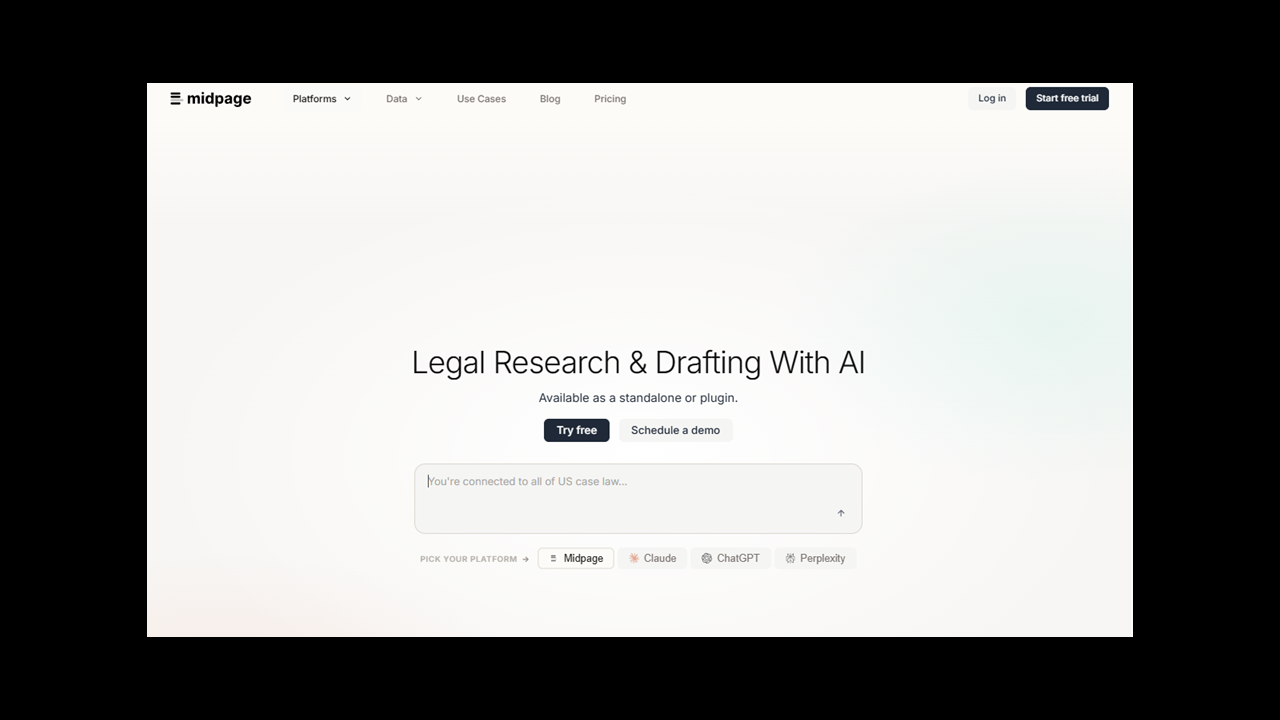


It was just 18 months ago that I wrote about the legal research startup Midpage passing what its founder considered a critical threshold in its development, achieving full data coverage of key U.S. case law.
Now the company is crossing another threshold, adding full coverage of the other major chunk of primary law — statutes, regulations, constitutions and agency guidance for all 50 states and the federal government.
For Midpage founder and CEO Otto Zastrow, the release is the company’s most significant since it launched its Midpage Data service six months ago, because it means that both lawyers and the growing number of legal tech companies that license Midpage’s data can now get comprehensive primary law — case law and codified law alike — from a single source.
“For the entire world of people building things in legal tech, they can now get both of these pieces from one place,” Zastrow told me in an interview earlier this week. “We’re pretty sure that this is the highest quality and highest coverage dataset for U.S. regulations out there.”
The expansion adds more than 4 million statutes, regulations and agency guidance documents to a database that already includes more than 14 million published and unpublished opinions, connected by what the company says are more than 111 million links between opinions, according to a data quality page the company published on its website.
As I wrote in February 2025, Midpage — which was a 2025 finalist in the Startup Alley competition I run at ABA Techshow and which raised $4 million last June — chose to build its own case law database largely from scratch rather than license it from an established provider.
It has now taken the same approach to codified law, collecting statutes and regulations directly from primary sources rather than through vendors or intermediaries.
What the Coverage Includes
According to the company’s public coverage page, the dataset now spans statutes, administrative codes and constitutions for U.S. states, territories and the District of Columbia, together with the United States Code, the Code of Federal Regulations, the Federal Register, executive orders, and public laws on the federal side.
It also includes a substantial body of federal agency guidance — materials such as IRS revenue rulings and private letter rulings, SEC no-action letters, the USPTO’s patent and trademark examination manuals, Department of Labor opinion letters, and guidance from the CFPB, EEOC, FDA, HUD, OFAC and USCIS, among others.
This kind of depth matters for practitioners in specialized areas, Zastrow said. “If you’re, say, a litigator working on tax litigation, it’s really important that all of the things are in there — that all the tax codes are in there.”
The Quality Differentiator
Zastrow says it is not just the breadth of the data that matters, but also its quality. He compare Midpage’s collection against those of both open source providers and major incumbents.
Open data efforts such as the Free Law Project’s CourtListener have made primary law far more accessible, he said, but they do not include statutes or regulations, and their court coverage has gaps in areas such as tax courts. “Even though they were doing God’s work for many decades, for commercial real-world litigation, it’s just not good enough.”
Lexis and Westlaw, meanwhile, have the data, but a vendor “couldn’t build on top of that data,” he said.
Zastrow said that the quality of Midpage’s data is driven by two factors.
The first is versioning. Every statute and regulation in the collection is stored with its historical versions, so a researcher can see not just the current text but the text as it stood on any given date. This is critical, Zastrow said, for a litigator who needs to know which version of a statute a case was relying on.
In one example on the data quality page, a West Virginia wage regulation is available in 39 point-in-time versions, with scanned tables rebuilt as clean HTML.
The second is freshness. “Unlike many others, we actually update all of our collections weekly, and for cases, we’re doing it multiple times per day,” Zastrow said.
For statutes and regulations, he said, the company re-scans entire collections every week, pulling directly from each state’s own websites. “We’re not going through any vendors or intermediaries,” he said, and the company does no book scanning.
The Lexis-Published States
One wrinkle in the 50-states coverage involves the handful of states whose official codes are published only through LexisNexis — a situation familiar to anyone who followed Georgia v. Public.Resource.Org, Carl Malamud’s fight over access to the Official Code of Georgia Annotated that reached the Supreme Court in 2020.
For those states, Zastrow told me, Midpage is reconstructing the codes from the underlying session laws and acts, rather than taking the text from the Lexis-published versions.
As of today’s release, that work will be complete for most states, with the New Jersey Administrative Code and the Code of Vermont Rules scheduled to be live today. Still in progress are the Official Code of Georgia Annotated, the Tennessee Code Annotated, the Mississippi Code, and the Arkansas Code.
PACER On Demand
Alongside the statutes release, Midpage also recently rolled out on-demand retrieval of PACER dockets and filings from federal district, bankruptcy and appellate courts. Zastrow said the company built its own PACER integration after finding that third-party APIs “weren’t quite accurate enough.”
The feature is designed for agentic workflows, so that a user working in Midpage’s own interface — or through its integrations in Claude, ChatGPT or Perplexity — can instruct the AI to pull a docket sheet or a cited filing, which the AI can then read and use, for example, to verify that a citation and quotation in a brief are accurate.
Because PACER charges for every document, Midpage cannot make the underlying retrieval free, but rather than requiring users to supply their own PACER credentials, it retrieves documents through its own account and passes the fees through to the customer.
Subscribers to Midpage’s Pro plan get $25 per month in PACER usage credits. Higher-level subscribers can negotiate custom credit levels.
“There were many types of tasks for which a partner would have a dedicated associate that would spend many hours per week on this,” Zastrow said. “They can now do it in a simple chat message.”
Distribution Through AI Assistants
Notably, Zastrow said that usage of Midpage through its Claude integration is now roughly twice as large as usage through its own web interface — and growing faster. The new statutes and regulations are available across all of those channels, both for search and for direct lookups, as well as through browsable navigation on the platform itself.
Coming soon, Zastrow said, is hyperlinking between documents. The company has already done much of the work to link cases that cite other cases, with clickable links to follow. Links from cases to the statutes they cite will come next, and statute-to-statute links after that.
Also on the roadmap is coverage of proposed bills at the state level, which the company currently offers only for federal legislation.
Meanwhile, Midpage’s data services business continues to add customers. Zastrow named BriefCatch and GC AI as newly announced customers, joining others it cannot yet disclose. The data quality page says five multibillion-dollar organizations now use its data.
Pointing to Midpage’s public listing of the resources it covers, Zastrow took a shot at some other newer entrants to the legal research market, which he said do not always have the coverage they claim to have.
“That’s why we said we’re going to make everything very interactive and transparent,” he said. He wants people to click around and judge the coverage for themselves.