 Robert Ambrogi Blog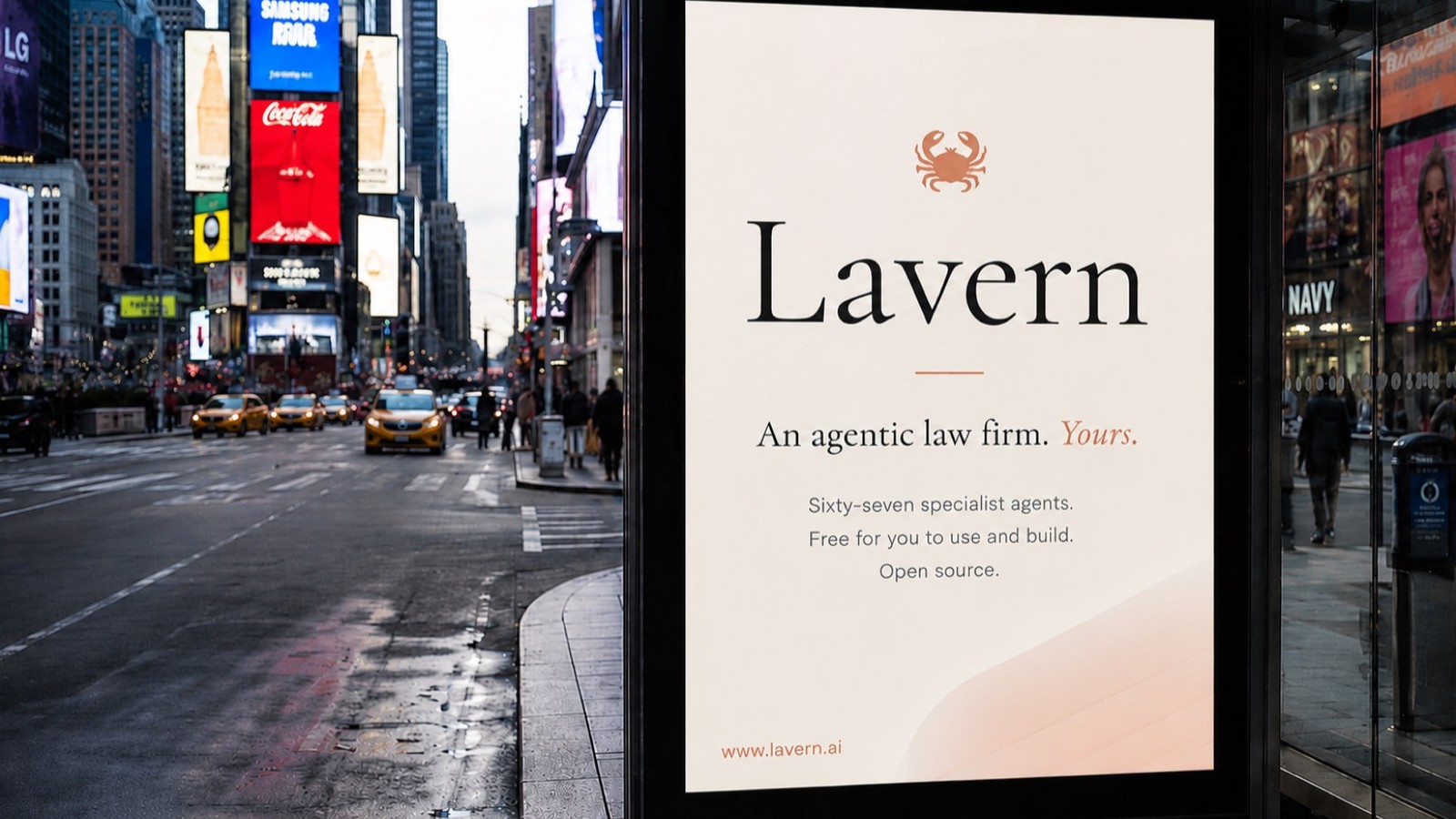


Somebody once told Antti Innanen that he had built a veggie burger dressed up to look like real meat. He thought it was a fun criticism, but he also thought it missed the point.
That burger is Lavern, an open-source “multi-agent legal system” that Innanen, a Finnish lawyer and law firm founder with a background in legal design, released this spring under an open-source Apache 2.0 license.
The “meat” it mimics is a modern law firm — but this veggie burger version is staffed by a team of 67 AI “specialists” that read your documents, argue with each other about what they find, and hand back the result in a typeset memo.
The agents come with names, faces, skill ratings and personalities. You assemble your team by flipping through what look very much like trading cards.
(Spoiler alert: There is even an Easter-egg agent named after a prominent legal AI endorsement deal. It is the most expensive lawyer on the roster but can do absolutely nothing.)
And yet, even with the whimsy, Lavern is a serious platform taking an alternative approach to how legal AI is built — and who gets to look under the hood.
“It works. It produces comparable results to any of the legal tech tools in the market,” Innanen told me in a demo last week, running the system locally from his home in Alicante, Spain.
“But it’s not all fun and games. I seriously think that the agentic debate can produce better and more varied results than just single agents. And that’s what we are testing here.”
A Team, Not An Assistant
Innanen’s background helps explain why he built Lavern. He was the founding managing partner of Dottir Attorneys, a Helsinki tech-and-media boutique, and went on to found Dot., a legal-design agency that spun out of the firm, and to co-found Legit, an AI company focused on helping organizations in regulated and high-stakes contexts adopt AI responsibly.
He helped start the Legal Design Summit and the Finnish Legal Tech Association. His initials, as his LinkedIn profile points out, are A.I.
Lavern is a project of his Legit and Dot. ventures, built over about six months.
At his former firm, Innanen had worked in mixed teams – lawyers alongside designers, technologists, and plain-language experts – and found the output was simply different, often better, than what all-lawyer teams produced. But no legal tech tools let him replicate that experience.
“If you think of almost all the legal tech tools in the market, the analog is the capable but very literal junior lawyer that you’re working with,” he said. Lavern, by contrast, is “more of a team than an assistant.”
It is an attempt to recreate that dynamic with agents – not just one capable assistant, but a roundtable of distinct personalities debating a problem, with an orchestrating agent that mines the disagreement for the interesting angles and compiles them into a deliverable.
“If you think of four talented lawyers discussing a case, this tries to use that as the analogy,” he said.
A Walk through the Firm
Lavern’s interface is structured like an engagement, and it shows off both the substance and the quirk.
It opens on a landing page that reads “Your firm is ready,” with three budget tiers — Counsel (an expert opinion, up to about $10 in model costs), Review (a dedicated team, up to ~$40), and Full Bench (every specialist, up to ~$125). You can drop a document and go, or choose the recommended “Full Engagement.”
That begins with intake and briefing — which is, Innanen argues, where most legal tech tools fall short. “Most of the legal tech tools don’t really have any kind of intake system. The lawyer is the context.”
Lavern offers two forms of intake. Either just “Drop & Go” a document or text, and it will figure out the rest. Or go through a guided interview that walks through questions such as jurisdiction, budget and fee structure, and potential conflicts. The interview is conducted by one of the AI “partners” (or multiple partners if you prefer), who scope what you actually need before any work begins.
“Law is a context game,” as the website puts it. “The model is not the bottleneck. Context is.”
Next comes strategy, where you pick the approach you want Lavern to take in analyzing your issue. Options are:
- The Roundtable, for full document review, redraft and plain-language enhancement.
- Stress Test, for performaing legal research and generating memoranda.
- Tabulate, to extract structured tables such as cap tables, paymetn schedules, or lease abstracts, with per-cell source citations and conficence ratings.
- Deep Review, for systematic contract analysis and redlining.
- Quick Counsel, for quick answers and analysis of legal questions.
These options differ in the number of steps they go through and human-approval gates they include.
You can also crank up the intensity so the system routes to a more capable, more expensive model, or dial it down and it drops to cheaper or local models.
“Typically in legal tech tools you can’t really choose the process,” he noted, even though there is a big difference between reviewing an NDA and litigating a bet-the-company case.
Then come the playing cards for selecting your team. Each of Lavern’s agents is rendered as a collectible card, complete with a skill radar chart, personality bars, practice areas, and a price.

Each of Lavern’s agents is rendered as a collectible card, complete with a skill radar chart, personality bars, practice areas, and a price.
There are partners (Managing, Supervising, Of Counsel, a Risk Partner, a Litigation Partner) and a deep bench of specialists (M&A, regulatory, privacy, tax, restructuring, an IP specialist billed as “The Investor”). You draft your lineup, manage your bench, and, when it gets unwieldy, do a little “agentic HR” and fire some.
You can also build your own agent from archetypes with names like The Shark, The Scholar, The Diplomat, and The Whitehat. If you want, you can clone yourself, or even an entire firm: paste a law firm’s homepage, and Lavern reads the site and generates agents modeled on the real, named lawyers it finds.
During our demo, Innanen cloned his former firm, watching former colleagues materialize as agents. “This is a crazy feature,” he admitted, “but I think it’s worth exploring.”
Once the work runs, you can sit by and watch the debate board. Agents post findings, each required to cite specific text from the document, challenging one another with counter-evidence, and an orchestrator resolves the disputes.
Unresolved or critical questions get flagged at a human gate for you to decide, unless you choose to let it “wing it” on autopilot.
The ultimate output is the sort of deliverable you would expect – a memo, a redline, a board email – with confidence scores, grounding indicators, and an audit trail, available in Traditional, Expert, or “Accessible” styles and in Word, HTML, or worksheet formats.
In my demo – a terms-of-service draft for a Delaware online-dating company – Innanen used a single agent to save money. It cost $2.52 of a $10 budget and took three minutes.
Agents that Challenge Each Other
Lavern’s engineering is where its real claim to originality lies, and the README on its GitHub page lays it out.
Each agent, it says, is a specialized system prompt with its own role, MCP permissions, and slot in the debate protocol. All 67 run on the same underlying frontier LLM — Anthropic’s Claude (the U.S. default) or Mistral (for EU data sovereignty) — or on a fully local model via Ollama.
All 67 can run on the same underlying frontier LLM – Anthropic’s Claude, which is the U.S. default, or Mistral, for EU data sovereignty. It can also run on a fully local model via Ollama.
But the real work is less in the prompts than in the processes wrapped around them:
- The debate protocol. Agents must cite specific text from the parsed document. Findings without citations never enter the board. Agents can challenge each other; the challenger also has to cite text.
- Three-layer verification. Findings go through an evaluator gate, which drops weak ones, then through an adversarial “red team/blue team” debate, then a 10-pass verification pipeline checking such things as accuracy, completeness, structure, context, clarity and risk. A separate verifier checks the accuracy of every quote.
- Human gates.Before critical findings are delivered, there is a mandatory human gate. The orchestrator surfaces the call and waits for a human to approve or override.
- Precedent Board. A persistent “precedent board” remembers patterns across engagements, promoting recurring findings to “confirmed” and letting stale ones decay.
“Whether all of that actually adds up to materially better outputs than a single well-prompted LLM is an open empirical question,” the README says. “We have structures in place to test it; we don’t claim to have settled it.”
Innanen is most excited about the ability to run Lavern locally. “I’m super into these local models,” he said. “All the data stays in your computer, you’re not sending it to anybody else, there’s no costs. It’s quite environmentally friendly too.”
In hybrid mode, a local “watchdog” model called Clawern runs continuously on a 30-minute heartbeat, triaging documents and escalating only the hard questions to a frontier model. “The local model is more like a lighthouse type of thing that is always on,” he said.
Innanen is frank about the platform’s potential shortcomings. The repository’s own documentation concedes there is no public benchmark, that multi-agent debate remains “imperfect” (agents “sometimes don’t listen to each other,” sometimes one dominates), that 67 agents is “probably more than needed,” and that the central quality claim is “a hypothesis.”
“The difficult thing about agentic debate is that agents don’t really listen to each other that well,” Innanen said. “And if you have a large group of agents, some agents usually dominate the debate too.”
How did he land on 67 agents? “I started maybe with six,” he said. “And honestly, I just kept adding stuff. There is no big plan. I stopped at 67.”
Opening A Closed System
Innanen believes that there are three aspects of what he has built that are genuinely interesting.
The first is open source itself. “Law is fundamentally a closed system,” he said. “People say that it’s open, but it’s very closed.” Both legal services and legal tech software are dominated by large players who “won’t let you look inside.”
Lavern, by contrast, can be taken apart. “It’s almost like a dead body – you can study the anatomy of it. It’s like a car engine the mechanics can look at.” Every agent prompt, debate protocol, and verification pass is readable and editable.
The second is his worry that the entire field is building toward the same thing: a legal chatbot that produces text, optimized by evaluations that reward sounding like a lawyer. “We’ve maybe lost the grasp of what is useful, or what is fun, or what is accessible,” he said. “It’s just efficiency and accuracy and fewer hallucinations.” A tool could ace every eval, he argues, and still give bad legal advice.
The third, he argues, is that the field has taken a step backward toward legalese. “I want to reclaim the idea that we want to produce different kinds of legal outcomes for all people,” he said, “and not just go back to the old legalese, but do it more accurately, a little bit faster.”
Innanen is openly skeptical of the well-funded incumbents. “Most of it is cigars and marble floors and little wooden panels and old, middle-aged actors,” he said, referring to some of their branding and marketing.
He is more interested in the question they do not answer. “What happens if Harvey or Legora win? How’s the law going to look when everybody’s just using Legora or Harvey?”
Their products will likely be good, given their funding and major clients. But he does not trust founders a couple of years out of law school to design the future of the profession.
Purposely Not A Product
Innanen insists Lavern is not a commercial product, and that he does not want to develop it into one. The economics of software have collapsed, he believes: a build like this would once have cost half a million dollars and a full tech team. Now it costs “next to nothing,” leaving him no need to turn it into a business.
“There’s at least 10, maybe even 20 things [in Lavern] you could actually make a product out of,” he said, “a good solid product that could get you into Y Combinator.”
Anyone, he notes, is free to fork it and try.
Does he see himself building that company? “Probably not. I don’t see myself as a founder anymore. Too old for that stuff.”
He has no interest, he says, in the Harvey-and-Legora founder lifestyle – the constant flying, the pressure, and now, he jokes, being cast as the villain. “I want to be the good guy.”
What he does want, however, is for people to find his platform and, he hopes, use it. “If we’re doing open source, the worst thing that can happen is that nobody really finds it.”
So far, by his account, the response has been encouraging, with a few hundred GitHub stars, around 100 forks, and people already lifting pieces of it for their own projects.
(A “fork” on GitHub is a way of spinning a repository off into another one as a starting point for a new project.)
All of this brings us back to that veggie burger. A patty that looks like meat is, in a sense, exactly what Lavern is – an imitation of a law firm that is, of course, not a law firm. But for Innanen, the whole point was never the meat. It was the concept.