 Robert Ambrogi Blog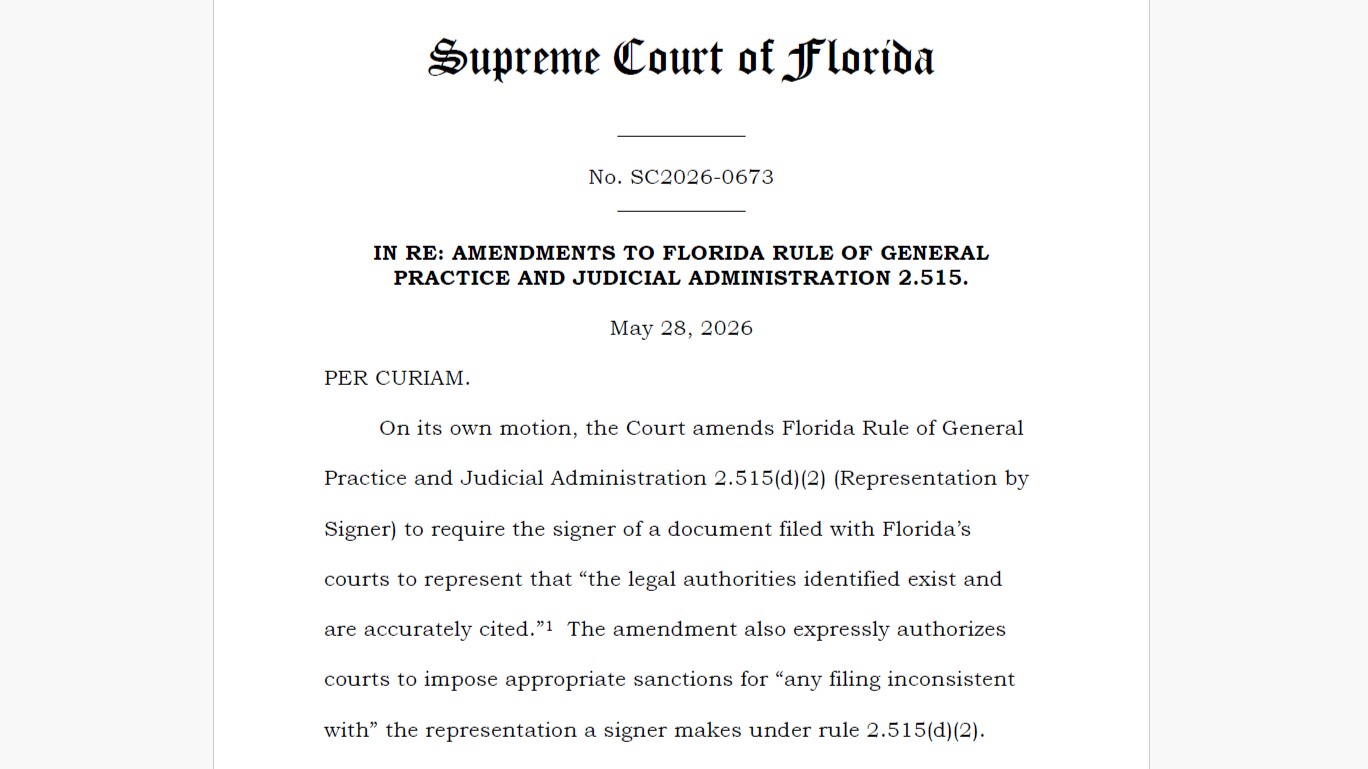


Aiming to curtail the glut of court filings containing hallucinated legal citations, the Florida Supreme Court today issued a new rule that requires the signer of any document filed in any Florida court to represent that “the legal authorities identified exist and are accurately cited.”
The court’s order (Opinion_SC2026-0673) also adds a rule that expressly authorizes courts to impose sanctions for any filing inconsistent with that required representation.
The new rule comes as an amendment Florida Rule of General Practice and Judicial Administration 2.515(d)(2), which already required attorneys signing court filings to certify that they accept responsibility for the document and that they have complied with applicable rules of court procedure.
But this amendment not only adds the accurate-citation certification, but also extends it to both attorneys and unrepresented parties.
“Given the demonstrated risks of generative AI and to promote the accuracy and integrity of court filings, we amend rule 2.515(d)(2) to require the signer of a filing to represent that the legal authorities identified in that filing ‘exist and are accurately cited,'” the court in a per curiam order.
The amendment also specifically authorizes courts to impose sanctions for any court filings inconsistent with this representation, after providing the signer notice and an opportunity to be heard. The court specifies that sanctions may include reprimand, contempt, striking of the document, dismissal of proceedings, costs, attorneys’ fees or other sanctions.
In commentary accompanying the order, the court says that it adopted these amendments primarily to create a uniform, statewide rule to replace the various orders that have been imposed by lower courts relating to the use of AI in filings.
The amended rule takes effect on June 15, 2026.
Because the court issued the order on its own motion, without providing an opportunity for public comment, it is allowing comments to be filed now.
It has set Aug. 11 as the deadline for comments, after which it may schedule an oral argument.
Licensed Florida attorneys must file comments through the Florida Courts E-Filing Portal. Others may file through the portal or by mail or deliver to Florida Supreme Court, Office of the Clerk, 500 South Duval Street, Tallahassee, Florida 32399.