 Robert Ambrogi Blog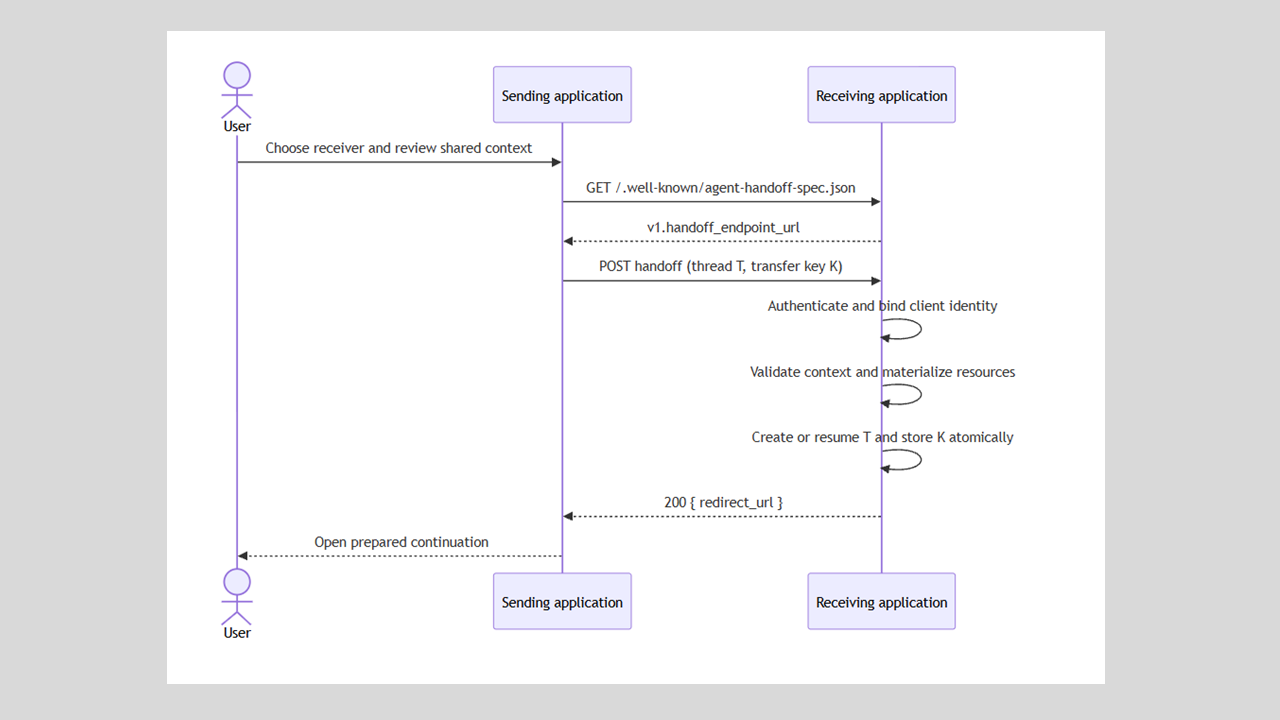


DeepJudge, the Zurich-based enterprise search company that describes itself as the institutional intelligence platform for legal AI, today introduced the Agent Handoff Protocol, an open protocol designed to let users move from one AI product into another – and, in some cases, back again – while retaining the full context of their work.
Harvey has already announced that it is building an integration implementing the protocol, which will enter beta this month, and Thomson Reuters says it will support it in CoCounsel for Legal, with details on its implementation and timing still to come.
“The most capable legal workflows will draw on more than one specialized system,” said Siva Gurumurthy, chief technology officer at Harvey. “Agent Handoff Protocol lets a user move from Harvey into a partner’s product and back without losing the thread of their work, while leveraging both products to their full potential.”
DeepJudge developed AHP to address the increasingly common problem of having to move between different AI products and experiences – such as from Harvey to DeepJudge – to get work done.
While existing protocols such as the Model Context Protocol developed by Anthropic let systems exchange information and perform discrete actions, they do not allow the broader context of the work – the objective, the supporting materials, the conversation history, the analysis already done – to travel with the user from one product to another.
“The Agent Handoff Protocol addresses this challenge by enabling AI platforms to transfer the user and the context needed to continue work from one system to another,” DeepJudge says. “Rather than rebuilding context each time they switch products, users can move between AI experiences while preserving the information and progress that led to the current point.”
In its announcement, DeepJudge gives the example of a lawyer researching a precedent question in DeepJudge, who can then move into Harvey with the relevant context already in place, without re-uploading materials, recreating prompts, or rebuilding prior analysis.
“No single AI experience will be the right one for every task,” Yannic Kilcher, DeepJudge’s CTO and co-founder, said in the announcement. “People should be able to use the AI tool that’s best for what they need to do and take their context with them.”
How It Works
For those wanting to dive in deeper, the technical documentation for the protocol can be found at agenthandoffprotocol.org. But in an interview yesterday, Kilcher told me that, for users, the actual mechanism of the handoff is a simple button. The user clicks it and says, in effect, I want to continue this work in this other application.
“In the background we take care of bringing that context along,” Kilcher said. “There’s multiple things that have to happen in the background. We have to authenticate you, so the whole transfer is secure and scoped to you as a user.”
The GitHub page describes it this way: “AHP gives two independently operated agent applications one shared action: Continue this user’s task over there, with this objective, this selected conversation context, and these resources.”
In terms of what context gets carried over, the protocol leaves that open so it is up to the vendor implementing the protocol to make that decision.
“The protocol itself has no opinion on that,” Kilcher said. “We feel it is the job of the individual partners in the ecosystem to decide what an appropriate context is.”
Harvey might decide the user’s conversation history is the right thing to pass, for example, whereas DeepJudge, as a search engine, is more likely to pass back the documents the user found.
As currently written, the specification describes one application handing off to another, and then the other possibly handing back.
Kilcher said the hand-back is optional for developers to adopt. A user who starts in DeepJudge, collects documents, and moves into CoCounsel to finish a drafting workflow may have no particular reason to return, he noted.
Handoffs among multiple applications are conceivable but not specified, Kilcher said. “We’re just trying to keep it really simple for now.”
Not an MCP Replacement
When asked how AHP differs from MCP, Kilcher said AHP is built on top of MCP and is not intended to replace it.
For simple retrieval, MCP works well, he said. For example, a lawyer using a firm’s Claude Enterprise deployment who asks whether the firm has done a particular kind of deal before can get an answer from DeepJudge through MCP without ever needing to leave Claude.
But for more complex tasks, it is sometimes preferable to work directly within the connected application’s full user interface.
“There is a reason products have different user interfaces, because we built these products to serve very particular needs,” Kilcher said. “There was no good way of delivering that via MCP, because all you get is basically the bit of text you send back and forth.”
The GitHub page puts it this way:
MCP connects an LLM application to external context and capabilities. Its core architecture has hosts, clients, and servers; servers expose resources, prompts, and tools through JSON-RPC over transports such as stdio and Streamable HTTP. A host can use those capabilities while keeping the user in the host application.
AHP connects two complete, independently operated agent applications. It transfers an explicit objective, a selected conversation sample, resources, and continuity identifiers, then returns a URL for a prepared experience in the receiving application. The user and the task cross the product boundary; tools, credentials, and execution privileges do not.
AHP reuses a good deal of MCP’s machinery, including how messages are structured. “It’s really about providing a different user experience than MCP, but it’s compatible and complementary to MCP,” Kilcher said. “This is not a replacement.”
He notes that MCP connectors often come with restrictions. A vendor will allow you to connect to its MCP server, but it may allow you to do only limited functions.
“With this, we’re voluntarily passing the user to the other product,” Kilcher said. “Philosophically, this is an ecosystem. The different players fulfill different roles, and if we make the user experience great, everyone profits.”
An Open Protocol
DeepJudge is publishing the specification, not an implementation. There is no license fee and no reference code, and Kilcher said the point of releasing it openly is to remove any question about whether other vendors can build on it.
“We wanted to make it so that there is no danger of us being like, ‘Hey, this is ours,’” he said. “We’re not releasing the implementation anyway. This would be useless today – you can just give this protocol spec that we released to an LLM. It will do a fine job at implementing it.”
The spec covers what each side of the handoff must implement – message structure, transfer mechanism, how resources are represented – and Kilcher said it documents what DeepJudge has already built with its partners, so it is not aspirational.
“This is a full description of what we have implemented with our partners. So we know that this works.”
Nothing about the protocol is legal-specific, and Kilcher said DeepJudge would be happy to see it picked up in other verticals. Asked whether anything comparable already exists, he said the team found individual projects but no standard.
“Professionals will increasingly work across specialized AI experiences, and those systems need to work together without sacrificing the context, trust, and expertise required for high-stakes work,” said Joel Hron, chief technology officer at Thomson Reuters. “Open standards like Agent Handoff Protocol can help enable that interoperability.”
To my mind, the premise of AHP makes perfect sense. There are some things you can do well via an MCP connector to an application and some things you can do well only by directing engaging with the application and its full user experience. But you do not want that context switching to lose the context of your work.
As for whether AHP becomes a widely used standard, time will tell. Kilcher is modest about that. “This is how we’re doing it,” he said. “It’s a suggestion from us to the industry.”