 Robert Ambrogi Blog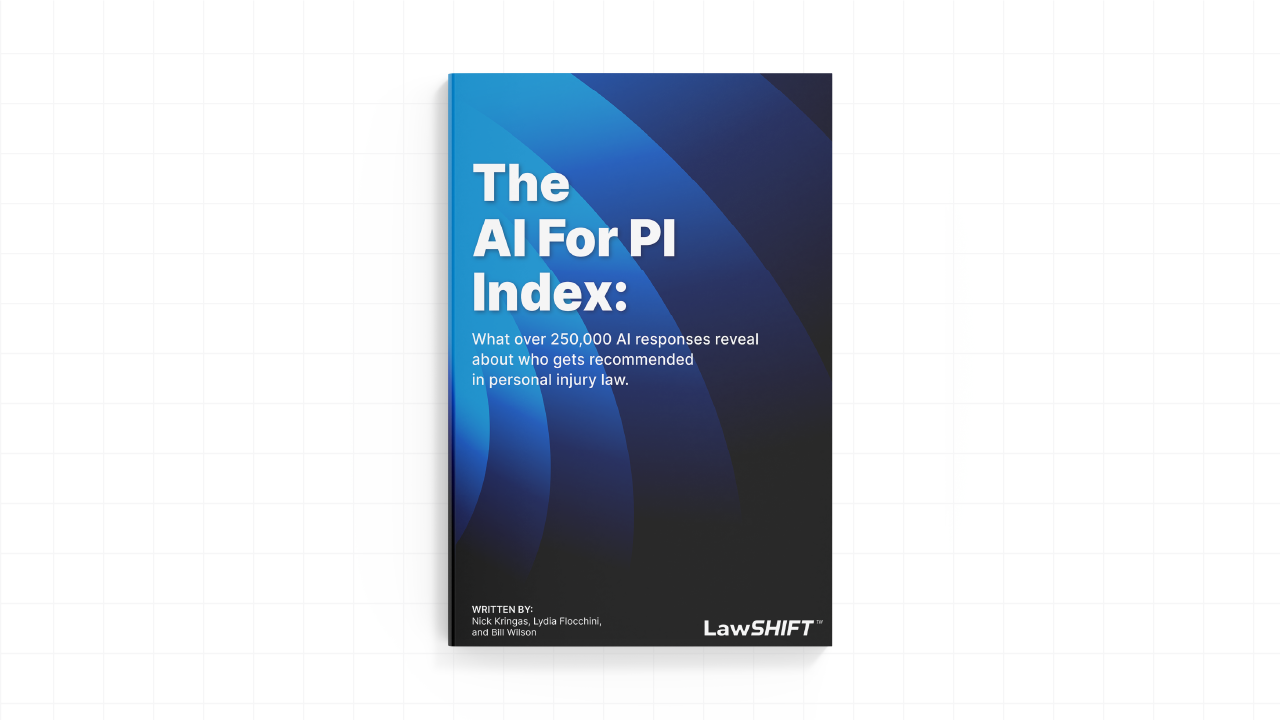


New publication examines which personal injury firms AI recommends, why traditional search authority often fails to carry over, and how AI is influencing consumers before law firm intake begins
FOR IMMEDIATE RELEASE
LawSHIFT has published The AI for PI Index: What Over 250,000 AI Responses Reveal About Who Gets Recommended in Personal Injury Law, a new mini-book examining how ChatGPT, Claude, Perplexity, and Google AI Overviews surface personal injury firms when consumers turn to AI for legal guidance.
The publication draws on LawSHIFT’s AI for PI Index™, an ongoing measurement system that analyzes more than 20,000 personal injury-related AI responses with each update. The Index currently covers more than 1,800 firms across hundreds of markets in all 50 states and Washington, D.C.
“We wanted to know what AI is actually telling people, not guess at it. Firms will likely spend millions acting on theories about AI that were never checked. The Index challenged many of our assumptions, and each update raises new questions for us to explore,” said Nick Kringas, Founder & CEO at LawSHIFT.
LawSHIFT developed the Index after finding that a law firm’s established search authority offered little indication of whether AI would recommend it. In the company’s initial analysis of 81 established personal injury firms, the correlation between traditional search authority and AI visibility was 0.076. The median AI Visibility Score among those firms was zero.
As LawSHIFT expanded the research, the relationship remained weak. Depending on the measurement period, the company found that SEO strength explained approximately 2% to 11% of AI visibility.
The mini-book examines that gap in detail and introduces what LawSHIFT calls the AI Authority Gap, the measurable difference between the authority a firm has built and the authority AI systems recognize when generating recommendations.
“When someone turns to AI for help, they may be deciding whether they need an attorney, what type of attorney they need, and which firm they should call. If attorneys are absent from that decision-making window, they are not simply losing visibility. An injured person may be led to believe they do not need legal help at all,” said Lydia Flocchini, Partner & Legal Category Designer at LawSHIFT. “The demand is suppressed before a law firm ever knows it existed. That is the invisible funnel firms cannot afford to ignore.”
Measuring What Happens Before Intake
LawSHIFT built the AI for PI Index around what it describes as the Pre-Intake Problem™, the period between the moment an injured person begins looking for guidance and the moment that person enters a law firm’s intake process.
Personal injury firms have traditionally been able to measure search rankings, website traffic, advertising performance and what happens once a prospective client makes contact. AI conversations fall outside those systems.
An injured person can now ask whether an accident may support a claim, research attorneys, compare firms and form expectations about a case before contacting anyone. A firm that never appears during that process may lose a potential client without knowing that the person ever considered hiring counsel.
The AI for PI Index was designed to make part of that activity measurable.
“We didn’t want a handful of prompts run once. We built a library of real buyer-intent questions, the kind an injured person actually types, and we run them across every major AI platform in hundreds of markets on a rolling basis. That’s what makes the confidence ranges mean something. We’re not reacting to one weird answer, we’re watching a pattern hold or break over time,” said Bill Wilson, Monetization and Data Science Lead at LawSHIFT.
LawSHIFT maintains a library of buyer-intent questions based on the kinds of inquiries injured people may make while seeking legal help. Those prompts are run across ChatGPT, Claude, Perplexity, and Google AI Overviews in hundreds of local markets. The Index records which firms are mentioned, which websites are cited and how those patterns change over time.
Its measures include AI Visibility Score, Share of Voice, Citation Share, geographic footprint and market depth. LawSHIFT also uses rolling measurements and confidence ranges to distinguish sustained changes in visibility from the normal variability of generative AI answers.
Most Firms Remain Difficult for AI to See
The mini-book reports a highly fragmented recommendation market.
In one Index update, AI systems named 24,694 personal injury firms, yet more than half appeared only once and nearly three-quarters appeared no more than twice. Only seven firms nationally appeared in more than 1% of AI answers.
Morgan & Morgan, the most visible national firm measured in that period, appeared in approximately 7% of answers nationwide. LawSHIFT also identified 61 firms with Domain Ratings of 50 or higher that appeared in fewer than one out of every 100 AI prompts during the week measured.
The publication examines why firms with substantial search authority can remain difficult for AI to surface and where AI systems appear to look when constructing recommendations.
LawSHIFT found that third-party legal directories account for a large share of cited sources, although reliance varies considerably by platform. ChatGPT, Claude, Perplexity, and Google AI Overviews do not draw on identical source patterns, which means a firm’s visibility can differ substantially from one AI system to another.
The mini-book also examines the geographic nature of AI visibility. National recognition does not consistently translate into local dominance, and many state and metro markets remain divided among regional firms. LawSHIFT argues that firms therefore need to understand their position in the specific markets where they practice rather than relying on a national visibility measure alone.
From Measurement to Pre-Intake Strategy
LawSHIFT uses the Index as the measurement layer within a broader system for personal injury firms.
The AI for PI Index™ shows firms where they appear, which competitors AI recommends, which sources influence answers and how visibility varies by platform and geography.
The AI Authority Protocol™ uses that intelligence to help firms strengthen the information and authority signals AI systems encounter when evaluating them.
LawSHIFT also works with firms on category design so their areas of authority and market position can be understood consistently across the sources AI uses. CASETIMATOR™ addresses the consumer side of the pre-intake period by giving injured people a way to explore their circumstances and move toward legal counsel earlier in that process.
The mini-book does not present the Index as a fixed model of how AI recommendations work. LawSHIFT recalculates its findings as AI platforms, source patterns and market behavior change.
Instead, the publication is intended to give personal injury attorneys a way to understand a part of client acquisition that previously left little measurable evidence.
The AI for PI Index: What Over 250,000 AI Responses Reveal About Who Gets Recommended in Personal Injury Law is now available through LawSHIFT’s AI for PI Insights™ Substack.
About LawSHIFT
LawSHIFT is the Pre-Intake AI for PI™ company focused on helping personal injury firms understand and compete during the period before a prospective client enters intake. Its work includes the AI for PI Index™, AI Authority Protocol™, category design and CASETIMATOR™, combining AI visibility measurement, authority development and pre-intake engagement for personal injury practices.
Contact
Lydia Flocchini
lydia@lawshift.ai