 Robert Ambrogi Blog


“We’ve reached peak legal tech.”
That was the takeaway of a veteran legal tech CEO while attending this week’s ILTACON, the annual conference of the International Legal Technology Association.
The conference was in Nashville, but it should have been in Texas, because everything was bigger this year. Consider:
- It was the largest ILTACON attendance ever. As of Wednesday, registrations had reached 5,700, 1,100 more than last year’s 4,600, and ILTA expected that number to go even higher before the week was over.
- At the Gaylord Opryland Resort where the conference was held, every one of its 2,803 hotel rooms was sold out – all to ILTACON attendees. Neighboring hotels – such as the one I was in – seemed also to have been taken over by attendees, and many I spoke to were staying miles away in downtown Nashville or at the airport. The legal AI company Legora provided free bus service running continuously among the hotels.
- The 241 booths in the exhibit hall beat last year’s number, but the bigger story was the size and ostentatiousness of some of the booths. Compared to last year, the sheer tonnage of booths and related equipment shipped into the exhibit hall was three times more than last year.
- This year’s ILTACON saw more countries represented than ever before, with people attending from 29 countries. They came mostly from the U.S., but 238 came from Europe, 210 from Canada, and 59 from Australia.
- The biggest party of the week, the iManage event Wednesday night, had 1,000 people — and a rough estimate is that 999 of them were dancing up a storm.
Legal Tech’s Haves and Have Nots
The most ostentatious booths were those of legal AI companies Harvey and Legora. Don’t quote me on this, as I am not sure I have it exactly right, but I believe ILTA said that Harvey’s booth occupied 16 single-booth spaces and Legora’s occupied 14 single-booth spaces.
(According to Haydn Jones on LinkedIn, the exhibit hall floor map shows that Harvey had 24 10×10 spaces, Fulcrum had 24, Legora had 22, and Clio had 18. The spots go for $10,000 apiece, with various discounts for volume and ILTA partnership tier.)
Both Harvey’s and Legora’s booths were striking in their starkness. Harvey’s booth was open on one side, but the other side was just a solid wall that stretched over the length of many booth spaces. As one person suggested to me, it just cried out for spray paint and a graffiti artist.
(Somehow I managed not to get a picture of either booth. If anyone wants to share one for me to post, please do.)
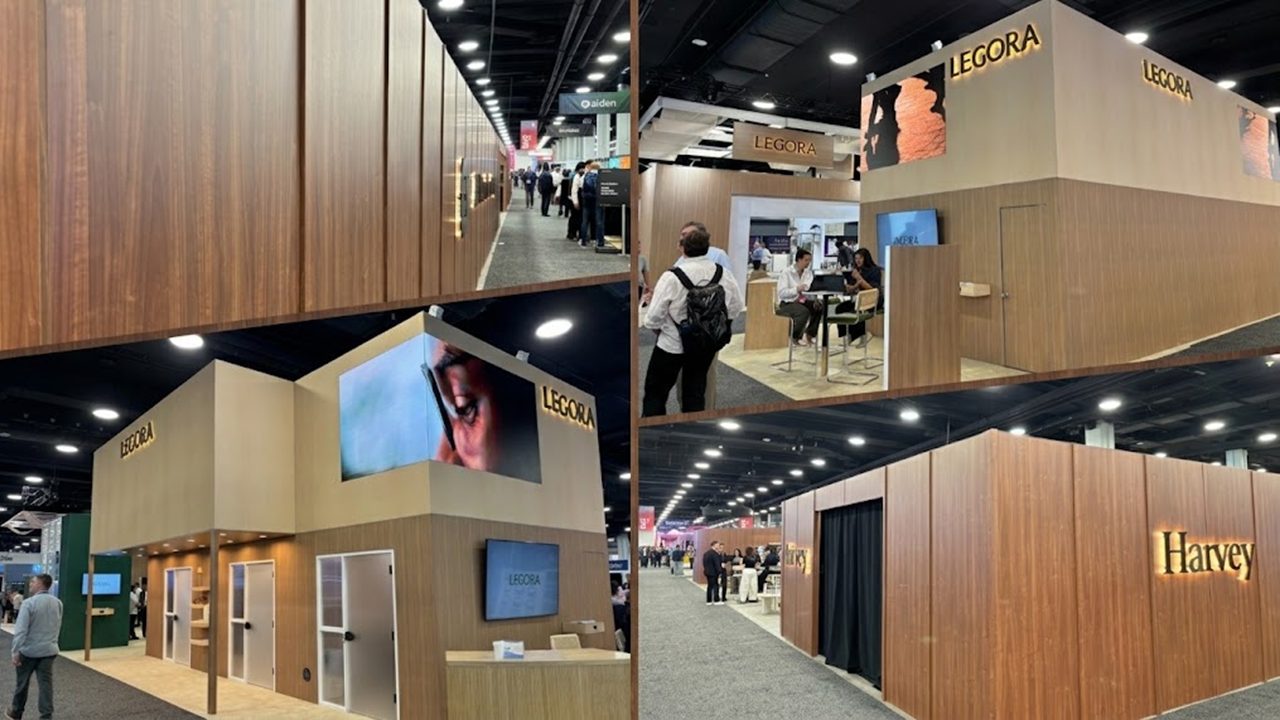
The Harvey and Legora booths, courtesy of Sarah Glassmeyer, director of data curation at Legaltechnology Hub.
Legora’s also had stark exterior walls, but was taller and more cube-like in its shape. I could not help but think that the look both companies were going for was best described as 1960s Berlin Wall.
If you did not know that Harvey and Legora had raised tons of money and achieved valuations in the billions of dollars, their parties might have clued you in. Both had big-name celebrities as performers – Lady A at Harvey’s party and Sheryl Crow at Legora’s party. Legora took over an entire building and transformed it into a one-night-only pop-up bar called the Outlawyer in honor of Nashville’s 1970s “outlaw” musicians. It even had its own branded beer and bourbon.

Sheryl Crow performs at Legora’s party held at a pop-up called The Outlawyer.
Thomson Reuters, whose CoCounsel is a Harvey and Legora competitor, also a big name country group at its party, Little Big Town.
All week, a common point of conversation and speculation was just how much Legora had to pay to get Cheryl Crow at its party. Guesses I heard ranged from $50,000 to $1 million. For what it’s worth, Perplexity says a company would have to budget $300,000-$500,000 to have Crow perform at a private corporate event, but that the fee could be as low as $150,000.
The big booths and the big parties had some attendees bemoaning the obscenity of such over-the-top and unnecessary spending. My own thoughts had me harkening back to a piece I wrote in 2024 about what I described as the legal tech justice gap – the gaping funding gap between those who are developing technology to better meet the legal needs of low-income Americans and those who are developing legal tech to serve large law firms and corporate legal departments.
When some legal tech companies have so much money that they do not know what to do with it, and other legal tech companies are struggling to raise capital to help needy individuals get access to legal help and legal resources, then this industry is horribly out of kilter.
What I wrote in that previous article – which was about the contrast between the glitz of Legalweek and the relative austerity of the Legal Services Corporation’s Innovations in Technology Conference – applies equally to many of the vendors I saw this week in Nashville: “If the legal tech sector reflected at Legalweek contributed more to the sector reflected at ITC, perhaps that imbalance could be offset, at least slightly, and the justice gap narrowed, even just a bit.”
Howdy Pardners
If there was a theme among the products and vendors this year, it was partnerships and integrations. Suddenly, it seems, everyone is friends with everyone else, and everyone is MCP-ing, API-ing, or otherwise integrating with everyone else. If I’d had a drink everytime someone said “ecosystem,” I would never have survived the week.
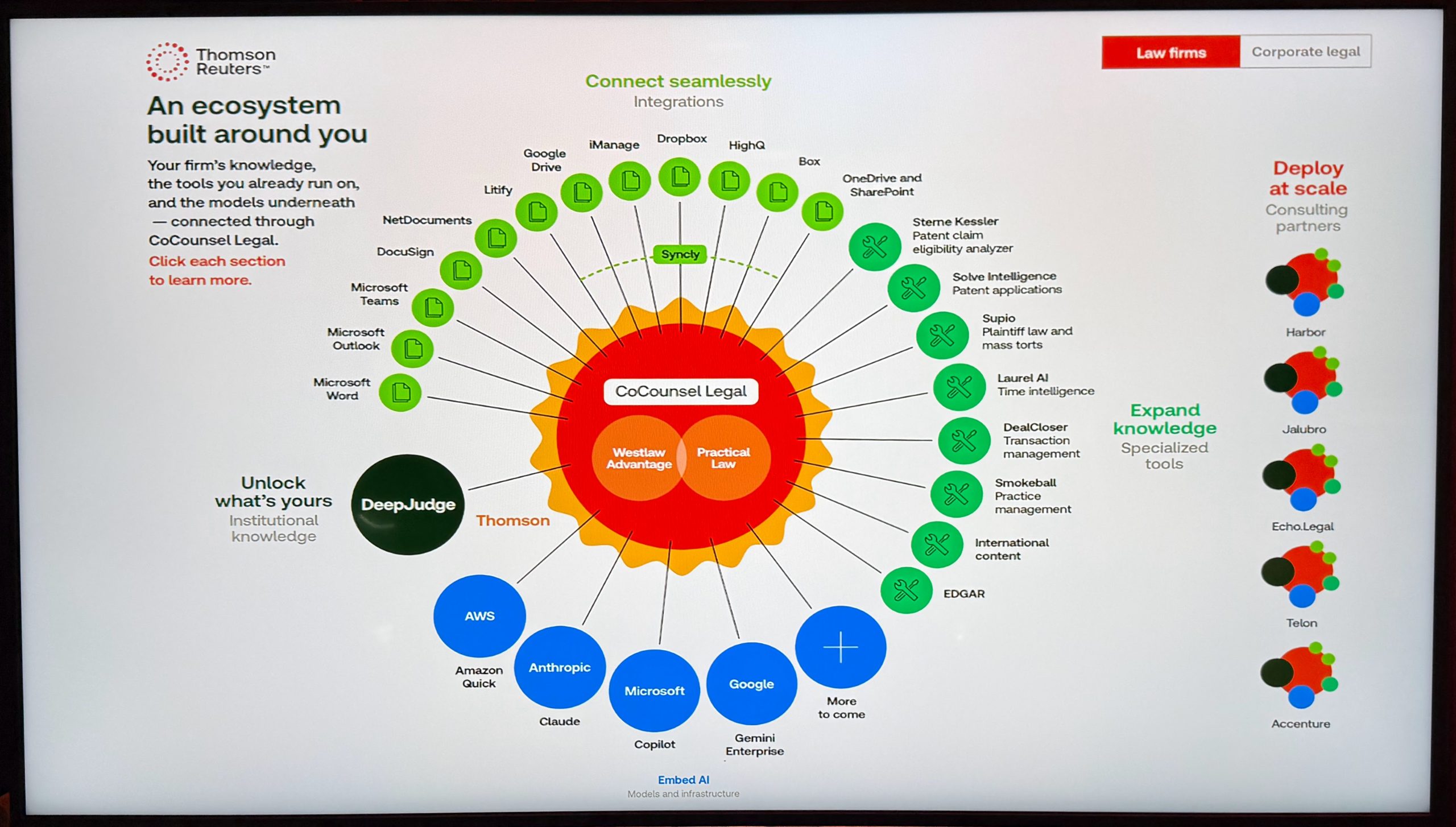
This graphic shown by Thomson Reuters at a media briefing illustrates the point. And the TR execs at the briefing said that graphic will be out of date in a matter of months, if not weeks.
Two factors are driving this. One is the need for better data to drive better AI. The other is the desire by vendors to meet lawyers where they work. An interesting theme at ILTACON was how often the answer to that “where they work” question turned out to be Anthropic’s Claude CoWork.
Optimism, Enthusiasm, Excitement
So, if ILTACON was marked by conspicuous spending – and, as a corollary, conspicuous consumption by larger firms – it was also marked by something else that was bigger this year, and that was electricity.
We are, indeed, at peak legal tech, and never has this industry been more energized, more vibrant. The excitement around legal tech right now is almost palpable – and that excitement seems to span everyone in the industry, from newcomers to veterans.
Dare I say it, but legal tech feels fun again. As much as people were at ILTACON to learn and share, they were there to have fun. And they seemed to be doing exactly that, not just at the over-the-top after-hours parties, but even just walking around the exhibit hall or mingling in the sometimes-confusing corridors of the Gaylord.
It also felt as if ILTACON’s attendees skewed distinctly younger this year. I have no numbers to back that up, but I know I was not alone in sensing that. Assuming I am correct in that perception, I attribute it, at least in part, to the hiring that is going on. Think of all the people hired in the last year just by Harvey and Legora, and then look across so many fast-growing companies, not to mention law firms rapidly expanding their innovation and IT staffs.
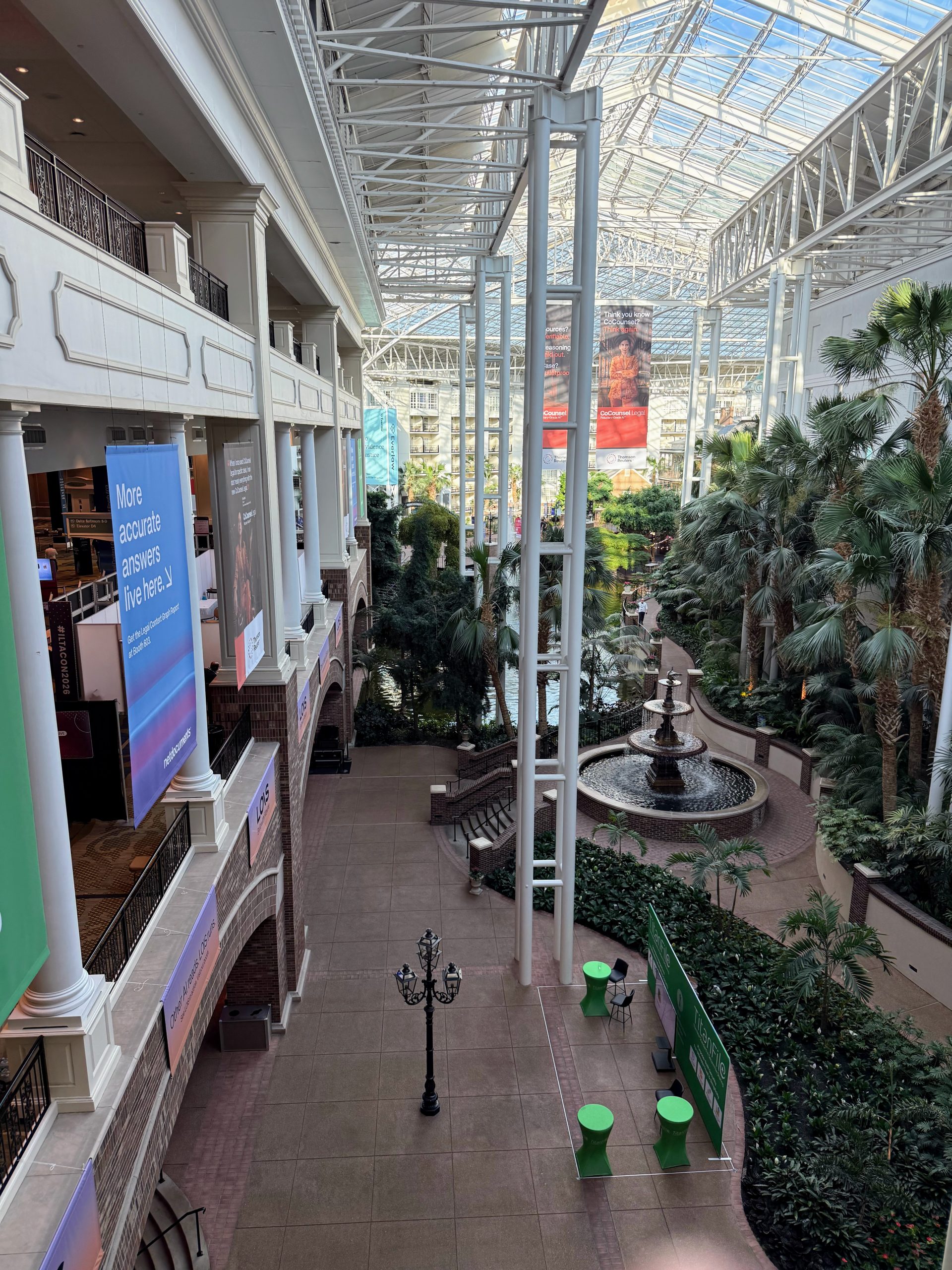
The Gaylord provides a lush setting for a conference.
Perhaps because the optimism, the enthusiasm, the excitement, were all so palpable this year – almost contagious this year – people seemed even to have warmed up to the Gaylord. Consider that this is a hotel I previously trashed as “a sprawling, byzantine facility that appears to have been designed by a team inspired by the drawings of graphic artist MC Escher.”
But as we have seen other conferences move into large, industrial convention facilities – ABA Techshow, ClioCon and Legalweek, I’m looking at you – the Gaylord, with its lush tropical greenhouses and indoor waterways, felt refreshingly pleasant to be in, even if its layout continues to confound even those who have been there multiple times.
That, by the way, is a good thing, because ILTACON will be back at the Nashville Gaylord next year.
Is It All A Bubble?
It would seem, then, that all of the grandiosity and energy of this year’s ILTACON substantiates that CEO’s observation. Yes, we have achieved peak legal tech.
But that also, of course, begs the question: Where do we go from here?
If this is the peak, then will next year’s ILTACON reach even greater heights? Will ILTACON be even larger? Will Harvey’s and Legora’s booths be even more ostentatious? Will some fledgling startup have taken off by then and surpassed them all?
Or are we about to begin a descent, or, even worse, a free fall? Is the bubble about to burst?
Yes, there has never been a more exciting time in legal tech. But there has also never been a more uncertain one.
From what I hear, many large firms are hedging their bets. They are not buying Harvey instead of Legora, or Legora instead of CoCounsel. They are buying them all. If one fails, they still have another.
Unfortunately, mid-sized and smaller firms do not have the luxury of hedging their bets across product groups. They are having to make hard choices about which products to invest in. As the market grows more volatile, those choices will be either prescient or disastrous.
I, for one, do not think the bubble will burst between this year’s ILTACON and next year’s. In fact, I do not think we have even reached the ultimate peak. More likely than a burst, I think, is a realignment, a correction, a normalization.
Vendors will come and go. Some will thrive, some will fail, and some will be gobbled up by others. But more will keep coming than will be going, and legal tech, as an industry, will continue to grow, because the legal profession is durable and essential and is not going anywhere, and legal professionals will continue to need the tools and capabilities that legal tech provides.