 Robert Ambrogi Blog


R&D & AI INNOVATION
The AI Productivity Inflection
How the Agentic PDLC Accelerated Delivery and Drove AI Adoption
R&D performance, Q1 FY2025 through Q2 FY2026
By Greg Ingino, Chief Technology Officer, Litera
Eighteen months ago, I walked out of an Hg conference in Silicon Valley knowing that how we built software was about to change completely. We had just seen a demo of Cognition’s Devin, the AI coding agent, and what followed has been one of the most exciting stretches of my career as a CTO, enabling teams to build software at an unprecedented pace.
Today we’re shipping AI products that are adding value to our customers faster than we could ever have imagined. Lito, our award-winning Legal AI agent, went from idea to a shipping MVP in six months, and monthly active users are up roughly 300% quarter over quarter. Litera One, the platform it anchors, is up roughly 100% and tracking at 91% of its end-of-quarter target. We’ve accelerated our pace of delivering highly requested capabilities ahead of industry timelines, and we’re shipping nearly twice as many releases each quarter, with fewer defects along the way.
What’s made this possible is a new generation of how we build: an Agentic PDLC that has fundamentally changed the speed at which an idea becomes something our customers can use. This is the outcome of a deliberate transformation in how we build software.
We knew we needed to transform how we think about the future of engineering at Litera and needed to do it immediately. Six months after that conference, with the early returns of AI-assisted engineering already in hand, we set a deliberate goal: double the productivity of our R&D organization within 12 months and I’m happy to say we hit that 12-month goal less than one year later. Putting that number on the record for our teams was uncomfortable, and there were stretches where we were not sure we would make it, but we did through championing change and rewarding teams for their adoption of the technology. Looking across the full period, output per engineer has grown roughly 3x and we are seeing velocity gains up to 8x and beyond without a sign of plateau yet. We expect to double again with our new Agentic PDLC initiative which has been driven by moving the Mates into the hands of our engineering managers, who now own more of the lifecycle directly, which cleared bottlenecks and put accountability where the work happens. What follows is an unfiltered look at what this shift has meant for our product and our organization, including the Mates program that automates our software lifecycle from idea to market.
BUSINESS OUTCOMES

VELOCITY AND QUALITY

01 From the Margins to the Majority
A year ago, AI touched a rounding error of the work. In Q1 FY2025, roughly 3% of pull requests carried any AI assistance, and AI accounted for under 10% of the code changed. By Q2 FY2026, those figures had crossed over decisively. AI now assists close to seven in 10 pull requests and contributes more than half of all code changed. Test authorship moved even faster, with QualityMate writing the large majority of new tests by the end of the period.
None of this happened on its own. It took a sustained, deliberate push. We put modern coding agents in the hands of every team, set clear guardrails for review and security so people could trust the output, and made the AI-assisted path the default way work gets done. As part of that bold goal, we required every person in engineering to use AI, which has driven adoption to 100% across the team. We measured adoption team by team, cleared the friction that slowed it, and reinvested the hours it freed into harder problems. We also built our own agents, the Mates, to carry the work through every stage of the lifecycle, which the next section covers in full. The shift below is the product of that work.
The shape of the curve matters as much as the endpoints. Adoption held at low levels through the first half of the year while tooling, guardrails, and developer trust were established, then accelerated sharply once the foundations were in place. The crossover quarter was Q4 FY2025, when AI assistance on pull requests jumped from under 20% to about half. That is what adoption looks like when people have to trust a tool before they rely on it. Once the trust was there, it stuck.
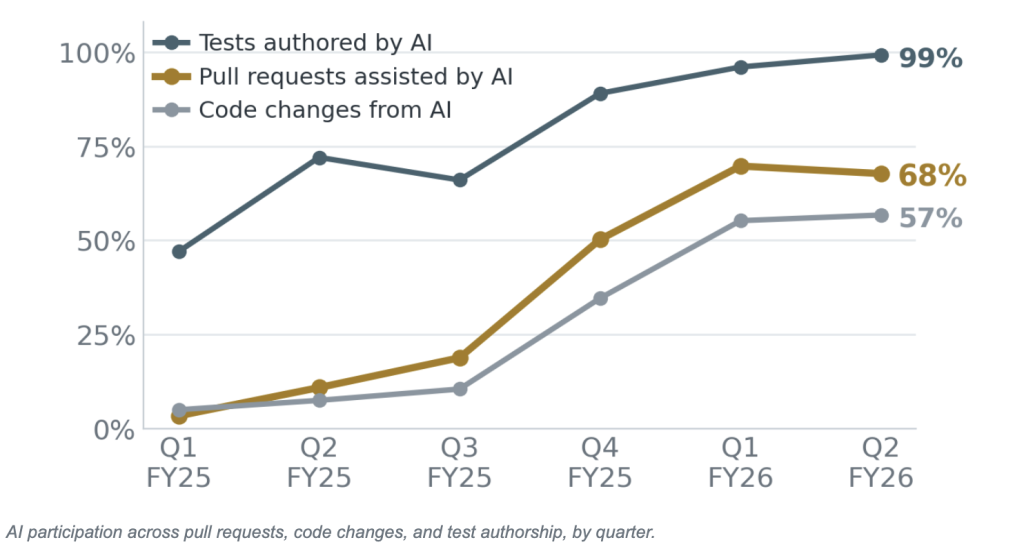

It is worth being precise about what assistance means here. These figures count only pull requests and code where AI materially contributed to the change. The practical effect is that the median engineering task now begins with an AI-generated draft that a human reviews, refines, and owns. The role of the engineer has shifted toward direction, review, and judgment, which is where senior engineering time carries the most value. The sections that follow show how we built the system that makes this the default, and what it produced.
02 The Mates Program: One Orchestrated Pipeline
The numbers in this report come from a deliberate program. We built a system of purpose-built agents, the Mates, with each one owning a stage of the lifecycle, and we orchestrate them end to end through ARGO, our centralized agent orchestration platform. A single layer dispatches each phase and hands work from one stage to the next, so the whole lifecycle runs as one connected system rather than a set of disconnected tools.
The pipeline carries a feature from idea to market. Discovery and definition sit on the product side, the R&D phases run from build through run, and go-to-market is automated as its own first-class phase. Every stage has a named owner, and every agent is grounded in our living, centralized Knowledge Repository, which is built, fueled, and tested hand in hand with the Litera One team. As the build-through-run phases have accelerated, go-to-market has become the part of the lifecycle that most needs the same treatment, and where much of our current attention sits.

The AI-driven lifecycle, idea to market, from Discover through Go-to-Market. Product phases bookend the R&D phases.
The design goal is to remove as many human touchpoints as possible to deliver an entire feature, then automate the sign-offs that remain. It was equally about removing handoffs: in the old model a single dev team passed work through at least four of them, and a team can now run a feature end to end with none. Confidence-scored review agents now stand in for the PRD, pull-request, and deploy sign-offs, and any low-scoring work routes straight back to the right human reviewer. The best way to see the program’s reach is to look at every Mate in production at once.
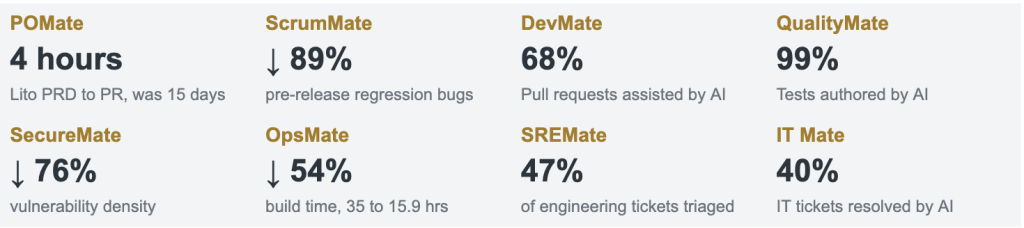
Each Mate in production, headline metric, Q2 FY2026.

02 POMate: From Idea to a Ready Specification
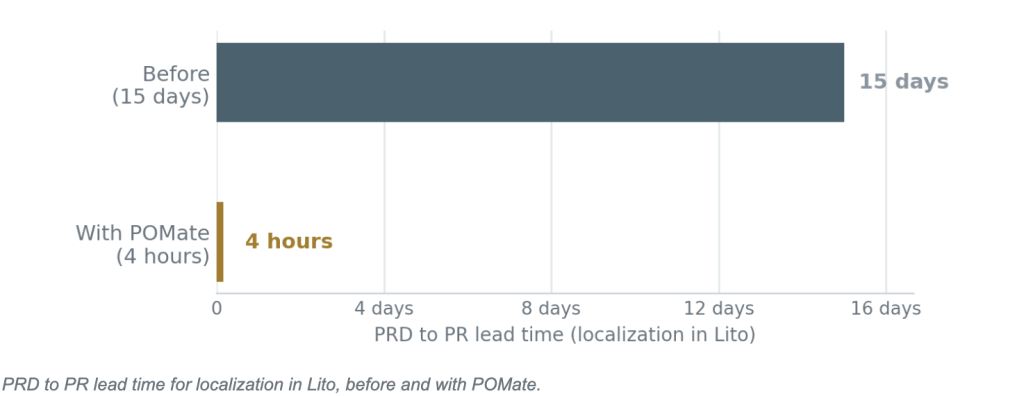
POMate sits at the very front of the pipeline, across Discover and Define, where a product idea becomes a development-ready specification. It automates the path from a raw idea to a finished PRD and into the first pull request, grounded in the centralized Knowledge Repository and orchestrated through ARGO. The work that used to consume the opening weeks of a feature now happens in an afternoon. At its core is the Grill Me skill, which interrogates a raw idea the way a demanding stakeholder would, pressing with pointed questions until the gaps are closed and the inputs are complete enough to generate a rigorous PRD.

POMate shows that the front of the lifecycle can be automated as effectively as the code itself. The Grill Me skill, the PRD generation skills for the Product Spec, Tech Spec, and QE Spec, and a Requirements Readiness pipeline now run end to end, all grounded in the centralized Knowledge Repository, so a specification holds together from the first question through to the pull request. A confidence-scored PRD sign-off agent, built in ARGO, keeps a person on the decisions that matter while routine approvals move on their own.
The effect on how work begins has been profound. Features that once took weeks to specify now reach a development-ready specification in an afternoon, and the first wave of features is already moving through the new pipeline. The frontier from here is extending the same discipline deeper into Define and Build, so the speed we have unlocked at the very front of the lifecycle carries all the way through it.
02 The Agents, and What Each One Drives
Each Mate is built for one job and measured on one outcome. The cards below pair each agent with the metric it moved over the period. Read together, they show automation spread across the lifecycle, with a different agent owning each stage.
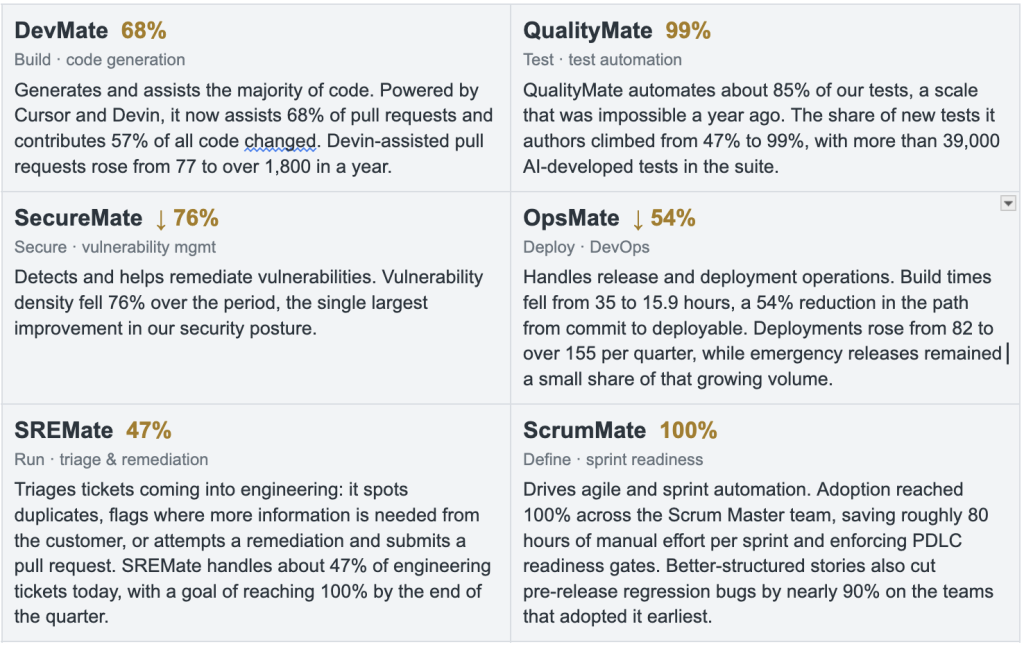

The agents share context and hand work between one another, so a change shaped by POMate, planned with ScrumMate, written with DevMate, tested by QualityMate, and cleared by SecureMate moves through a single connected pipeline. That coordination, more than any individual agent, is what turned isolated time savings into a step change across the whole organization.
03 The Engine: Tools and Scale
Two coding agents do most of the heavy lifting inside DevMate. Cursor carries the bulk of AI-assisted code, with Devin adding autonomous, longer-running work. Together they took AI-assisted code from roughly a tenth of a million lines per quarter to nearly 3 million, and the split shows a healthy mix of interactive assistance and autonomous execution. We chose these two deliberately and committed, going deep enough to build real fluency, even as newer tools and models kept appearing.
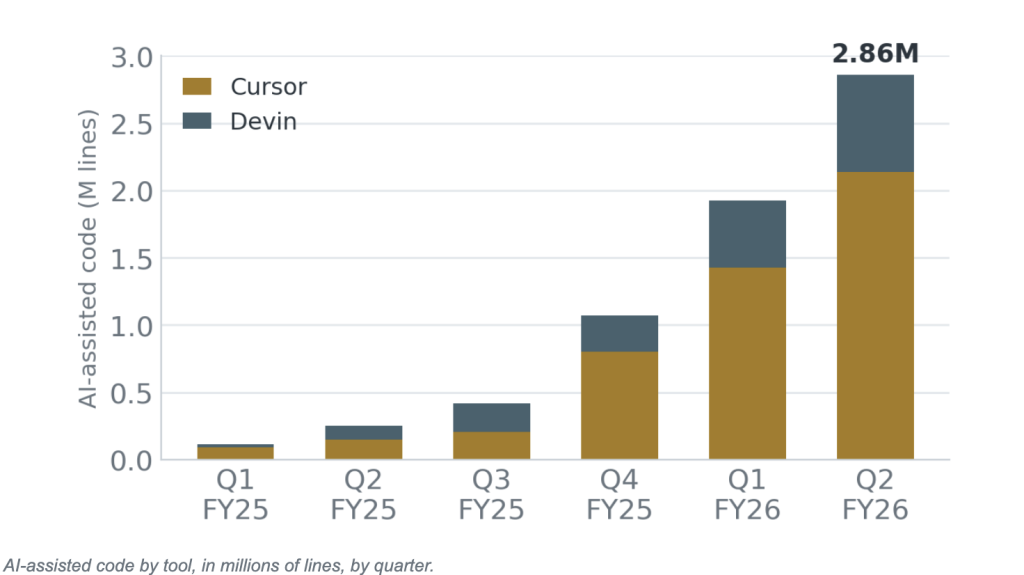
The scale also shows up in raw output. Total code changed across the organization grew from about 2.25 million lines a quarter to about 5 million, with the AI-assisted share rising from a small fraction to the majority, about 57% today. The engine is the combination of these agents working inside a lifecycle built to use them.

04 Output per Engineer Climbed Across the Board
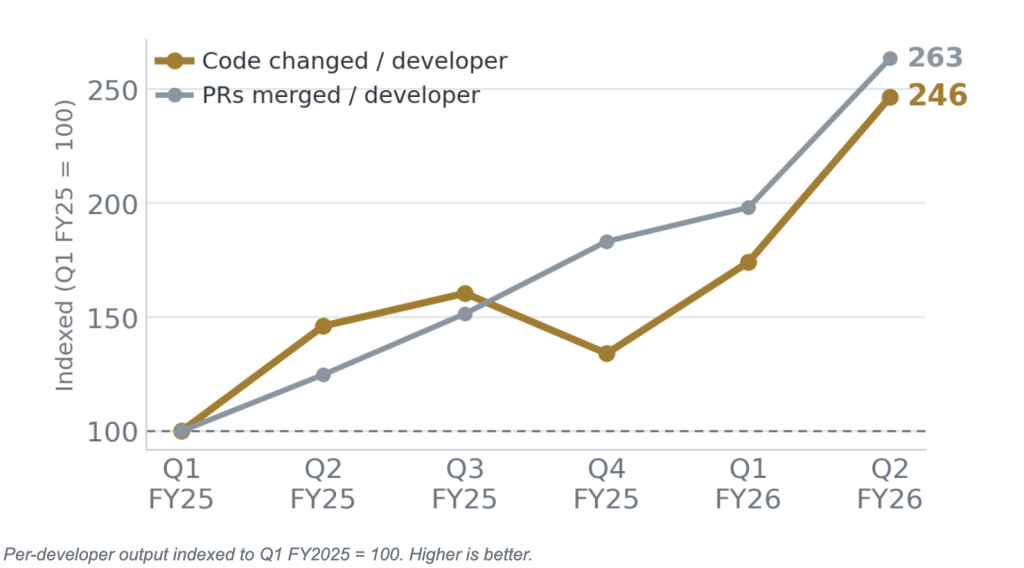
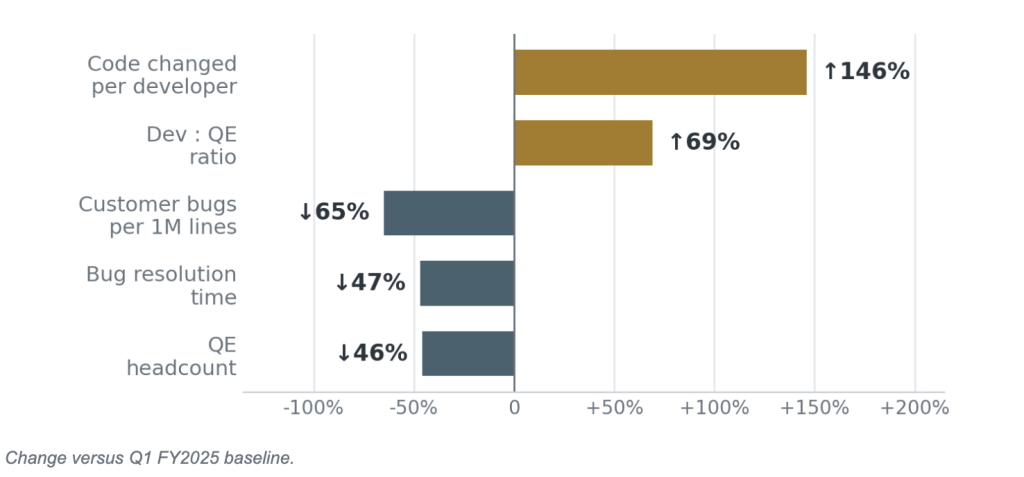
Rising AI usage matters only if it reaches output, and it did. Indexed to the start of the period, code changed per developer grew about two and a half times, reaching 246 on a base of 100. Pull requests merged per developer more than doubled, to 263 on the same base. These are per-person measures, so they isolate genuine productivity at the individual level.
Quarterly Detail
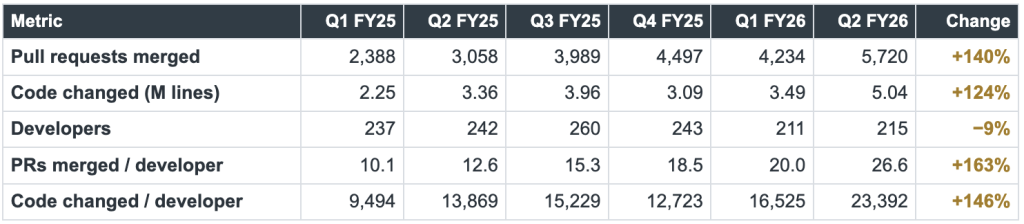
There is a useful nuance in the planning units. Story points completed and completed epics both rose over the period, though far less steeply than code volume and per-developer output. The gains concentrated in throughput and code. The cleanest reading of the table is the gap between two rows: total code changed rose by well over 100% while the developer count fell by roughly a tenth. The organization is producing substantially more with fewer people, and the per-developer figures show this as real leverage at the individual level.
05 Quality and Security Held as Volume Rose
A productivity surge usually raises the risk that quality quietly erodes. Here the data runs the other way. As the volume of code changed rose every quarter, the rate of customer-reported defects per million lines fell by about two thirds. Output and quality moved in opposite directions, which is the result you want and the one that is hardest to achieve. Even in absolute terms, total customer defects have fallen over the period even as deployment volume climbed, the clearest sign that the added velocity has not come at the cost of quality.
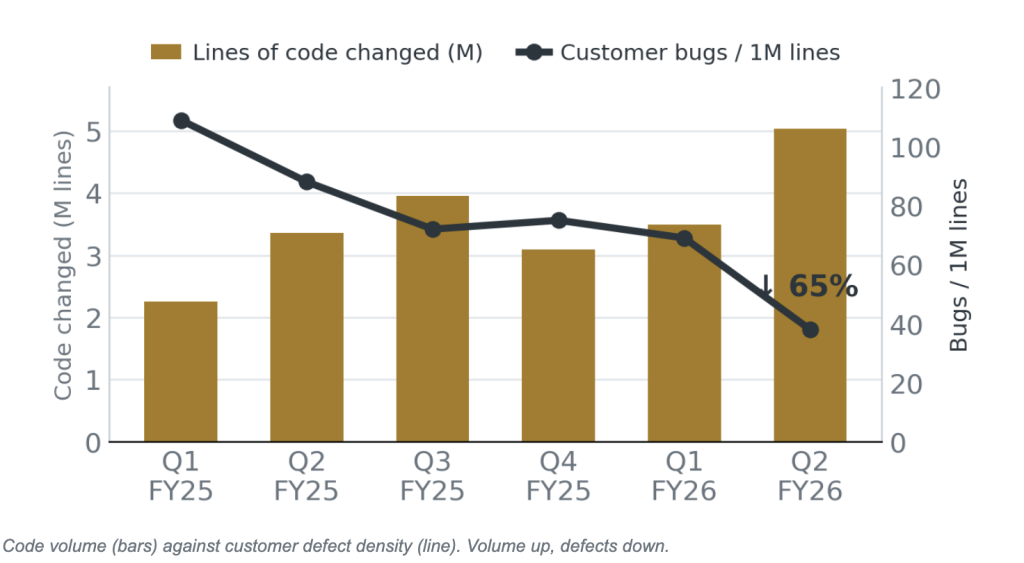
Two mechanisms explain this. QualityMate expanded test coverage faster than humans could have managed alone, so more of the new code arrived with tests attached. And because engineers spend less time producing first drafts, more of their attention goes to reviewing and hardening what the system generates. As QualityMate absorbed the bulk of test creation, we redeployed many of our quality engineers, who were among our highest AI adopters, into other parts of the organization to lead the same transformation there.
The discipline is in keeping the suite healthy as it grows. QualityMate retires stale tests about as fast as it authors new ones, so the total stays close to flat, regression time stays down, and coverage keeps climbing.

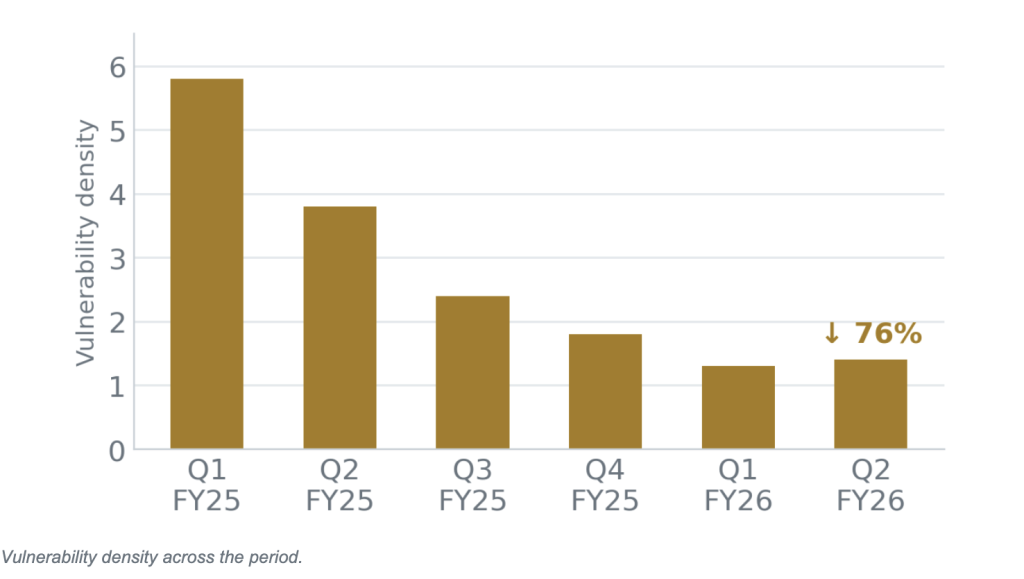
Security followed the same path. Vulnerability density fell by more than three quarters over the period. SecureMate carries much of this load, surfacing and helping remediate issues earlier in the lifecycle where they are cheaper to fix.
06 Faster Response, More Carried per Person
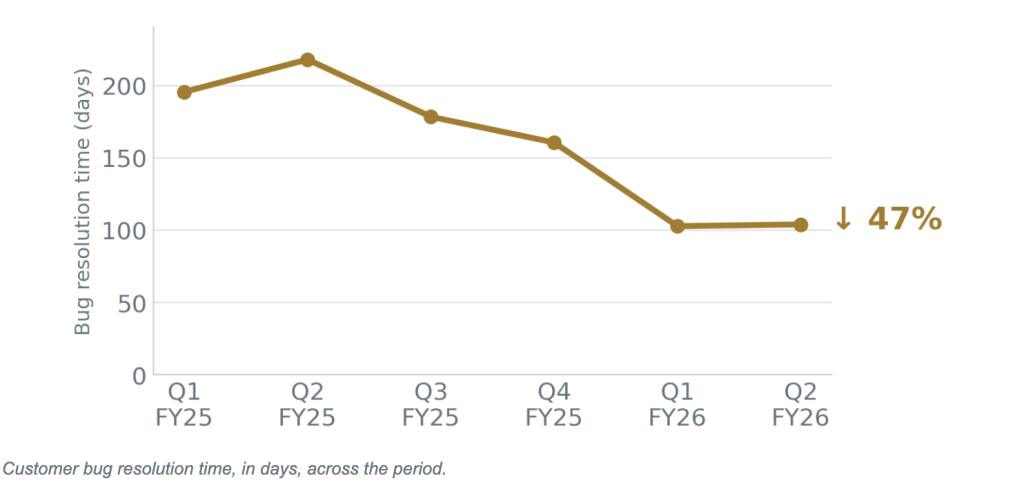
The productivity and quality gains compound into operating leverage. Average customer bug resolution time roughly halved, and the ratio of developers to quality engineers widened as QualityMate absorbed a growing share of test work. Each of these is a measure of how much the team can carry per person. One operational note worth recording: as the pace rises, geographic proximity has become an advantage with teams that build and run a feature sitting close together. This means real time work, adjustments, and issue resolution become more collaborative and faster. This is one interesting finding that higher automation has brought our people closer together.
Set against the Q1 FY2025 baseline, the leverage shows up clearly across the board. Code per developer is the standout, but the operational measures moved just as decisively in the directions that matter, including a 65% drop in customer defect density. Doing more, with better quality, with fewer people is the whole story in a single chart.
07 What We Are Watching
Change at this pace creates real tensions, and it would be dishonest to present only the gains. We are tracking a few items closely, and the most pressing one now sits at the end of the pipeline.
Go-to-Market and the Pace of Change
The speed of release has become its own challenge. We can now ship faster than the organization can absorb, which has pushed the constraint downstream to go-to-market. Every release carries change that has to be learned and enabled across the company, and customers have to be prepared for the volume that is coming. Bringing go-to-market into the automated pipeline as a first-class phase, so enablement and customer readiness move at the speed of delivery, is a current focus.
Human Touchpoints as the Next Bottleneck
With most of the lifecycle automated, the human touchpoints that remain, the reviews and the sign-offs, are becoming the limiting factor on speed. We are developing confidence scoring to clear those touchpoints without sacrificing safety. The aim is to keep firm security and quality gates in place so that anything shipping or being approved still carries the right oversight, while routine work passes through automatically and only the cases that genuinely need a person are routed to one. Finding ways to do this without giving up that oversight is the next unlock for velocity.
The Rising Cost of Consumption
As our use of AI scales, the cost of running it rises, and so far, that cost is well justified by the value we are seeing. The discipline we are building is to weigh each body of work on its own terms, the cost to produce it against the value it returns, and to ask whether a given piece of work should be done at all. That cost-to-value judgment is the next thing to watch.
DevOps Controls and Automation
Moving at this pace only works if the delivery pipeline can keep up. We are watching the maturity of our DevOps automation and the quality and security gates inside it, to be sure the controls that protect the firm scale alongside the speed. The goal is a pipeline where those controls are automated into every release, so velocity and oversight rise together.
Team Sentiment
The early going was hard. The pace of change and the shift in how the organization works asked a great deal of people. As people learned the tools and folded them into their everyday work, however, sentiment rose above where it was before we started this transformation. We keep a close watch on it, because the people doing the work are what give the gains lasting impact.
Customer Defects as Velocity Rises
As we keep increasing velocity, the priority we watch most closely is making sure the number of customer bugs in our deployments does not climb with it. Total customer defects have fallen over the period even as throughput grew and holding that line as we go faster is the goal.
Lead Times at the Planning Edge
R&D and release lead times have held roughly steady. POMate is closing this gap at the front of the lifecycle and extending the same discipline through Define and Build is the next priority.

08 How to Pursue the Same Shift
The approach is portable. If I were starting again in another organization, these are the principles I would hold to.
Set a Bold, Measured Goal and Blow Up the Old Way of Working
Commit to a specific, public, almost impossible target, and align the organization on the few metrics that prove it, why each one matters, and an honest baseline. Reaching it takes more than incremental gains; it means dismantling the old ways of working while the technology is still maturing.
Put Dedicated Owners on It
This does not happen in the gaps of a day job. Stand up a dedicated team with its own learning and development environment and a clear owner for adoption and governance, and push ownership of the Mates to engineering managers, so accountability sits where the work happens.
Build Governance In From the Start
Put governance up front, before the rollout scales. Being late is costly: it slows everything down and puts the firm at risk. Make security, quality, and oversight part of the foundation from day one.
Automate the Entire Lifecycle
Start in a single area, master it, and build out from there. The largest gains came from removing handoffs, so put a named owner on every step from idea to go-to-market and orchestrate them through one layer, until a team can run a feature end to end on its own.
Automate Your DevOps Pipeline, With Gates
Velocity only holds if the pipeline can carry it. Automate the DevOps pipeline so releases move at the pace of the work and build quality and security gates into it so every release earns the right oversight automatically.
Plan Go-to-Market From the Start
Treat go-to-market as a first-class part of the lifecycle from day one. Plan for the internal enablement each release demands and for preparing customers for the change coming, so delivery speed does not outrun the organization’s ability to absorb it.
Pick Your Tools and Get Good at Them
The market ships a better model or tool nearly every week, and the pull to chase each one is real. Teams that flip-flop spend their time evaluating and never build momentum. Pick a small set, commit, and get good at them. We standardized on Cursor and Devin and went deep, and that focus is what let us keep executing while others were still comparing.
Ground Every Agent in Shared Knowledge
A living, centralized knowledge repository is what lets agents hand work to one another without losing context. Build it alongside the product team.
Find Your Champions and Give Room to Explore
Run pilots and ask for volunteers; the champions become obvious fast and show everyone the art of the possible. Give teams room to experiment and permission to fail, so those champions can lead.
Automate the Sign-Offs, Keep Humans on Judgment
Confidence-scored review agents handle routine approvals and route the rest to the right reviewer, so people spend their time where judgment matters.
The trajectory is favorable, and the evidence here points to gains that are durable and compounding. The next phase is consolidation: extending the same discipline to the workflows that are not yet automated, holding quality firm, and bringing go-to-market up to the speed of delivery. A closing thought for anyone taking this on. Design your organization for the velocity it will create from the very start, because the bottleneck moves downstream to learning, enablement, and customer readiness. Build the capacity to absorb change with the same intent you bring to creating it.
Greg Ingino is Chief Technology Officer at Litera.