 Robert Ambrogi Blog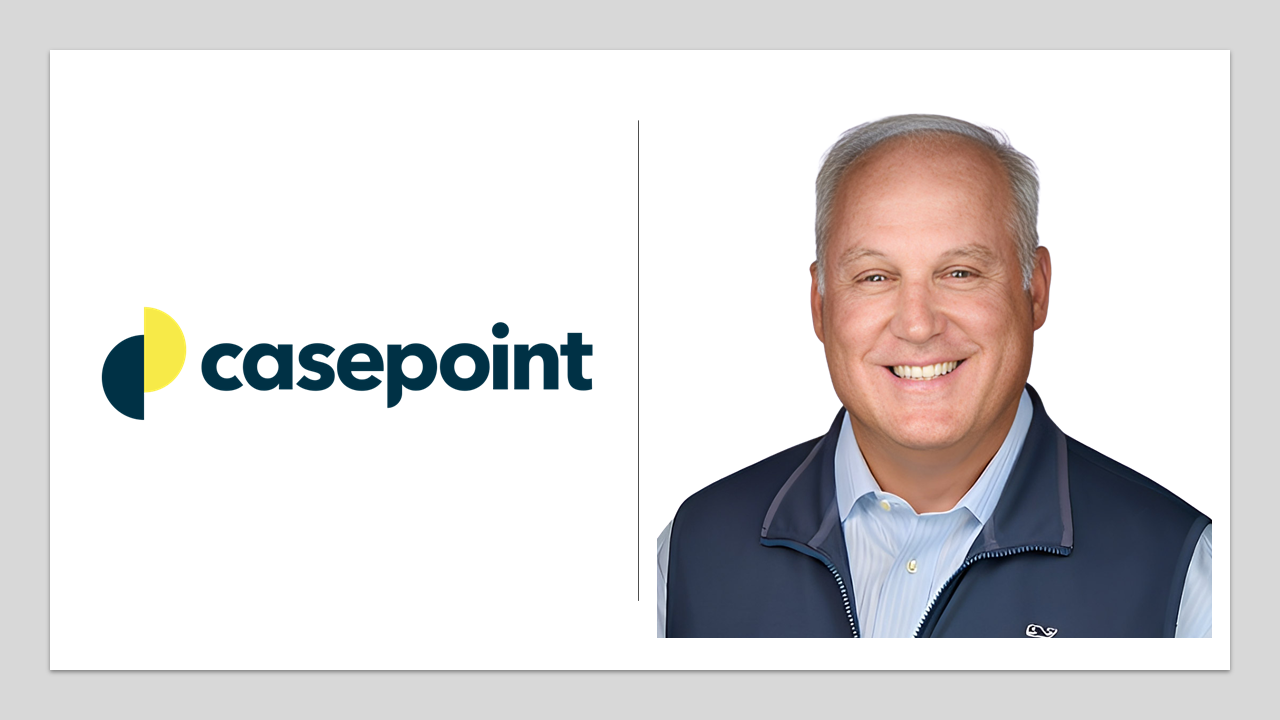


Casepoint has named Paul Colangelo, a longtime government- and enterprise-software executive, as its chief executive officer, the company announced this morning.
He will oversee the company’s continuing integration following its January 2025 acquisition by private-equity firm Thoma Bravo and merger with OPEXUS, as well as the growth of its e-discovery, legal hold, Freedom of Information Act (FOIA), regulatory and compliance products.
That includes investment in agentic AI-powered workflows to help legal, compliance and investigative teams automate repetitive tasks while maintaining appropriate governance, the company said.
Colangelo comes to Casepoint with more than 25 years’ experience running government and enterprise software, data analytics, compliance, and identity-focused businesses.
Most recently, he was founder and CEO of Neumo, a government software company that develops applications for justice, compliance, motor-vehicle, and public-administration agencies.
His experience, the company says, “uniquely positions him to guide Casepoint through the next phase of AI-driven modernization across government and regulated industries.”
The appointment comes 18 months after Thoma Bravo, one of the largest software-focused private-equity firms, took a majority stake in Casepoint and simultaneously merged it with OPEXUS, a Washington-based provider of government process-management and FOIA software that Thoma Bravo acquired from Gemspring Capital.
Immediately following the merger, Haresh Bhungalia, who had been CEO since 2012, left, and the combined company was led until last September by Howard Langsam, who had been CEO of OPEXUS.
Founded in 2008 by brothers Vishal and Vipul Rajpara and bootstrapped for much of its history, Casepoint built its name as a cloud-based e-discovery platform before expanding aggressively into the government sector and, through the OPEXUS merger, deeper into FOIA and case management.
Vishal Rajpara remains the company’s chief technology officer.
Consolidation and Transformation
In the announcement, Colangelo said that he perceives the market as moving away from standalone tools toward unified platforms.
“What I hear from government agencies and regulated enterprises is frustration with fragmented systems, inefficient handoffs, and unnecessary risk,” he said. “The market is moving toward unified solutions and Casepoint is well positioned for that shift.”
Board Chairman Bill McKinzie said Colangelo’s record of “scaling companies, building customer-focused cultures, and delivering transformation made him the clear choice to lead Casepoint into its next chapter.”
In an exclusive advance interview on my LawNext podcast, to be published tomorrow, Colangelo said his most immediate task is finishing the work of stitching the two companies together.
He described his early mandate as “one culture, one team, one dream,” and said that while most operations are now fully integrated and the product is unified across e-discovery, FOIA, and case management, a handful of internal policies remain to be reconciled over the next 30 to 60 days.
His broader job, he said, is to drive alignment around what he called a “value creation plan.”
“My job as the new CEO is to drive alignment right across that organization around what I call a value creation plan — something that really gets an organization aligned around priorities from product to operations to sales to go-to-market to marketing, et cetera.”
Doubling Down on Government
In our interview, I asked Colangelo whether the hiring of a govtech veteran as CEO on the heels of a government-focused merger represents a doubling down on the government sector.
One of the core theses behind the merger, he said, was to expand the company’s total addressable market, and that a major part of that will indeed be to double down on state and local government, where he sees the same demand for FOIA, e-discovery, and case-management tools that the company already serves at the federal level.
“While we are a very strong player in the enterprise market and federal market, we do have state and local customers today,” he said. “So we will be doubling down on the state and local side. The state and local customers have the same needs of FOIA, e-discovery and case management, and so we feel there’s a natural adjacency for us to expand our business into those markets.”
He remains bullish on the government market even amid what has been a turbulent stretch for federal contracting.
Asked whether the DOGE-era climate of contract and staffing cuts made this a risky moment to invest in the sector, Colangelo argued that the opposite is true — that mission-critical government software is, in his words, “DOGE-proof, recession-proof, pandemic-proof,” and that the tailwinds for investors in the space are strong.
Casepoint’s FOIA business has drawn increasing competition of late from other e-discovery companies. Everlaw has built a substantial FOIA customer base, and Relativity recently announced a product specifically for managing FOIA requests.
Given that increasing competition, I asked Colangelo what distinguishes Casepoint, both specifically as to FOIA but also in the broader e-discovery market.
He singled out the company’s employees, who he said have many years of experience in e-discovery on both the government and enterprise sides of the market, and also the company’s agentic AI capabilities, which he said the company is taking “to a whole different level.”
But he put particular emphasis on security and governance. The company says it is the first and only data discovery platform to hold FedRAMP High, Department of Defense Impact Level 5 (IL5), and IL6 authorizations.
For IL6, it says it is one of only six providers worldwide to achieve that, alongside Amazon, Google, Microsoft, Oracle, and Palantir. The company also lists major federal customers, including the “Department of War.”
AI, with Humans in the Loop
With regard to artificial intelligence, Colangelo believes that the technology will accelerate legal and investigative work without displacing professional judgment.
“Many companies are focused on AI, but trust is the real challenge,” he said. “Organizations need AI that operates within secure, governed workflows and enhances human judgment.”
In our interview for LawNext, Colangelo drew a line between the “assisted AI” of search and summarization that he said many competitors now offer, and the agentic workflows he wants to use to set Casepoint apart, in which agentic systems handle repetitive work within governed, auditable workflows.
But he was also emphatic that the technology has limits in legal settings. AI “is not going to take over how legal teams do their jobs,” he said. “It’s going to make them quicker, faster, better, but that human in the loop is going to be the differentiator.”
He also recognizes that there remains tension in the adoption of AI, particularly around pricing. Customers, he said, are pushing for predictable pricing even as the underlying technology runs on variable, token-based consumption, and Casepoint will continue to strive to provide that predictability.
“As you’re dealing with AI and token-based consumption, they’re pushing for more predictability so they can be effective and efficient.”
Organic and Inorganic Growth
As Colangelo looks to the future, he said that he will continue to look at “bolt-on” acquisitions.
“The way we’ll continue to grow will be organically, but also inorganically,” he said. “So there are interesting companies that are in the e-discovery space, in the FOIA space, in the case management space that we’re evaluating.”
Any acquisitions will be “very product centric,” he said.
“We want to map back to the customer journey and we want to make sure that we’re providing them the appropriate tools they need to continue to do their jobs in a very evolving marketplace.”
As for Thoma Bravo’s eventual exit — a fair question for any PE-owned company — Colangelo declined to predict a timeframe. But for the time being, he said, the company is focused on execution and its value creation plan, and that “the rest of that stuff kind of takes care of itself over time.”
On company culture, he praised the founders who built the company and its culture. As noted above, Vishal Rajpara remains CTO and is someone he said he has come to rely on. Vipul Rajpara, though no longer with the business, still offers vision and strategy.
Colangelo said he intends to build on that history while organizing the company around three principles: trust, transparency, and communication.
Colangelo’s full conversation for the LawNext podcast will be published as a podcast episode tomorrow.