 Robert Ambrogi Blog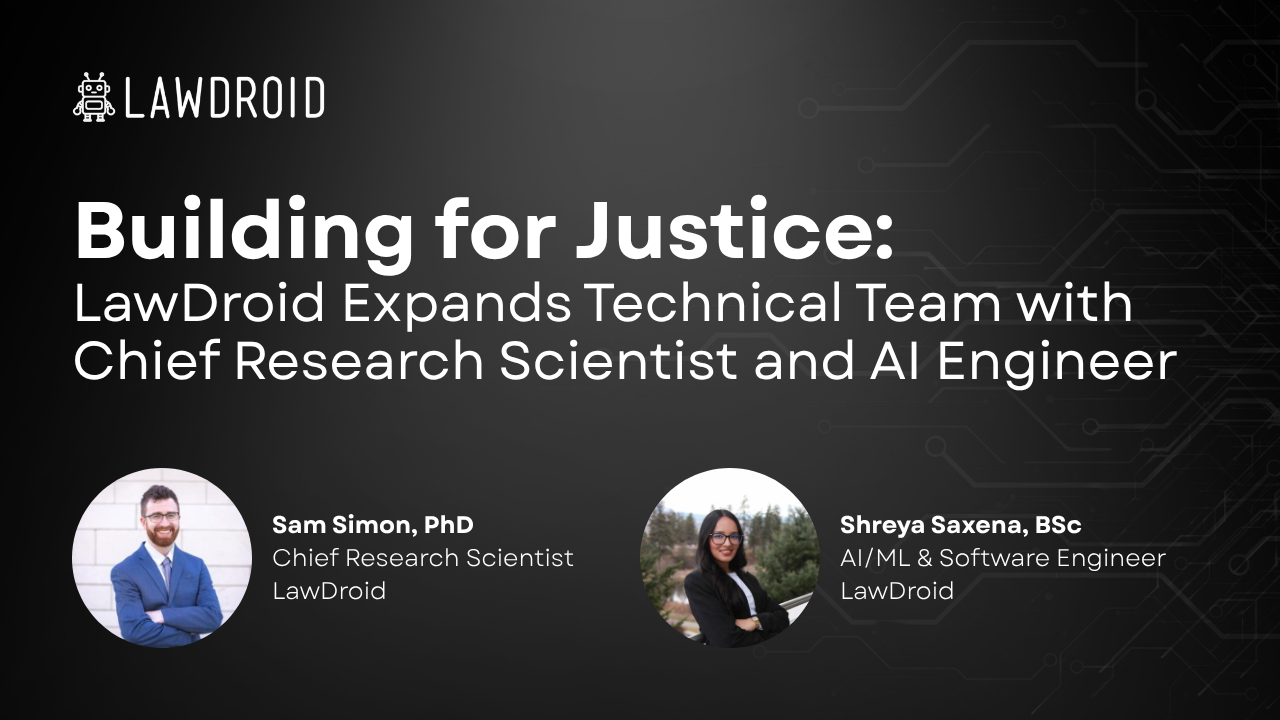


The new appointments reflect LawDroid’s deepening commitment to developing reliable and responsible AI infrastructure for legal aid organizations, court systems, and public-interest legal providers.
VANCOUVER, British Columbia, June 17, 2026 — LawDroid announced the addition of two new members to its technical team: Sam Simon, PhD, as Chief Research Scientist, and Shreya Saxena, BSc, as AI/ML & Software Engineer. These appointments demonstrate LawDroid’s ongoing investment in the people, research, and development required to build AI that truly serves those who need it most.
The need has never been more apparent. According to the Legal Services Corporation’s Justice Gap Report, low-income Americans received little or no legal help for 92% of their civil legal problems. At the same time, the World Justice Project’s 2025 Rule of Law Index ranks the United States 112 out of 143 countries for accessibility and affordability of civil justice—a drop of over 40 places since 2015. Legal aid organizations, court self-help centers, and public-interest legal providers face this reality daily, contending with rising demand, shrinking resources, and increasing pressure to do more with less. For LawDroid, hiring is not separate from this reality, but it is a direct response to it.
“Access to justice is the whole reason the legal system is supposed to exist, and too often we treat it as an afterthought. For ten years we have built for the people that system tends to overlook. Hiring Sam and Shreya is how we make good on that promise at a scale that finally matches the size of the need.” – Tom Martin, CEO and Founder
Sam Simon brings more than a decade of experience at the intersection of machine learning research and real-world application. As Chief Research Scientist, he leads the research and development of advanced mathematical frameworks to ensure the reliability and logical consistency of generative AI systems. His work is central to LawDroid’s mission to build AI infrastructure that legal aid organizations and courts can trust.
Prior to joining LawDroid, Sam led R&D projects in time-series data analysis and Natural Language Processing across diverse domains, including complex network dynamics, orbital mechanics, and financial signal extraction. He holds a PhD and MS in Mathematics from Simon Fraser University and a bachelor’s degree in Mathematics and Physics from Carnegie Mellon University. He has published eight peer-reviewed journal articles and presented at international conferences throughout North America and Europe.
“I’ve spent my career working on hard research problems. Access to justice turns out to be one of the hardest. I’m here because the work at LawDroid contributes to a more equitable society.” — Sam Simon, Chief Research Scientist
Shreya Saxena joins as an AI/ML & Software Engineer, supporting the development of scalable software systems for technology-driven legal services and operational automation. She holds a Bachelor of Science with Honors in Computer Science from the University of British Columbia.
“LawDroid is doing work that means something, for people who don’t always have someone in their corner. The problems are real, and the stakes are high, and that matters to me.” — Shreya Saxena, AI/ML & Software Engineer
LawDroid’s AI research and development is supported in part by the National Research Council of Canada Industrial Research Assistance Program (NRC IRAP), the country’s leading innovation assistance program for small and medium-sized businesses. NRC IRAP provides financial support and advisory services to help Canadian companies develop and commercialize technology.
These new appointments follow a period of active research and open-source contribution at LawDroid. Earlier this month, LawDroid CEO Tom Martin published “A2JRAG: Process-Aware Retrieval-Augmented Generation for Public Legal Information Systems,” a research paper co-authored with Scheree Gilchrist, Chief Innovation Officer at Legal Aid of North Carolina. The paper explores how AI systems can provide not only accurate legal information but also information appropriate to a person’s specific stage in the legal process. LawDroid also recently released the Legal Aid Plugin, a free, open-source tool for Anthropic’s Claude platform, built specifically for civil legal aid organizations, court self-help programs, and public-interest legal providers. Additional technology launches are planned for the second half of this year.
LawDroid has spent a decade partnering with organizations on the front lines of access to justice. These appointments are the latest expression of that same work. For LawDroid, the work continues.
About LawDroid
LawDroid is a justice tech company powering AI solutions for legal aid organizations, court systems, and government agencies, helping expand access to justice through responsible AI, open technology, and innovation. Widely known for generative AI, voice agents, legal information assistants, client intake, document automation, and implementation consulting, LawDroid enables justice-focused organizations to serve more people with limited resources while guiding communities from legal problems to actionable solutions.
LawDroid also contributes to the broader access-to-justice community through open-source tools like the Legal Aid Plugin and research initiatives like A2JRAG, designed to expand the reach of legal AI to organizations and people most often overlooked by mainstream legal technology. For more than 10 years, LawDroid has partnered with organizations on the front lines of access to justice, helping expand impact and empower underserved communities across the United States.
###
Media Contact:
David Gray
Director, Business & Strategy
david@lawdroid.com