 Robert Ambrogi Blog


While much of the AI development in legal tech focuses on the practice of law — research, drafting, document review and the like — Centerbase, the practice management platform for midsized law firms, is releasing a new AI feature that focuses on the business of law.
Today, the company is announcing the limited release of Centerbase IQ, an AI-powered natural language chat tool embedded directly within the Centerbase platform that enables managing partners and firm administrators to ask questions about firm performance in plain language and get quick, visual, citation-backed answers drawn from the billing, financial, matter, and productivity data already housed in Centerbase.
The company is debuting the product this week at the 2026 Association of Legal Administrators Annual Conference & Expo in National Harbor, Md.
For many firm leaders, getting answers about firm performance still means submitting a report request, waiting for it to be built, and then receiving information that may already be outdated. Centerbase IQ is designed to eliminate that cycle.
“Managing partners should not need a help ticket to understand how their firm is performing,” said Michael Dunn, CEO of Centerbase, in a statement.
In a pre-release demonstration last week, Rob Joyner, senior vice president of business development, framed the launch in the context of Centerbase’s broader evolution. The company’s first act, he said, was building the core system of record — billing, accounting, and practice management. Its second act, which I wrote about last month, has been connecting AI-powered tools such as NetDocuments’ ndMAX into Centerbase workflows to create what Joyner calls a “fluid data layer” for midsized firms.
Centerbase IQ represents the third act, putting an intelligence layer on top of that data so firms can make sense of it through natural conversation rather than static reports.
“A lot of the agentic AI that you’re talking about is really focused on the practice of law,” Joyner told me. “Centerbase IQ is agentic AI built around the business of law.”
How It Works
During the live demo, Scott Cormier, Centerbase’s chief product officer, showed me how the interface works. Users can either type or speak questions in natural language, or start from pre-configured “kickstarter” questions organized by categories such as financial health, matter status, intake pipeline, billing methods, and more.
The system responds with a combination of narrative text, embedded tables, and charts — including line, bar, and pie charts — along with citations showing the source records behind each answer. A right-side panel displays the full set of data sources used for any given response, and users can export tables and visuals or continue asking follow-up questions in a threaded conversation.
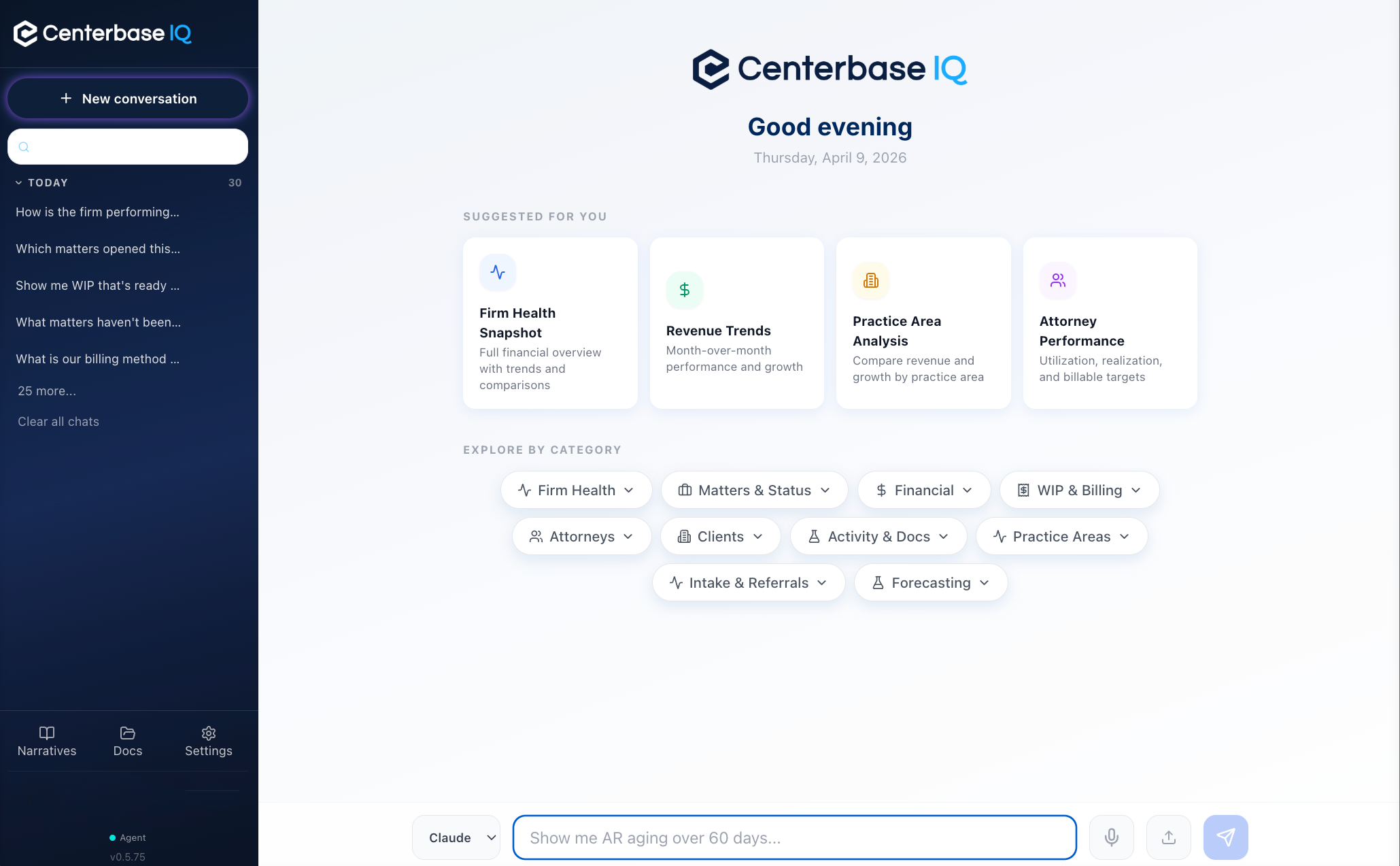
Cormier demonstrated queries ranging from broad financial overviews to specific operational questions, such as identifying trends in flat-fee arrangements or determining which timekeepers logged the most hours in a given month. Each response included proactive insights — observations and recommendations generated alongside the raw data.
The tool draws on more than 20 data entities within Centerbase, spanning matters, clients, attorneys, billing entries, invoices, payments, documents, calendar events, and more.
Cormier credited Joyner for pushing for the citation capability during the product’s development. Every answer includes the source records behind it, so that managing partners can trace figures back to the underlying data.
“Think of this as almost like a Harvey-like solution for the business of law,” Cormier said. “We want a really high level of trust when they’re looking at this data.”
“AI in legal software has to earn trust before it earns adoption,” Cormier added. “We are not asking firm leaders to trust a black box. We are showing them both the answer and the source.”
Custom Knowledge Base
Another notable feature is the ability for firms to build an internal knowledge base within Centerbase IQ that incorporates their own performance standards and best practices.
For example, if a managing partner asks how associates are tracking against their monthly goals, the system needs to know what those goals are.
Firms can define that context within the knowledge base, ensuring that answers reflect not just raw data but the firm’s own operating benchmarks.
An Initial Pilot Program
Centerbase has launched Centerbase IQ in a pilot program with its customer advisory board, with roughly half a dozen firms expected to be up and running in the initial phase.
The company plans to create a waiting list for other existing customers, and will also be including the capability in new customer deals.
The system currently defaults to Anthropic’s Claude as its underlying AI model, though the interface includes a model selection option. Cormier said the company anticipates offering multiple model choices and potentially allowing firms to use their own API keys.
Looking ahead, Joyner described what he called a “fourth act” for the platform, which will add proactive agentic AI that surfaces stories and insights before users even ask, and then uses Centerbase’s workflow engine to kick off actions automatically — combining agentic AI with human-in-the-loop workflows.
“It’ll be proactive agentic AI that will surface these stories within your firm or different things going on within your firm before you even uncover them,” Joyner said.
The company also envisions extending the data pipeline beyond Centerbase’s own data to include information from strategic partners and integrated systems such as NetDocuments and Billables.
Centerbase is demonstrating Centerbase IQ at the ALA conference at Booth 231. For more information, visit centerbase.com/IQ.