 Robert Ambrogi Blog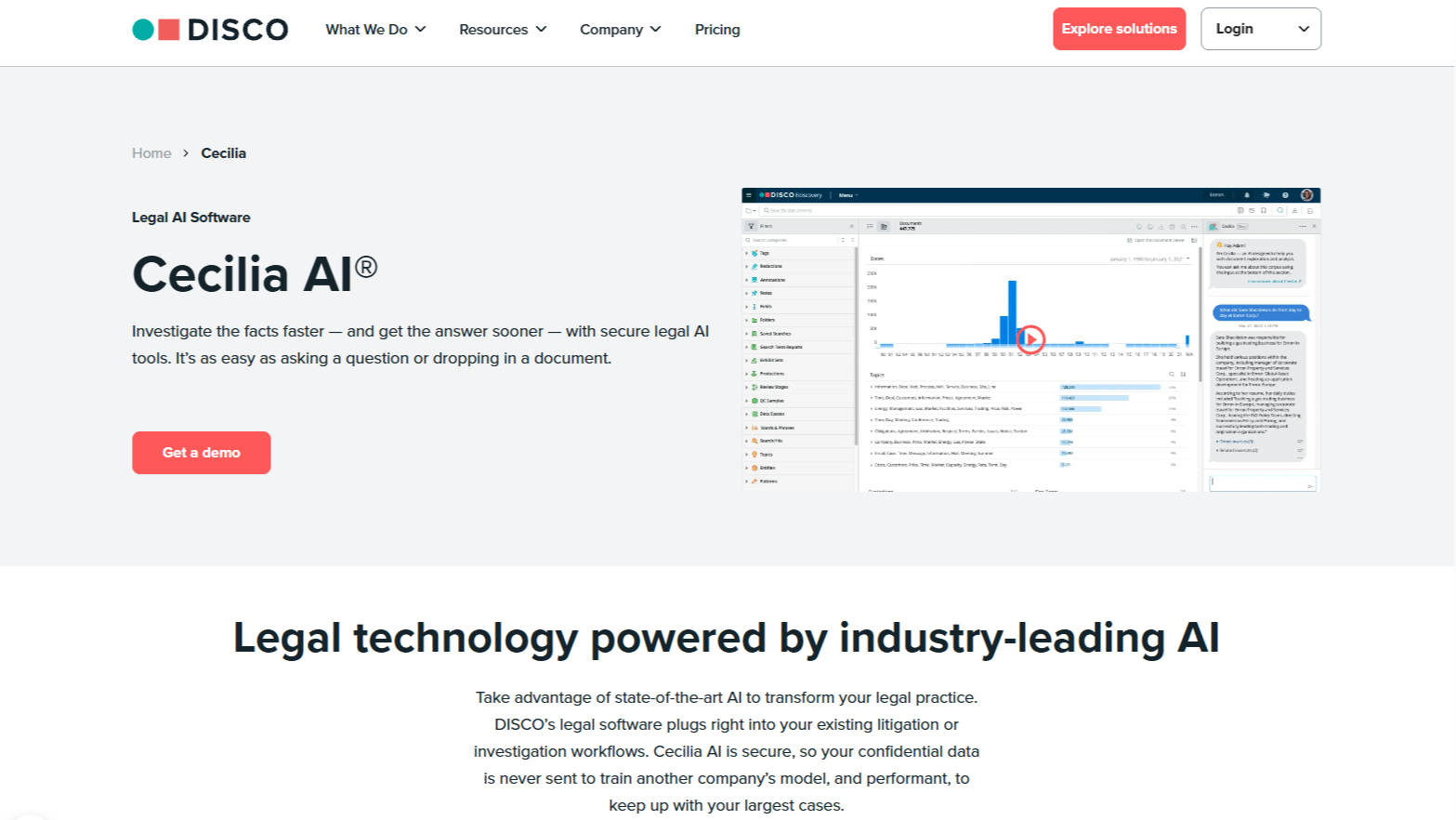


Calling it “the industry’s first scaled agentic AI tool for fact investigation and e-discovery,” DISCO today announced an agentic AI enhancement to its Cecilia Q&A tool, which the company says is designed to handle large-scale e-discovery matters with millions of documents and terabytes of data.
The Austin-based legal technology company’s new tool adds what it describes as an autonomous, multi-step reasoning engine to its existing AI platform. CEO Eric Friedrichsen says the enhancement is intended to provide more detailed analysis and identify nuanced connections in large document sets.
By describing it as “scaled agentic AI,” DISCO is referring to its ability to operate on enterprise-level datasets — the millions of documents and terabytes of data common in major litigation matters. This distinguishes it from agentic AI applications that focus on smaller, more bounded tasks.
Agentic AI generally refers to AI systems that can autonomously break down complex requests into multiple steps, reason through problems, and take actions to complete tasks without requiring human intervention at each stage. In legal tech, many agentic AI applications focus on specific tasks such as contract review, where the AI might analyze a single document, or brief writing, where it works with a defined set of materials.
DISCO’s approach, according to Richard Crum, chief product, technology and strategy officer, is designed for “large, complex workflows” rather than these narrower applications. The distinction is primarily about the volume of data the system can process while maintaining its autonomous reasoning capabilities — handling entire litigation matters rather than individual documents or discrete tasks.
Extending Its Cecilia Platform
Over the past 18 months, DISCO has rolled out several AI-powered tools as part of its Cecilia AI platform. These include Cecilia Q&A, the tool now being enhanced with agentic capabilities, and Cecilia Auto Review, which the company says enables automated document review at speeds of up to 32,000 documents per hour.
The company has also launched Cecilia Definitions for text analysis and was named a G2 2025 award winner in the “Best Legal Software Products” category based on user reviews.
In October 2025, DISCO and Ari Kaplan Advisors released research showing that 72% of legal professionals expect to adopt generative AI within 12 months, with 35% already using it. The study found security concerns to be the top barrier to adoption.
On the partnership front, DISCO announced an expansion of its strategic e-discovery and technology partnership with Mourant, a professional services firm focused on financial services clients.
‘Customer-Centric’ Development
DISCO, which went public in 2021 and trades on the NYSE under the ticker symbol LAW, has been building e-discovery and litigation technology for over a decade. Founded in 2012, the company has positioned itself as a cloud-native platform provider that combines technology with professional services support.
The company has been undergoing a strategic transformation under CEO Eric Friedrichsen, who took over leadership in April 2024. The focus has shifted toward what the company describes as “customer-centric” development targeting high-value, complex litigation matters rather than being a generalist provider.
In its most recent quarterly results for Q3 2025, DISCO reported total revenue of $40.9 million, up 13% year-over-year, with software revenue of $35.2 million, up 17%. The company also reported that customer adoption of its Cecilia AI platform grew by over 300% since September 30, 2024.
Available Later this Year
DISCO says the agentic capabilities it is adding to Cecilia Q&A will be available later in 2026 at no additional cost to customers. The tool is built on DISCO’s cloud-native platform and operates within the company’s existing security and privacy framework.
DISCO will demonstrate the tool at Legalweek and will continue to provide updates on its website, it said.