 Robert Ambrogi Blog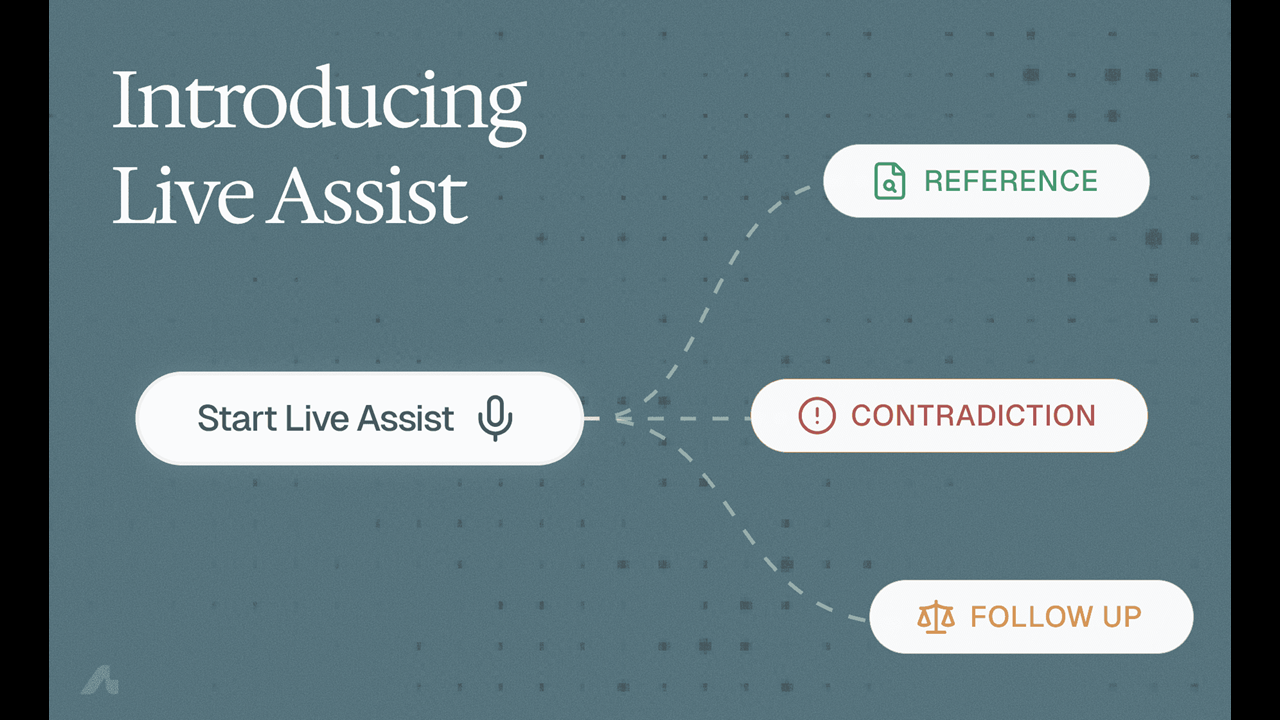


In every deposition, client call or witness prep session, there is an inherent tension. The more focused attorneys are on listening, the less bandwidth they have to simultaneously verify what is being said against the record. Conversely, the more they are mentally cross-referencing documents, the less present they are in what is being said.
August, the legal AI platform I covered in January when it opened self-service access to its legal AI platform for solo and small-firm lawyers, is today launching a feature called Live Assist that aims to dissolve that tension. The idea is to let the AI handle the fact checking, so the attorney can focus on the conversation.
Live Assist joins a legal conversation in progress, transcribes it with speaker labels, and continuously cross-references what is being said against whatever case materials the attorney has uploaded — prior testimony, contracts, email productions, declarations, earlier call transcripts, etc..
When something does not match, a flag appears in a side panel with a citation to the exact source document. Even when the statements are consistent, it provides links to reference documents and suggests follow-up questions. It all happens quietly, without interrupting the attorney’s engagement with the other person.
“Lawyers have always had to choose between being present in a conversation and verifying what’s being said,” said cofounder and CEO Rutvik Rau. “Live Assist means they no longer have to pick one.”
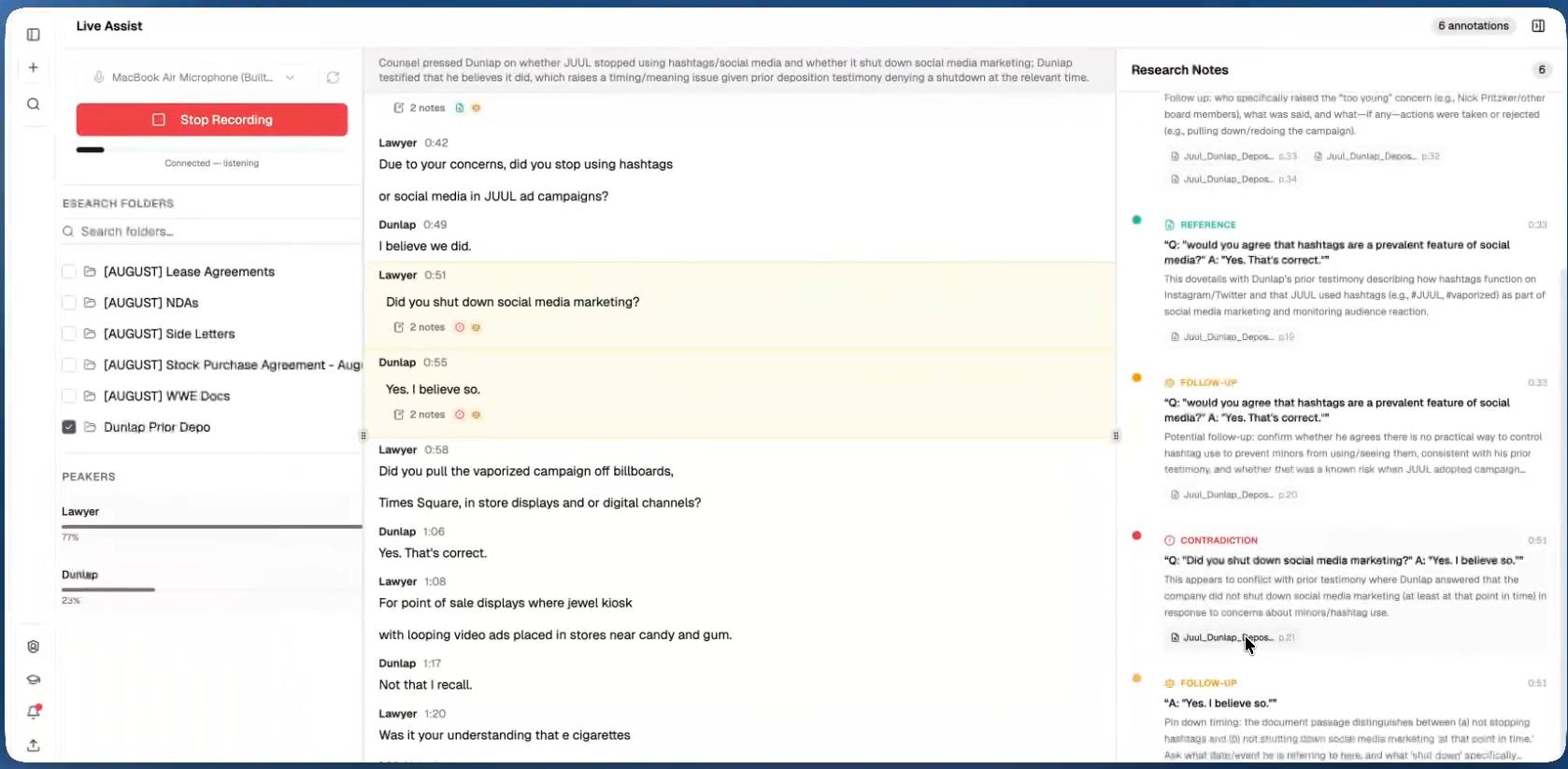
The most obvioius use case for this technology is in a deposition, where the ability to identify when a witness is contradicting prior testimony or statements is the kind of moment that can change a case.
But August sees the feature applying anywhere the spoken word might diverge from the written record — client calls where a story does not quite match the contracts, witness prep sessions where inconsistencies are better caught before trial, or settlement negotiations where terms get mischaracterized and no one notices until later, if at all.
“The issue is not about competence,” the company says. “It is a bandwidth problem. No one can simultaneously listen, strategize and cross-reference hundreds of pages of case materials.”
The application’s passive design is intended to keep it from distracting the attorney. Flags surface without demanding attention, leaving the attorney in control of when and whether to act on them. When the conversation ends, the attorney gets an annotated record of the entire session and where it diverged from the documents.
August says it built the application with attorney-client privilege and work-product protections as core design constraints. All audio is encrypted in transit, logically isolated by customer, and never used to train models.
Live Assist is available immediately to all August users at no additional cost.
The platform, aimed squarely at small and midsized firms that have largely been priced and process-barred out of enterprise legal AI, costs $375 per month or $4,000 annually, with a two-week free trial.
It offers AI capabilities across the legal workflow — from drafting motions and demand letters to due diligence extraction to reviewing contracts with AI-generated playbooks based on their own precedent documents.
The company has raised $7 million in seed funding from New Enterprise Associates, Stanford Law School, and others.