 Robert Ambrogi Blog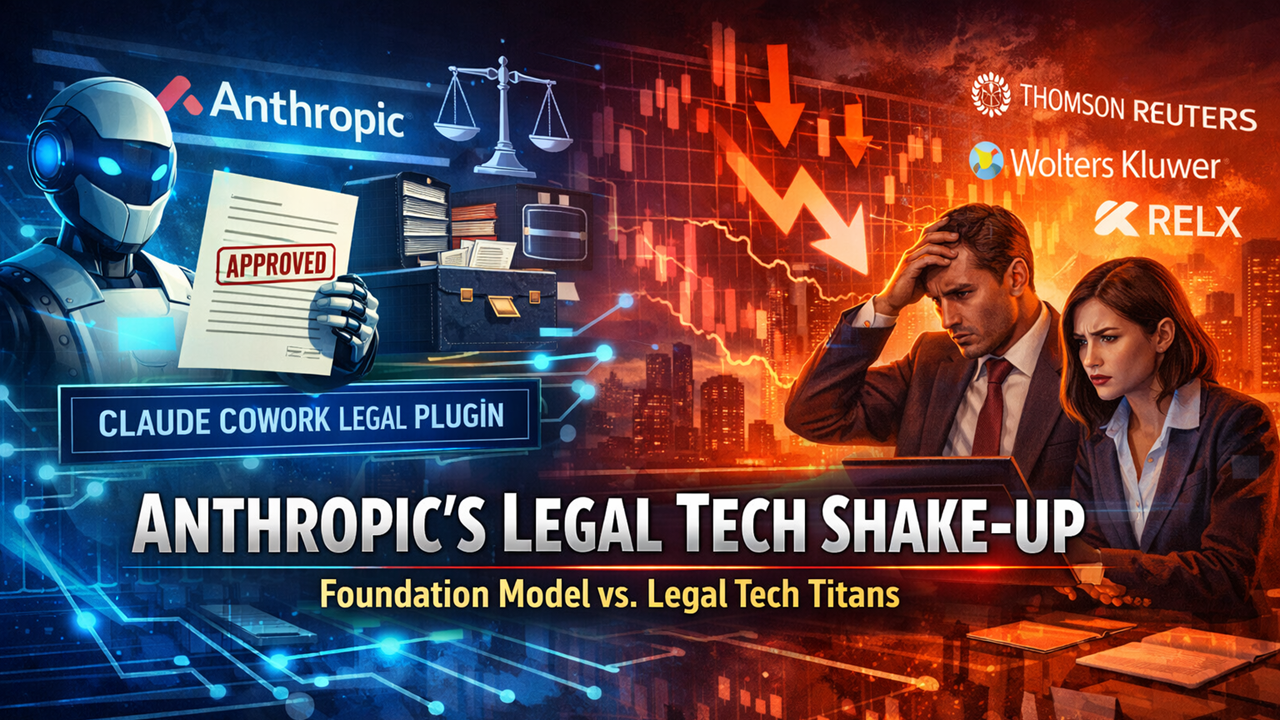


To read today’s news, you’d think it was the shot heard ’round the world — or around the legal tech world, at least.
“Legal software companies have suffered sharp declines in their share prices,” reports The Guardian. “Anthropic’s Move Into Legal, Data Services Sinks Software Stocks,” says Bloomberg. “A selloff in … stocks deepened on Tuesday after new artificial intelligence models raised concerns over the potential impact on sectors once seen as AI beneficiaries,” Reuters reports.
The catalyst of this market panic is a rather simple plugin launched last week on Github by Anthropic, the company behind the artificial intelligence platform Claude.
Two weeks after introducing a new general-purpose “agentic” work mode called Claude Cowork, Anthropic has now rolled out a legal plugin aimed squarely at the legal workflows of in-house counsel, including contract review, NDA triage, compliance checks, briefings and templated responses.
It is configurable to an organization’s own playbook and risk tolerances, and Anthropic explicitly frames it as assistance, not advice, cautioning that outputs should be reviewed by licensed attorneys.
It may sound like just another feature drop in a crowded AI market. But for legal tech, it is landing more like a tsunami than a drop. For the first time, a foundation-model company is packaging a legal workflow product directly into its platform, rather than merely supplying an API to legal-tech vendors.
And the legal tech market is taking notice.
A Plugin for Cowork
If you are not familiar with Cowork, Anthropic launched it Jan. 12 as an extension of Claude Code, a previously released tool designed to be used by developers for coding.
Anthropic positions Cowork as “Claude Code for the rest of your work,” with an interface designed to feel less like chat and more like assigning tasks to a colleague.
You give it access to a folder on your computer, and it can read, edit and create files in that workspace while it plans and executes multi-step tasks.
It runs on your computer and executes work in a virtual machine environment, providing security and ensuring it operates within boundaries you define.
A Suite of Specialized Plugins
What has the legal tech world buzzing is that, on Jan. 30, Anthropic added a suite of plugins to Cowork designed to turn it from a generalist tool to a specialist for specific purposes or functions.
Specifically, Anthropic open-sourced 11 “starter” plugins and published them on GitHub as templates that companies can customize. They cover various tasks such as marketing, finance, customer support and sales — and among them is one for legal.
As TechCrunch summarized it, the idea is to automate specialized departmental work – including legal document review – using agentic workflows, and to let enterprises customize plugins without heavy technical lift.
The Legal Plugin
Anthropic’s legal plugin is, according to the description, designed to “speed up contract review, NDA triage, and compliance workflows for in-house legal teams.” I have not tried it, but, according to Anthropic, it can:
- Review a contract against your playbook: The prompt /review-contract runs a clause-by-clause review against a configured negotiation playbook, returning green/yellow/red flags and redline suggestions.
- Triage incoming NDAs: /triage-nda categorizes incoming NDAs for standard approval, counsel review, or full review.
- Other tasks: Check vendor agreement status with /vendor-check, generate contextual briefings with /brief (daily briefs, topic research, or incident response), and create templated responses for common inquiries like data subject requests and discovery holds with /respond.
“All outputs should be reviewed by licensed attorneys,” Claude cautions.
Unlike using Claude for general-purpose chat, this is closer to an actual workflow product for commercial legal work. In that sense, it treads the same terrain where many legal AI vendors have competed – sometimes by wrapping these very same foundation models with playbooks, clause libraries, redline suggestions and integrations.
The Github page adds that the legal plugin can connect to applications such as Slack, Box, Egnyte, Jira and Microsoft 365. Needless to say, those are all applications common to enterprise legal operations.
Enabled By MCP
Anthropic’s new plugins depend on MCP, or Model Context Protocol, which Anthropic introduced as an open standard for secure, two-way connections between AI tools and external systems and data sources.
For legal teams, MCP forms the bridge from AI that can simply draft text to AI that can draft text within the context of your matters, your documents, and your workflow triggers.
That is where the competitive bar starts to get interesting and where foundation-model vendors can start to look more like platform vendors, at least in legal.
The Legal Tech Market Reacts
Although the plugin may seem like a rather modest application in the scheme of things, its launch has sent shockwaves through the legal market.
An article today in The Guardian, Anthropic’s Launch of AI Legal Tool Hits Shares in European Data Companies, reported that the plugin’s launch resulted in sharp share-price drops among major European data, publishing and information-services companies, alongside a significant decline for Thomson Reuters shares in the U.S.
Reuters and Bloomberg had similar reports, describing the launch as the catalyst for steep declines in companies such as RELX and Wolters Kluwer.
Whether the sell-off was an overreaction is almost beside the point. It underscores the fear among established legal tech vendors that the foundation model companies can now ship targeted workflow automation tools directly into the enterprise – and potentially law firms as well.
A Pivotal Moment for Legal Tech?
One reason this is so potentially significant is that it signals that the foundation models such as Claude and ChatGPT are no longer just “plumbing” underlying legal AI products but rather potential competitors.
Many legal AI vendors have built their products on the “model + wrapper + workflow” model, assuming that the model layer remains a neutral player. But now Anthropic is effectively bundling its own “model + wrapper + workflow” – circumventing the legal vendor and going straight to the customer.
Added to that is the fact that Anthropic is bundling this legal plugin with others for sales, marketing, finance and other enterprise functions. For inhouse legal departments dealing with NDAs and sales contracts, that could translate to an effective and streamlined distribution channel for handling routine agreements from other corporate departments.
Last but not least, Anthropic’s plugin is open source. That means corporate legal ops professionals can customize and build on the plugin to create something tailored to their needs – without waiting for a vendor to build out those features.
None of this eliminates the need for legal tech vendors. But it raises the bar to where wrappers + workflows alone may not be enough.
Is this a major threat to the industry? Well, not yet. It is, however, an opening salvo in what is likely to change the competitive landscape over the next couple of years.
Going forward, the big question might be just how much of an appetite Anthropic or other foundation companies have to compete in the legal tech market with more robust offerings – and how legal AI companies respond.
Meanwhile, legal tech vendors have one ace in the hole that the foundation companies cannot easily replicate, and that is the potent and powerful combination of proprietary datasets and subject-matter expertise.
They have the resources and know-how their customers need — and that legal AI needs. And that gives them the upper hand, at least for now.