 Robert Ambrogi Blog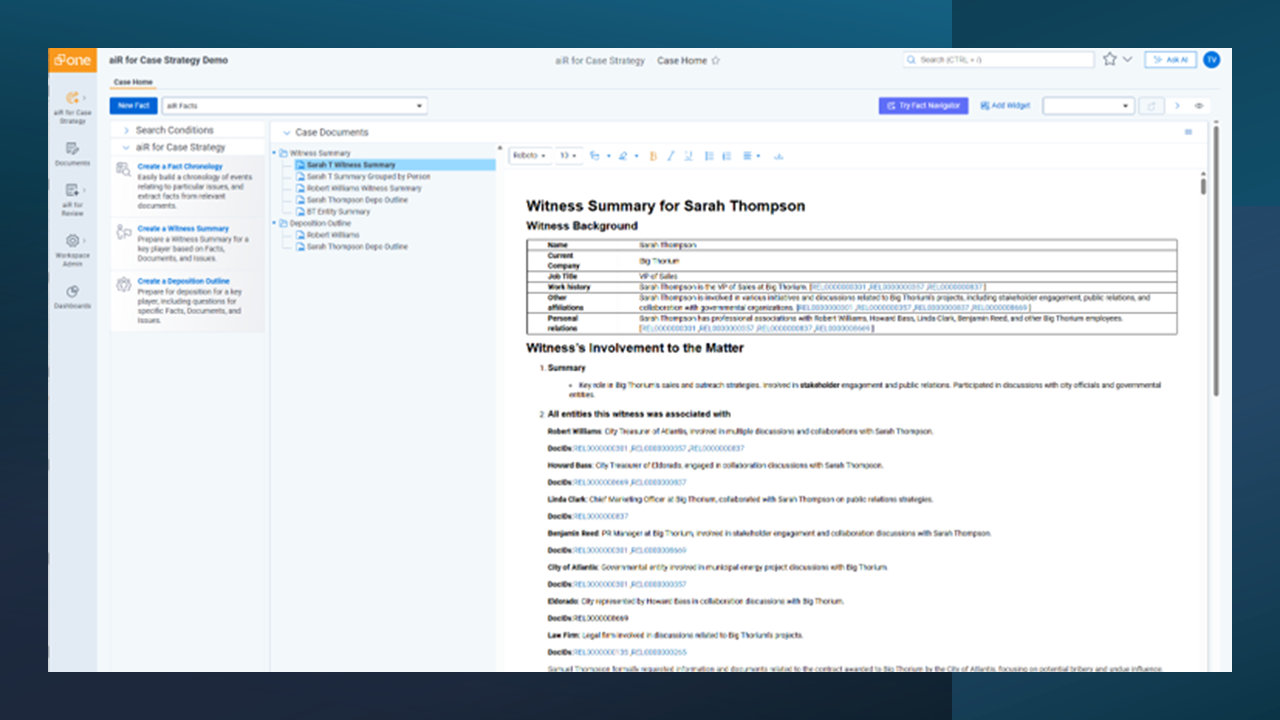


Relativity today announced the general availability of aiR for Case Strategy, a generative AI-powered product designed to help lawyers and litigation professionals develop case narratives faster by automatically extracting facts, building chronologies and generating strategic work product from evidence.
The legal data intelligence company said the tool enables legal teams to auto-extract key facts from documents, visualize fact chronologies, accelerate deposition preparation, and create document, witness and transcript summaries – all within the RelativityOne platform.
More than 50 customers tested aiR for Case Strategy during a limited general availability program that began in March 2025, extracting approximately 600,000 facts through the platform. Early adopters reported being able to pull facts together up to 70% faster than manual processes, with tasks that once took hours now taking minutes, Relativity said.
One of the customers who tested the product, Michael Song, head of GTDocs at Gilbert + Tobin, said it enabled case teams to see the story behind the evidence much earlier in the process, according to information provided by Relativity. “It helps extract and organize facts into timelines so our teams can quickly turn information into actionable insights.”
Another tester, Martha Louks, managing director of Discovery Technology Services at McDermott Will & Emery, said the product dramatically reduced the manual work of extracting facts and building timelines in Relativity.
How the Product Works
Last month, I was given a preview demonstration of aiR for Case Strategy by Relativity’s Jim Witte, director of product management, and Cristin Traylor, senior director of AI transformation and law firm strategy.
At its core, the product uses gen AI to extract what Witte describes as “high quality, nuanced facts at scale” from document sets. Users begin by creating a fact-extraction prompt that includes a matter overview, what they are trying to prove or disprove, and relevant issues in the case.
The system can process up to 5,000 documents per job, Witte said. While some customers are running multiple jobs to analyze larger data sets, Witte said 5,000 documents represents a good set for internal investigations or key document analysis.
For each document where facts are identified, the system extracts several key data points: a primary fact date, a fact name, a fact type, related issues, associated entities (both individuals and organizations), and a document summary. Every extracted fact includes a citation linking back to specific text in the source document.
“This is really meant to ground what we’re extracting in document truth,” Witte said during the demonstration. “If we do not find a match in the document, we’re not going to generate a fact for you.”
Addressing Bias Concerns
One notable feature addresses a common concern with AI-powered legal tools: the risk that prompting the system with a desired outcome could lead to biased results that ignore contradictory evidence.
To counter this, aiR for Case Strategy tags each extracted fact as either “harmful” or “helpful” to the user’s stated case theory, ensuring that potentially damaging evidence surfaces alongside supportive facts.
“We’re fact agnostic in that sense, where we will identify facts that will help prove what you’re trying to prove,” Witte said. “But on the flip side, as we uncover things that are verifiable material to the matter, we’re also tagging them as harmful or helpful.”
The system also scores each fact on a scale of one to four based on its strength and provides a rationale explaining why a particular fact received its score.
Eliminating Duplicate Facts
A recent enhancement addresses the challenge of duplicate or near-duplicate facts appearing across multiple documents. The product automatically identifies exact duplicate facts, semantically similar facts, and what Relativity calls “primary constructed” facts, grouping similar facts from multiple documents together.
This deduplication feature can dramatically reduce the number of facts requiring human review. In one demonstration, a data set that initially produced 650 extracted facts was condensed to just 50 unique primary facts after filtering out duplicates, making the chronology far more manageable to analyze.
New Timeline Visualization
As of the Dec. 12, 2025, date of my demonstration, Relativity had just recently added a timeline visualization feature. It provides a visual representation of facts along a chronological timeline, with the ability to zoom in and out, filter by date ranges, and organize facts into “issue swim lanes,” as Witte called them, for different legal issues.
The timeline view is designed to help legal teams identify gaps or blind spots in the evidence – periods where expected activity did not occur or where the documentary record is thin.
“Why did nothing happen between April and May? That would tip somebody off,” Witte said, explaining how the visual representation can surface investigative leads. “We are looking at different generative AI techniques to be able to do more gap analysis, but this is really just that first start.”
Witness Summaries and Deposition Outlines
Beyond fact extraction, aiR for Case Strategy generates two additional types of strategic documents: comprehensive witness summaries and deposition outlines.
Witness summaries provide what Witte described as “360-degree deep dives” into key individuals, organizing facts and documents by issue and categorizing evidence as harmful or helpful. These summaries include a background section, an analysis of the person’s involvement in the matter, and an issue-by-issue breakdown with live links back to source documents.
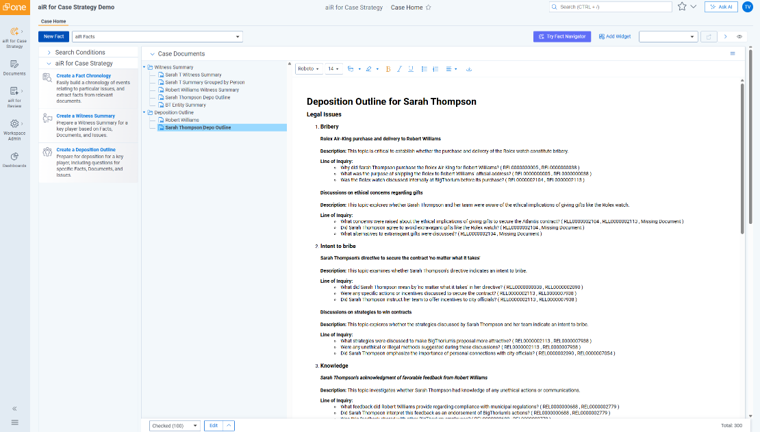
The deposition outline feature generates interview questions grounded in both the documents and the extracted facts. Questions are organized by issue and topic, with citations to relevant documents that could become exhibits.
The product also generates a section on potentially harmful evidence, including questions designed to challenge a witness’s credibility.
All of these documents are editable within RelativityOne using a rich text editor and can be exported to Word format with live links back to the platform maintained.
Traylor, who was formerly a litigator and discovery counsel at McGuireWoods before joining Relativity in 2019, emphasized that the deposition outline is not meant to be a replacement for a lawyer’s legal judgment, but rather a starting point.
“This isn’t like press the button and walk away,” she said. “This is where the lawyer really can bring their value by taking what’s here and then starting to work with it and really tailor it to what they’re going to do in this deposition.”
The feature is also useful in investigations, she said, providing lists of questions that can be used in witness interviews.
‘70% Faster Transcript Review’
Relativity partner Page One, Inc. used aiR for Case Strategy on a fast-paced financial services case involving large volumes of lengthy deposition transcripts. The team needed to review 32 transcripts, each ranging from 200 to 300 pages.
“We went from spending hours per transcript to extracting key facts within minutes,” said Andrew Milauskas, chief operating officer of Page One.
“Our confidence grew quickly once we saw that aiR for Case Strategy consistently surfaced the same core insights we would have found manually.”
The company reported completing the task 70% faster than traditional manual review methods.
Enhanced Transcript Capabilities
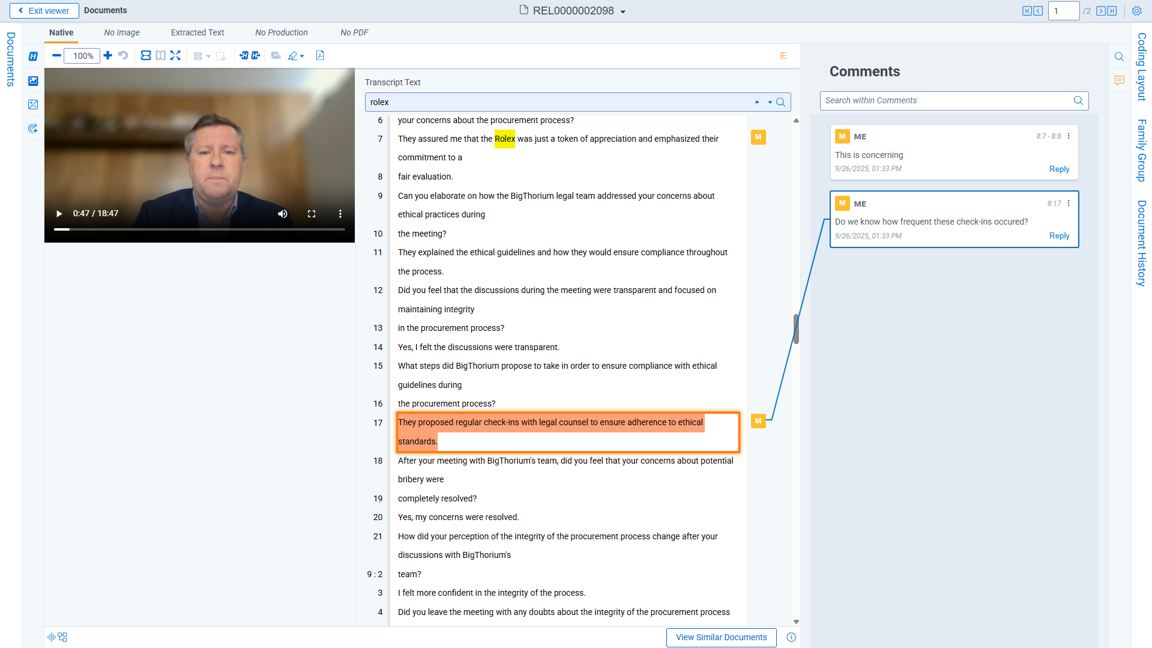
Relativity has also rebuilt its transcript application to work seamlessly with aiR for Case Strategy, adding multi-synced video deposition capabilities that allow users to view depositions spanning multiple days and video files while keeping the video synchronized with the transcript text.
The platform can now automatically generate transcript summaries that include sections on key takeaways, issue analysis, attorney advice, inconsistencies and contradictions, notable moments, and response patterns. These summaries will include live links to specific page and line numbers in the transcript.
Witte indicated that Relativity is working on more robust conflict detection capabilities for 2026, which would allow users to identify inconsistencies not just within a single witness’s testimony, but across multiple depositions or documents over time – a feature that could be particularly valuable for vetting expert witnesses who have testified in multiple matters.
Breaking Down Silos
A key benefit of aiR for Case Strategy, Relativity says, is that it serves as a centralized hub within RelativityOne, enabling case teams to work from a shared repository of case intelligence.
“What we’re seeing now with generative AI tools is tighter overlap across teams, reviewers, case teams, and partners working from the same pool of insights,” said Michael Frankel, counsel at Troutman Pepper Locke. “The silos are breaking down, and everyone can contribute to building the narrative earlier.”
Teams can move directly from document review into crafting their strategic case story and preparing for investigations, witness examinations, depositions, and trial, all within one environment.
Availability and Pricing
aiR for Case Strategy is currently available in the U.S., the U.K., Australia, Canada, Germany, Switzerland, the Netherlands, Ireland, the UAE, Brazil, South Africa, India, Japan, South Korea, Singapore and Hong Kong, with additional markets to be added over time.
The product is projected to launch in RelativityOne Government in the first half of 2026.
Relativity did not disclose pricing for the new offering.
If you are interested in learning more about aiR for Case Strategy, the company will demonstrate it in a webinar on Feb. 19 at 12 p.m. CT.