 Robert Ambrogi Blog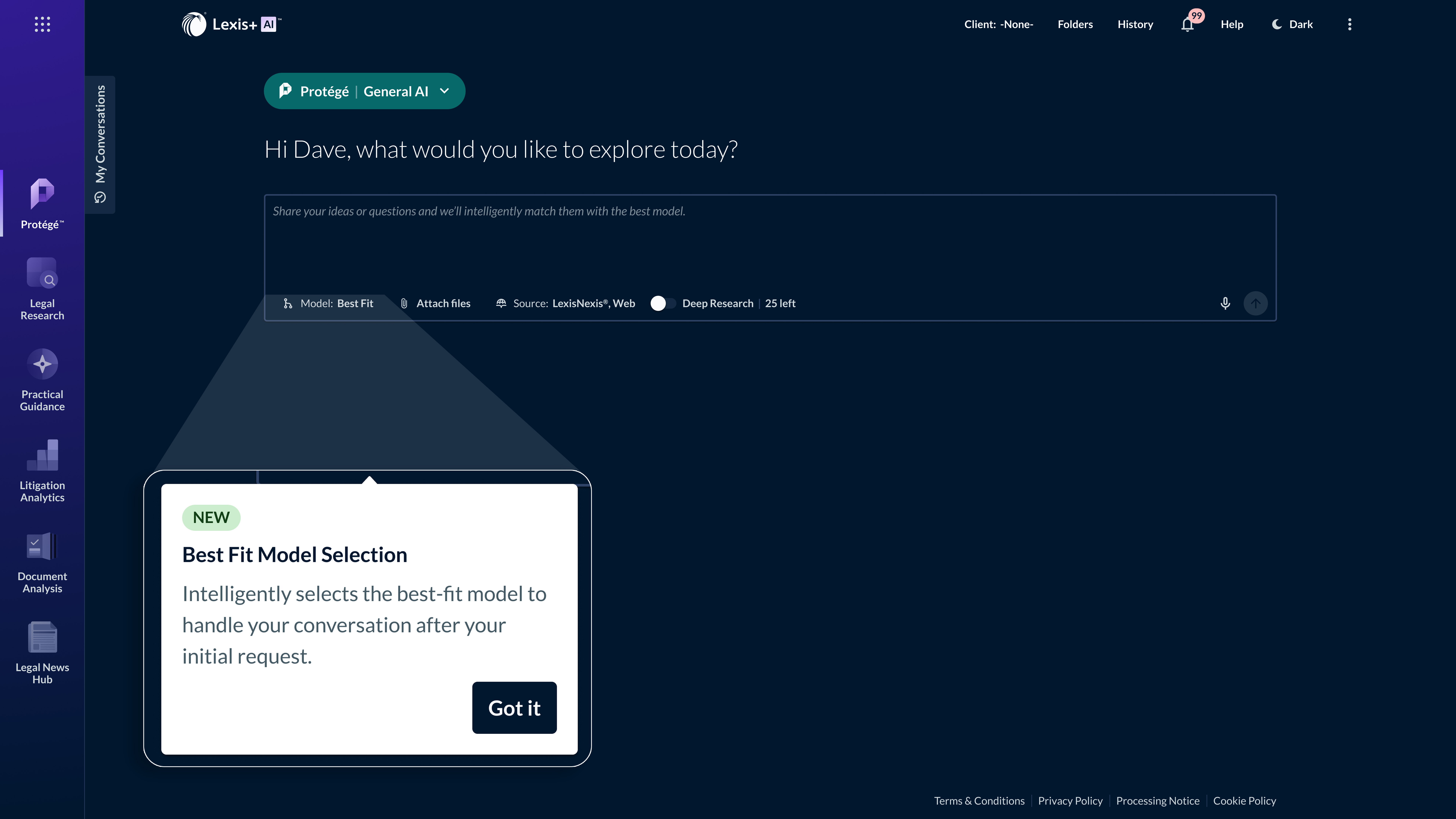


Following the preview release in August and the commercial release in October of its Protégé General AI, LexisNexis Legal & Professional today rolled out what it is calling the product’s next generation, expanding its capabilities to unify authoritative legal content, customer documents and open web insights within a single secure AI workflow environment.
LexisNexis developed Protégé General AI as a way to provide customers with secure access to multiple general-purpose AI models alongside Protégé’s existing legal-specific AI tools. The version unveiled today represents what LexisNexis describes as the most comprehensive integration yet of multiple data sources for legal AI work.
“Legal professionals want one trusted legal AI workflow solution,” said Sean Fitzpatrick, CEO of LexisNexis North America, UK, and Ireland. “Only LexisNexis can bring together agentic intelligence, customer documents, open web insights, and our authoritative content to produce next-level legal drafts and work output backed by Shepard’s.”
The product’s rapid pace of development from August to now also underscores the competitive intensity in the legal AI market, as well as what LexisNexis describes as its commitment to “customer-driven innovation.”
Unified Content Sources
Protégé General AI is designed to work alongside Protégé Legal AI and allow legal professionals to access general AI models within the company’s existing Lexis+ AI workflow.
LexisNexis says this enables users to choose between Protégé Legal AI, which is optimized for authoritative legal AI workflows like legal drafting and analysis, or Protégé General AI, which allows users to perform various tasks using the latest available AI models grounded in web content and LexisNexis content.
The core advancement in this release is Protégé General AI’s ability to easily combine insights from three distinct content sources:
- Customer legal documents uploaded to the system.
- Open web search results.
- LexisNexis’s comprehensive legal content database.
Users retain control over which content sources Protégé draws upon, allowing them to ground responses in all sources or select specific combinations of LexisNexis content, web sources, and their own documents.
Intelligent Model Selection
Another significant enhancement is the introduction of “Best Fit” mode, which automatically selects the optimal AI model for each specific task. Users can also manually choose from an expanded roster of AI models, including:
- Claude Sonnet 4.5 from Anthropic.
- GPT-5.1 from OpenAI.
- Claude Sonnet 4
- GPT-4o
- GPT-5
- OpenAI o3
Anything generated from these models that Protégé General AI recognizes as legal citations are verified and linked through the Shepard’s Citation Agent, providing an additional layer of reliability for legal professionals working with general-purpose AI models.
Enhanced Agentic Capabilities
Behind the scenes, Protégé General AI includes what LexisNexis describes as “a new agentic infrastructure” that enables AI agents to collaborate on complex legal workflows requiring broad understanding from diverse data sources.
The system includes four specialized agents:
- Orchestrator Agent: Coordinates multiple agents working together.
- Legal Research Agent: Decomposes user prompts into legal questions and generates answers based on relevant legal authorities from LexisNexis content.
- Web Search Agent: Brings relevant open web insights into Protégé responses.
- Customer Document Research Agent: Autonomously reasons, plans and uses other research tools to produce analysis based on customers’ own documents.
LexisNexis says this infrastructure extends what it calls “Agentic Retrieval-Augmented Generation (RAG),” which itsays excels at understanding user intent, intelligently planning workflows, and retrieving authoritative information to ensure accurate and grounded AI responses.
Expanded Use Cases
According to LexisNexis, the enhanced Protégé General AI now enables legal professionals to:
- Draft more precise communications for both legal and non-legal audiences, including client emails, matter updates, and plain-language explanations
- Accelerate foundational research with fast overviews of technical concepts and evolving areas such as AI policy and crypto regulation
- Enrich legal work with real-world context by incorporating non-legal sources to strengthen legal strategy and recommendations
- Drive strategic ideation by outlining arguments, testing counterpoints, exploring alternative approaches, and obtaining a second “opinion” from AI
- Break down complex, multi-layered problems across M&A, compliance, multi-party disputes, and emerging regulatory issues
- Securely upload and analyze documents, generating summaries, issue lists, and audience-specific versions across a wider range of formats
The system also now supports Deep Research capabilities and advanced reasoning for high-complexity legal problems, features that users can toggle on or off as needed.
Security and Control
LexisNexis emphasizes that all of this functionality operates within what it describes as a “fully encrypted Lexis+ AI environment” that provides “enterprise-grade data privacy protections for confident access to general purpose models.”
Organizations can disable general AI access entirely for users, and individual users can toggle the feature on or off according to their preferences or firm policies.
The company also highlights a “streamlined interface” that keeps questions, sources, citations, and drafts together for what it describes as “a more efficient, transparent workflow.”
Evolution of Protégé
Today’s announcement represents the latest milestone in the rapid evolution of LexisNexis’s Protégé AI assistant since its initial unveiling in August 2024.
The original Protégé preview, coincidentally launched in August 2024 on the same day as Thomson Reuters’ CoCounsel 2.0, introduced agentic AI capabilities and emphasized personalization based on user profiles and preferences.
It was made generally available in January 2025 with features including autonomous task completion and the ability to review its own work.
In August 2025, LexisNexis launched Protégé General AI in customer preview, allowing users to toggle between legal-specific and general-purpose AI models. That release gave approximately 200 law firms, corporate legal departments and law schools access to models including GPT-5, Claude Sonnet 4, GPT-4o, and OpenAI o3, all within the secure LexisNexis environment.