 Robert Ambrogi Blog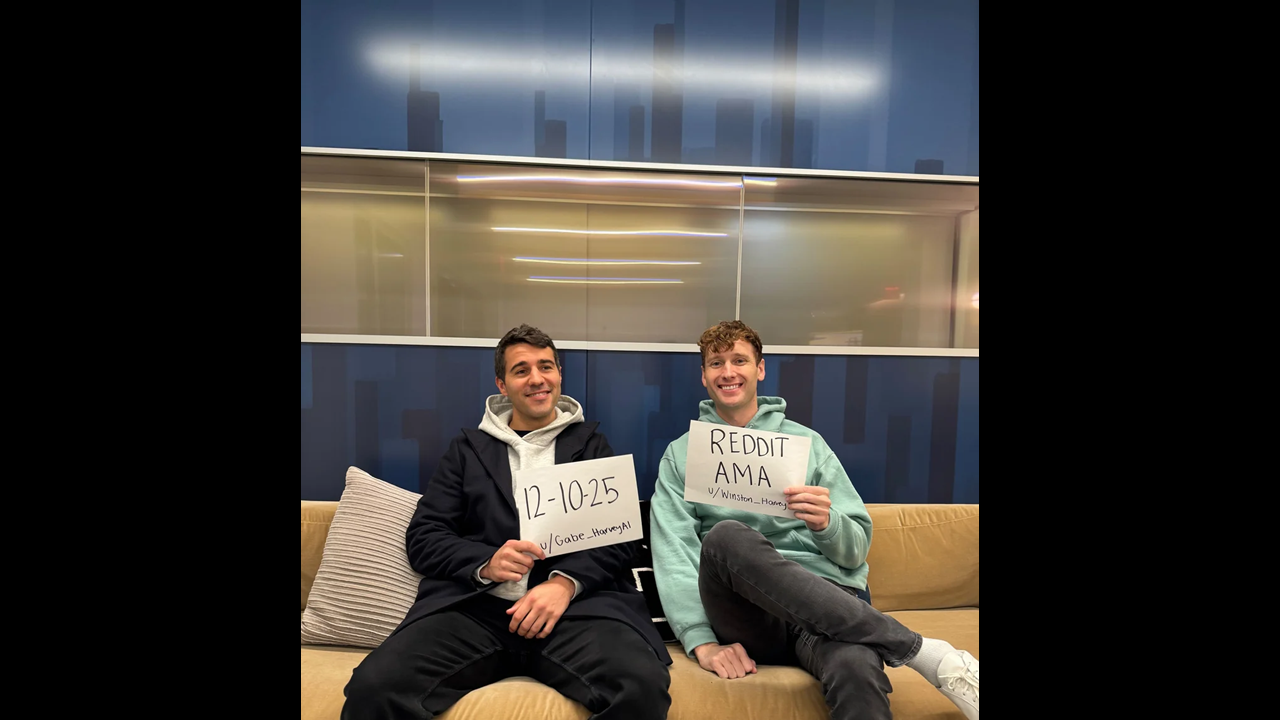


In a rare public forum appearance, Harvey co-founders Winston Weinberg, its CEO, and Gabriel Pereyra, its president, spent over two hours answering questions from the legal tech community in a Reddit AMA earlier today, addressing everything from their $8 billion valuation to how they compete with legal research giants and what the future holds for AI in law.
The AMA — short for “ask me anything” — took place on the subreddit legaltech, which is devoted to discussions of legal technology and innovation. It was the third vendor AMA the subreddit has hosted.
When pressed on his company’s eye-popping $8 billion valuation, Weinberg was notably modest: “We need to earn that valuation everyday.”
He broke down the investment analysis into two components: math and momentum. On the math side, there are approximately 10 million global legal professionals, and Harvey currently serves only single-digit percentage points of them.
On momentum, the company has seen an 81% increase in daily active users as a percentage of monthly active users since launching in 2023, with power users showing engagement levels comparable to Slack or email.
But Weinberg’s longer-term vision reveals the real bet investors are making. Today’s $30 billion legal tech market represents just 3% of the $1 trillion total legal services market.
“The simplest answer here is that the tech penetration into the legal market is going to change massively,” Weinberg said, “and if we build a great product we hopefully capture some of that very large upside.”
Importantly, Weinberg emphasized this is about task automation, not job automation.
He also said he sees plenty of room other legal AI startups.
“I don’t think a single player is going to capture all of the pretty enormous amount of value that will be created in the next 10 years in this space,” he said.
The Lexis Partnership and Competing on Research
Another question addressed Harvey’s competitive position now that it has partnered with LexisNexis. Historically, Harvey sat atop general AI models and firm data, while competitors such as Westlaw CoCounsel and Lexis+ AI were deeply integrated with proprietary legal research databases.
Weinberg called Lexis “an insanely trusted data source” and said customers using both platforms see tremendous value from the integration. The partnership has enabled Harvey to build specialized workflows like drafting motions for summary judgment and motions to dismiss that combine Lexis data with Harvey’s drafting capabilities.
“I think if we can nail these two it’ll be a really cool step change in data+drafting,” Weinberg said. “Hopefully we’ll have some more in the near future!”
When asked specifically how Harvey’s research capabilities compare to Lexis Protégé on complex workflows, the response focused on Harvey driving the research strategy itself – determining which searches to run, analyzing initial results, and deciding what to look for next – rather than simply relying on Lexis to do the heavy lifting.
Product Development Philosophy
About 20% of Harvey’s team are lawyers, and this is intentional, Pereyra said. “Our goal is to build with and for the industry we serve.” Lawyers and engineers work side-by-side on everything from workflow design to evaluating new model performance.
When asked the key to Harvey’s client growth and adoption, Weinberg answered that the three main drivers were:
- Building out very vertical specific workflows and features, with one example being going down to the level of pass-through defenses in pharmaceutical antitrust cases.
- Focusing immensely on security.
- Integrating with current systems to reduce friction for lawyers.
Interestingly, when asked if there was one product decision they would “un-do,” Pereyra said he would revisit their vault product design.
They initially tried to support two very different workflows in the same interface: asking simple questions over hundreds of documents and performing complex review over thousands of contracts. This led to significant scaling challenges that required substantial engineering work to resolve.
The Early Days: Building Trust
Sharing details about Harvey’s early sales approach, Weinberg said the most effective tactic was demonstrating Harvey on specific matters lawyers were actively working on. For litigators, for example, he would pull their latest brief from PACER and have Harvey draft counter-arguments.
“This worked super well with litigators because they like lasered onto the screen reading every word,” he recalled.
It was risky – if the AI hallucinated, lawyers would immediately call it out – but when it worked, they were highly engaged.
For M&A lawyers, he used the same approach with EDGAR filings, though Weinberg noted it worked “not as well as the briefs with litigators.”
The origin story itself is compelling: Weinberg and Pereyra were roommates and best friends in San Diego, never expecting to start a company together. When Pereyra was brainstorming AI assistant ideas with friends from Google Brain, Weinberg suggested, “Why don’t you build a legal assistant?”
They cold-emailed Sam Altman and Jason Kwon (then OpenAI’s general counsel) with the pitch and raised funding before landing any customers.
Addressing the Tough Questions
Participants in the AMA did not shy away from difficult topics. When asked about hallucinations, Pereyra acknowledged that fine-tuning is just one of many techniques they use, including RAG, inline citations, agentic methods and other applied research approaches.
However, he pushed back on the notion that AI needs to be perfect. “One common misconception in legal is that an AI system needs to be 0 hallucinations to be useful. Our experience has been that these systems are incredibly valuable and the rate of hallucinations will continue to decrease.”
When confronted with claims from an alleged former Harvey employee about low user engagement, Weinberg was direct: “It’s unclear to us that that individual actually worked at Harvey at all, but our DAU/MAU and renewal rates would suggest that person has inaccurate and/or outdated information.”
Pereyra added that some early customers now see 80-90% monthly active users with strong weekly and daily engagement.
To the question of why law firm fees are not going down despite efficiency gains from AI, Pereyra said that making individual lawyers more productive does not cleanly map onto making entire matters cheaper, because legal pricing is not about the sum of hours worked but about delivering complete outcomes.
However, he noted that firms and clients are beginning to restructure matters in ways that can be more profitable for firms while providing clearer value for clients. “That’s ultimately our goal.”
However, he believes that, in the long run, both firms and clients stand to benefit.
“Harvey is already enabling discussions where firms and clients restructure matters in ways that are more profitable for the law firm while also providing clearer value and predictability for the client,” Pererya said. “That’s ultimately our goal: to help both sides rethink how legal work is delivered and priced so everyone wins from increased productivity.”
What’s Ahead
Over the course of the AMA, Weinberg and Pereyra revealed some of their plans for the coming year. Among them:
- Support power users. Increase the number of “power users” at firms that are Harvey customers and make it easier for them to learn from one another and teach others.
- Support technical integration. Harvey already provides workflow builders (no-code), APIs, and MCPs (Model Context Protocols) to support firms building custom integrations. However, Pereyra said, “Our goal is to build an extensible platform for lawyers and innovation teams to create custom and proprietary workflows that leverage their and their firms expertise to help their clients.”
- Shared spaces. Weinberg specifically mentioned this client collaboration feature as a major focus, in order to enable firms and their clients to securely share data and work together.
- Access to justice. When asked if Harvey is planning any access to justice programs, Weinberg mentioned their existing A2J program with courts in Singapore and said they are “super committed to this as a North Star for how we scale Harvey.”
- Startup partnerships: Weinberg said that Harvey plans to announce something related to startup partnerships next year, suggesting they are (or will be) open to integrating with emerging legal AI tools.
The Differentiation Question
Perhaps the most pointed question came from a tech-savvy attorney who asked what Harvey can do that Claude Opus 4 cannot. Pereyra outlined what he sees as six key differentiators:
- Better AI for legal through a singular focus on this industry.
- A goal to make entire legal teams (not just individual lawyers) more effective on matters.
- Deep integrations with legal tech ecosystems and internal law firm systems.
- Governance features such as ethical walls that firms and clients require.
- A focus on making law firms more profitable as businesses.
- Client collaboration infrastructure to allow firms and clients to securely share data and collaborate.
Bottom Line
The AMA offered unique insights into a company that has matured significantly since its 2022 launch – but that still faces skepticism about its valuation, competitive moat and real-world impact.
However, it was refreshing to see the co-founders’ willingness to engage with and be transparent around some tough questions, many from actual users.
As I noted here way back in 2024 (an eternity in gen AI years), Harvey had long maintained an air of mystery around the company and the product, even as it quickly began to gain significant traction. As of that point, Weinberg and Pereyra had only rarely given media interviews.
What came through clearly in this AMA is that Harvey is betting on vertical depth rather than horizontal breadth, on workflow orchestration rather than just better models, and on the belief that legal tech penetration will expand dramatically beyond today’s 3% of the total market.
Whether that bet justifies an $8 billion valuation remains to be seen. But, to repeat what Weinberg said in the AMA: “We need to earn that valuation everyday.”