 Robert Ambrogi Blog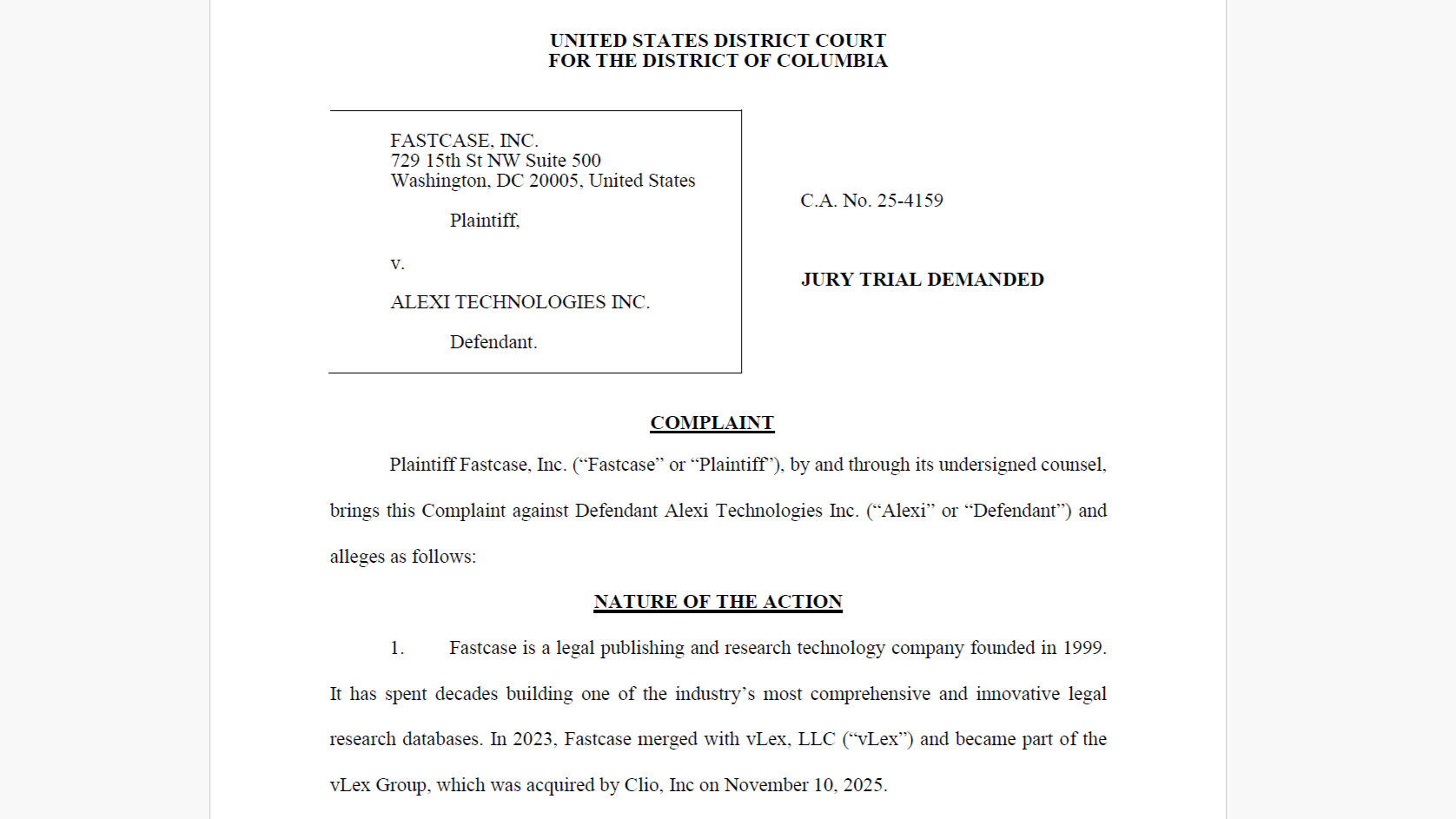


In an early win for legal research company Fastcase in its data-licensing lawsuit against AI legal research platform Alexi, a federal judge has denied Alexi’s emergency request for a temporary restraining order that would have compelled Fastcase to restore Alexi’s access to its proprietary legal database.
In Washington, D.C., U.S. District Judge Richard J. Leon issued a brief, two-page order yesterday denying Alexi’s motion for temporary injunctive relief, finding that the company failed to meet the legal standard for such extraordinary relief that it demonstrate irreparable harm.
Related: Fastcase Files Lawsuit Against Alexi Over Alleged Data Misuse and Trademark Infringement.
“Alexi’s claimed harm is primarily economic,” Judge Leon wrote. “Alexi says it will suffer irreparable harm without access to Fastcase’s updated data because it will lose revenue and customers and will sustain reputational damage that will hurt its competitive position.”
However, after “a careful review of the entire record,” the judge found that “Alexi’s harm is too speculative and is not sufficiently corroborated to merit emergency relief at this time.”
The court applied the D.C. Circuit Court of Appeal’s rigorous standard for irreparable injury, which requires harm that is “certain and great” and “actual and not theoretical.” When the claimed injury is primarily economic, as here, courts typically require the moving party to show either that losses cannot be calculated or that they threaten the company’s very ability to stay in business.
Alexi failed to meet this “high bar,” Judge Leon said.
Because Alexi did not make a sufficient showing of irreparable harm, Judge Leon stated he could deny the motion for injunctive relief without considering the other factors that go into whether to grant a TRO, including Alexi’s likelihood of success on the merits or the balance of equities.
The court denied Alexi’s request for a temporary restraining order outright, but deferred its request for a preliminary injunction. The judge ordered the parties to file a joint status report by Dec. 22 clarifying whether Alexi intends to continue pursuing preliminary injunctive relief.
(Note that Fastcase is now owned by Clio, as a result of Clio’s acquisition of vLex, which closed Nov. 10.)
Fastcase’s Opposition Arguments
Alexi filed its motion for a TRO under seal, which means it is not available to the public. However, Fastcase’s filed a 38-page opposition brief that — while heavily redacted — provides insights into the company’s defense and the nature of Alexi’s emergency request.
Fastcase’s opposition centers on its allegation that Alexi materially breached the parties’ 2021 Data License Agreement by transforming its business from an internal legal memo service into a customer-facing AI research platform, which Fastcase says the agreement expressly prohibited. (That agreement is also under seal on the court’s docket.)
According to Fastcase, the agreement granted Alexi access to Fastcase’s proprietary legal database solely for “internal research purposes” and explicitly prohibited using the data for “commercial purposes” or “for any purpose which is competitive with Fastcase.”
Fastcase argues that Alexi’s current product — as demonstrated in public presentations — violates those restrictions. It contends that Alexi now operates a “customer-facing, self-service legal research platform” where end users themselves conduct legal research through an AI interface powered by Fastcase data, rather than receiving lawyer-prepared memoranda as contemplated in the original agreement.
“This case turns on a simple but dispositive fact: Alexi is no longer the ‘memo-writing’ service it repeatedly claims to be,” Fastcase wrote in its opposition. “Today, Alexi’s end users themselves conduct legal research through an interactive AI interface powered by Fastcase’s proprietary and licensed data.”
Evidence of Business Transformation
Fastcase’s opposition includes citations to public demonstrations of Alexi’s platform that the company says prove the fundamental shift in business model.
The brief references an October 2024 public presentation where Alexi’s director of revenue demonstrated a “newly released self-service ‘question and answer system'” that allows lawyers to “ask rapid fire questions about the law” and iteratively refine research in real time.
According to Fastcase, the demonstration showed that Alexi’s model was “trained on over 30 million pairs of questions and answers that are derived from caselaw.”
Fastcase also cited a May 2025 demonstration (on my How It Works program) in which Alexi’s platform displayed full-text case law to users with clickable citations, and where the presenter confirmed that “We license our case law from Fastcase.” Screenshots allegedly showed Alexi’s interface stating, “View this document on Fastcase.”
Fastcase’s opposition further pointed to a December 2024 podcast interview where Alexi’s CEO Mark Doble described the company as having moved from “human lawyers in the loop” to “fully automated” memo generation.
‘Self-Inflicted Harm’
Fastcase further argued that any harm Alexi claims is “self-inflicted” — a principle of equity law that courts sometimes apply to deny injunctive relief.
“Alexi chose to design, market, and monetize a consumer-facing AI product around data licensed only for narrow ‘internal research’ use,” Fastcase wrote. “In doing so, Alexi knowingly assumed the risk” of losing access if the license were terminated for breach.
Fastcase contended that the agreement included a 30-day cure period precisely to allow a breaching party to transition to compliant alternatives or negotiate new terms. It said that Alexi received written notice of material breach on Oct. 27, 2025, but rather than cure the breach, Alexi’s counsel responded by affirmatively admitting that Alexi had used Fastcase data as “training data” for its commercial AI product and stated the company intended to continue doing so.
Availability of Alternative Data Sources
As I have already noted, significant portions of Fastcase’s brief are redacted, particularly in one section. However, that section appears to address Alexi’s arguments about the availability of alternative data sources and the costs of transitioning away from Fastcase data.
The brief cites a declaration from a Fastcase witness stating that major legal research providers including LexisNexis actively license primary law content to AI companies, pointing specifically to LexisNexis’s publicly announced partnership with Harvey, another AI legal technology company.
According to Fastcase, Alexi’s true complaint is not that alternative data is unavailable, but rather that it would be more expensive than the “bargain-basement price” Alexi paid for a narrowly scoped internal-use license.
Background of the Case
Fastcase sued Alexi Nov. 26 in the U.S. District Court for the District of Columbia, alleging breach of contract, trademark infringement and trade secret misappropriation, relating to its use of data licensed from Fastcase.
The dispute stems from a December 2021 data-licensing agreement between Fastcase and Alexi at a time, Fastcase alleges, when Alexi was operating a much-different business than it does today.
According to Fastcase’s complaint and opposition brief, the license was deliberately narrow and budget-driven. Alexi was a cash-constrained startup seeking low-cost access to legal data. The agreement explicitly described its purpose as providing Fastcase’s “database of primary law for Alexsei’s legal memos.” (The company was formerly named Alexsei.)
Fastcase alleges that beginning in 2023, after merger discussions between the companies failed to materialize and Fastcase instead merged with vLex, Alexi began transforming its business model. By 2024, according to public statements cited by Fastcase, Alexi was positioning itself as “increasingly a legitimate alternative to incumbent legal research providers.”
When Fastcase discovered what it characterized as Alexi’s unauthorized expansion beyond the license terms, it sent a formal Notice of Material Breach on Oct. 27, 2025, providing the 30-day cure period required by the contract.
After Alexi declined to cure and instead asserted it had the right to use Fastcase data for AI training purposes, Fastcase terminated the agreement on Nov. 26 and filed suit the same day.
Alexi has yet to formally answer the complaint and its motion for injunctive relief was filed under seal. However, in an interview with LawSites at the time the complaint was filed, Alexi’s founder and CEO Mark Doble denied any wrongdoing and told me that he believes the lawsuit is based on a misunderstanding of the original licensing agreement that came to light during Clio’s recent closing of its purchase of vLex, which had merged with Fastcase in 2023.
Next Steps In the Case
As noted, Judge Leon’s order requires the parties to file a joint status report by close of business on Monday, in which they must clarify whether Alexi will continue to seek a preliminary injunction and, if so, propose a briefing schedule for that stage of the case.
For now, at least, the denial of the TRO means Alexi will not have access to Fastcase’s data while the litigation proceeds, unless the company successfully obtains a preliminary injunction after fuller briefing or the parties reach a settlement.
Worth repeating is that Judge Leon’s order denying the TRO focused narrowly on Alexi’s failure to demonstrate irreparable harm. It explicitly did not reach the merits of the breach of contract claim.
Meanwhile, the heavy redaction of Fastcase’s brief and the sealed status of Alexi’s motion mean many details of both parties’ arguments remain unknown.