 Robert Ambrogi Blog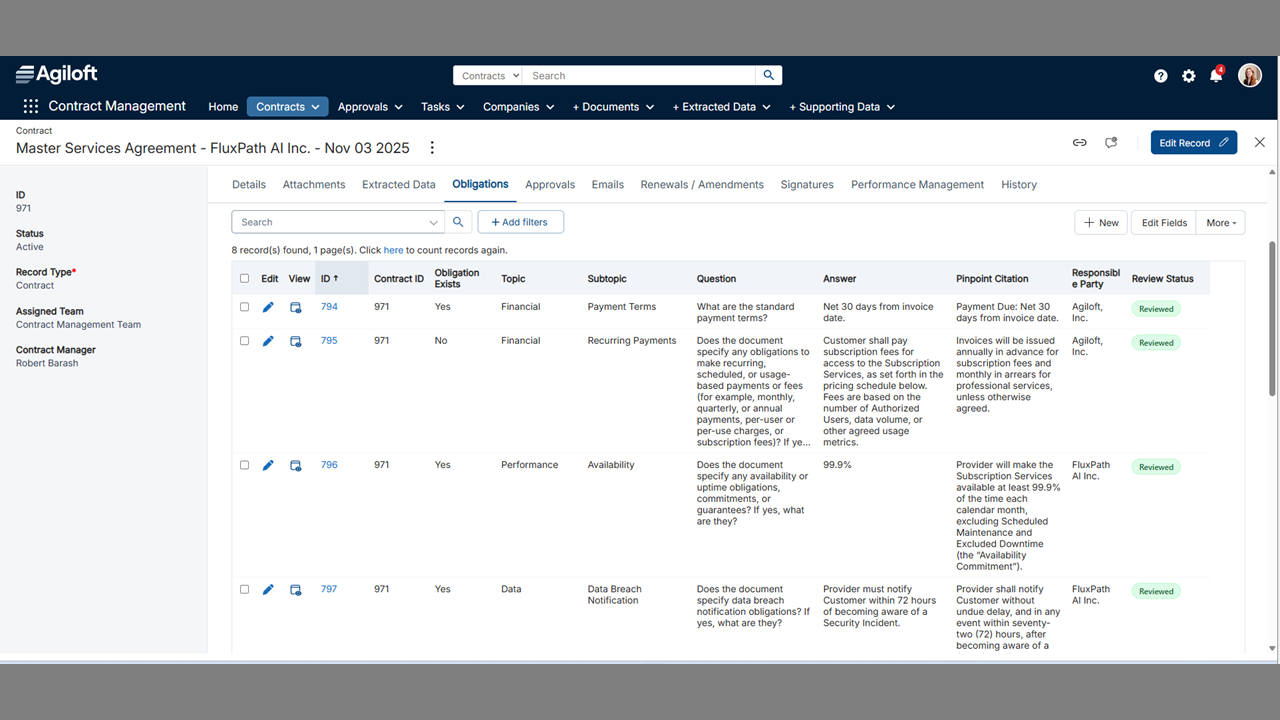


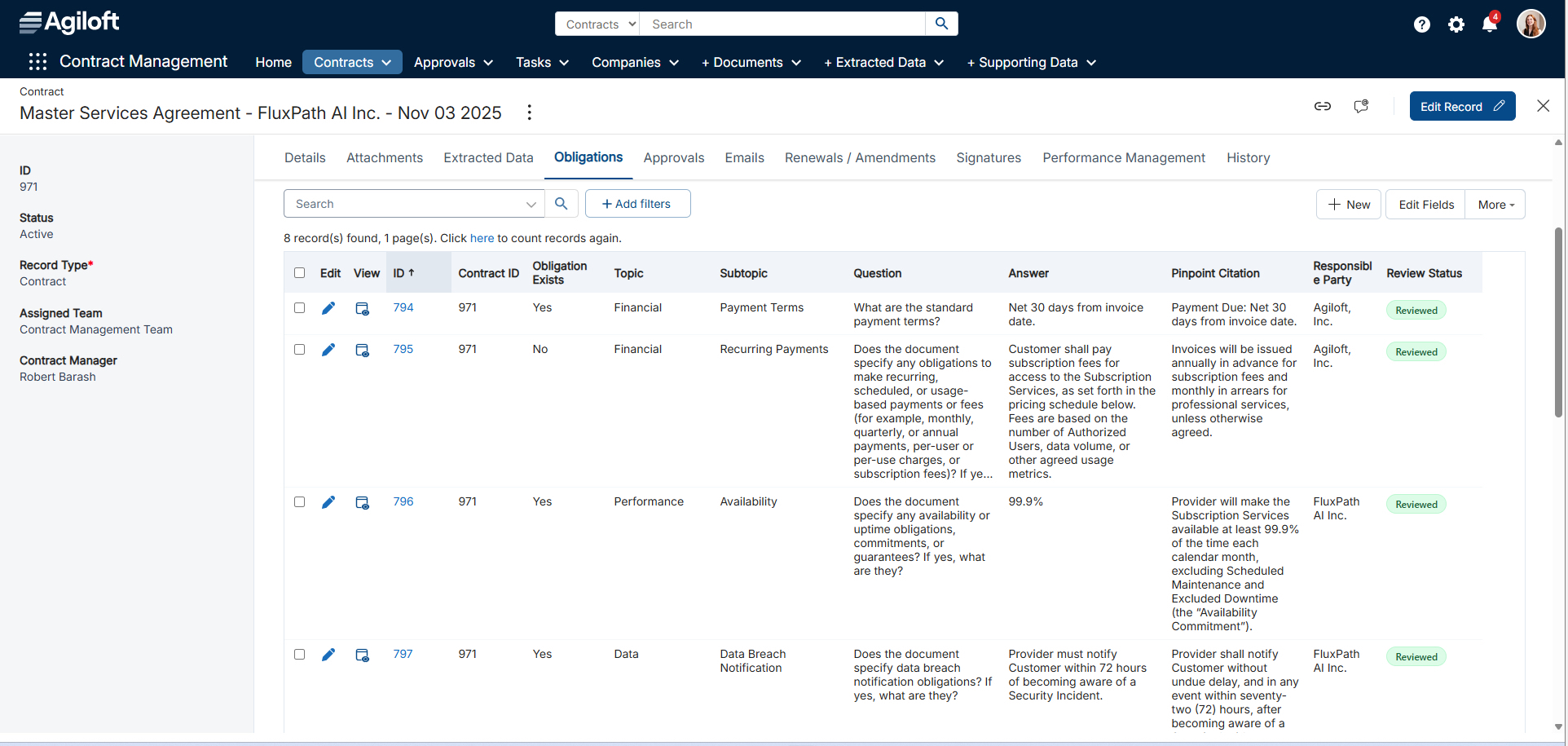
Contract lifecycle management company Agiloft today released Obligation Management, a new feature that uses artificial intelligence to automatically extract and track commitments from contracts.
The feature is designed to address a persistent challenge in contract management: organizations frequently overlook critical obligations after signing agreements. Citing research from PwC, Agiloft says that companies can lose 5-9% of annual revenue due to poor obligation management, particularly when key commitments and deliverables go unmonitored.
Agiloft’s Obligation Management feature applies AI to scan contracts and identify various commitment types, including service-level agreements, renewals, compliance requirements, payments and milestones. The system then transforms static contract text into actionable data that teams can track throughout the contract lifecycle.
Once obligations are extracted, the platform allows businesses to assign tasks to individuals or teams, set deadlines and track progress. The system can send automated reminders and escalate overdue tasks, helping to ensure that contract commitments are not overlooked.
The feature builds on Agiloft’s acquisition last January of Screens, a company whose AI contract review and redlining product uses expert-created and auto-generated playbooks to “screen” and redline contracts.
“Enterprises today manage thousands of contracts, and the cost of missed obligations – whether penalties, compliance failures, or missed revenue – is staggering,” said Andy Wishart, chief product officer at Agiloft. “With our new Obligation Management capabilities, we are giving enterprises data-rich tools for modern business transformation: to turn every contractual commitment into actionable insight, capture real business value, mitigate risk, and turn obligations into measurable outcomes.”
Automating Obligation Tracking
The platform includes several capabilities designed to automate obligation tracking:
Automated extraction: A new Screens Run Action (SRA) capability analyzes contracts uploaded to Agiloft and automatically identifies obligations, extracting key information and sending results back to the platform for review and reporting.
Categorized obligations: The system includes a pre-built library of obligation types organized by categories relevant to procurement and legal teams, including Financial, Delivery, Service Levels, Termination, Confidentiality, Regulatory, Data and Insurance.
Customizable tracking: Organizations can create custom obligation categories tailored to their specific requirements and adjust the system to fit their needs. Users can edit an existing screen or copy it to create their own version, and the system will still bring the results back into Agiloft.
According to Agiloft, users can configure tracking rules, integrate obligation data with other enterprise systems, and surface commitments through text analysis without manually scanning contract documents.
Three Layers of Intelligence
With today’s release, Agiloft says, its Screens now brings three layers of intelligence to every contract review:
- Precision and efficiency in redlining: A new redlining configuration panel enables teams to guide how the LLM rewrites language during contract review. Users can set preferred wording for redlines, choose the style of redlining they want (more direct, more conservative, etc.), and add a default explanation for why a change is being suggested.
- Contract standardization: Customers who use both Agiloft CLM and Screens can now pull approved contract language directly from their clause library when configuring a playbook. Using the Screens Word add-in, these suggestions appear directly when reviewing contracts in Word, so that the system is using the organization’s own preferred clauses to shape its suggested edits.
- Security and collaboration: Role-based permissions – Admin, Editor, and Reviewer – are now available, giving organizations more control over how their playbooks are shared and maintained.
“This launch is only the beginning,” said Wishart. “Agiloft is on an agentic AI journey, building toward a future where AI can actively collaborate, reason, and take meaningful actions across the contract lifecycle. Obligation Management is the latest step in that direction, and many more are already in development.”