 Robert Ambrogi Blog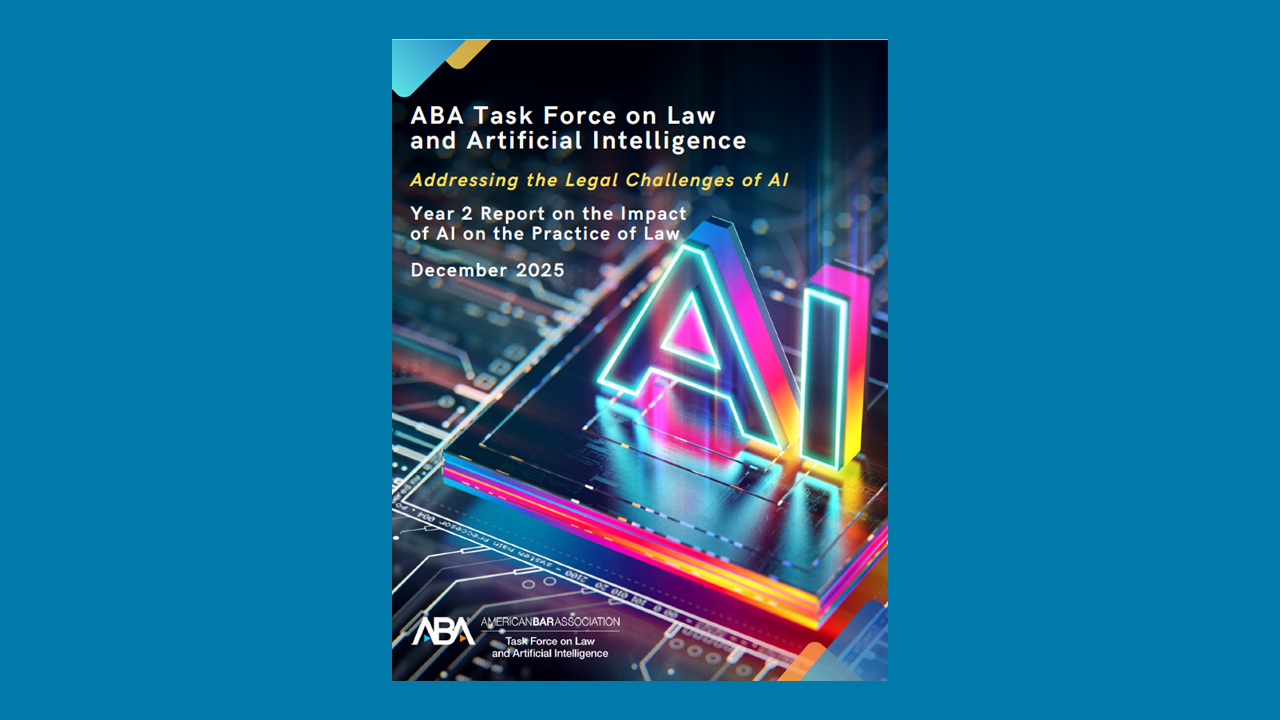


Artificial intelligence is no longer an abstract or experimental technology for lawyers – it is rapidly becoming core infrastructure for law practice, courts, legal education and access-to-justice efforts, and the legal profession must now shift its focus from whether to use AI to how to govern, supervise and integrate it responsibly.
That is the central conclusion of a report released yesterday from the American Bar Association’s Task Force on Law and Artificial Intelligence, a 56-page assessment that takes stock of how AI is already reshaping the profession and discusses the risks, opportunities and unresolved challenges that lie ahead.
The report, Addressing the Legal Challenges of AI: Year 2 Report on the Impact of AI on the Practice of Law, arrives at what the Task Force calls a “pivotal moment” for the profession. AI adoption has accelerated dramatically over the past year, pushing lawyers, judges, regulators and educators into unfamiliar terrain that demands new ethical frameworks, governance models and competencies.
“AI is no longer an abstract concept,” William R. Bay, the ABA’s immediate past president, writes in the report’s introduction. “AI has become key to reshaping the way we practice, serve our clients, and safeguard the rule of law.”
It is called the “year 2” report because this is the second and final year of the Task Force, which the ABA convened to study the evolving landscape of AI in law. The ABA Center for Innovation will now be responsible for carrying out its findings and recommendations.
From ‘Whether’ to ‘How’
The report includes sections on the implications of AI for the rule of law, law practice, the courts, access to justice, legal education, governance, risk management and ethics. Peppered throughout are Task Force members’ and advisors’ answers to the question, “What do you think the most important development/ improvement or challenge will be in the application of AI to the law in the next two years?”
One of the most striking shifts identified in the report is how quickly the profession’s posture toward generative AI has evolved. Just a year ago, the dominant concerns centered on whether lawyers should use AI at all, with debates focused heavily on confidentiality, competence and the risk of hallucinated citations.
That debate has largely given way to a more pragmatic question: How should AI be used – and governed – in real legal workflows?
According to the Task Force, early AI adoption concentrated on relatively low-risk tasks such as summarizing documents, extracting insights from large datasets, drafting routine communications, and preparing first drafts of memos and client alerts.
But the report observes that more advanced uses are now emerging, including “agentic” systems that chain together multiple tasks and operate with increasing autonomy.
“[A]s the platforms become more sophisticated and begin to chain together tasks – whether called robotic process automation or agentic AI – lawyers’ creativity in exploring the bounds of AI tools presents interesting challenges for the legal profession and for the innovation teams supporting them,” the report says.
Among those challenges is the widening gap between firms and organizations that can afford secure, enterprise-grade AI systems and those that cannot.
The report warns of a growing stratification between technology “haves” and “have-nots,” driven by licensing costs, infrastructure demands and a shortage of staff with the technical expertise to deploy AI effectively.
For Courts, Opportunities and Risks
The report devotes substantial attention to the judiciary, where AI is creating both efficiency gains and profound new risks.
The report focuses on the Task Force’s development this year of Guidelines for U.S. Judicial Officers Regarding the Responsible Use of Artificial Intelligence, developed by a working group of judges and legal technologists.
As I wrote about the guidelines when they came out, they emphasize a core principle: AI may assist judges, but it can never replace judicial judgment. Judges remain solely responsible for decisions issued in their names, and AI outputs must always be independently verified.
The report also highlights the growing threat posed by AI-generated disinformation and deepfakes, which Chief Justice John Roberts has identified as a direct danger to judicial independence and public trust.
Judges are increasingly confronting questions about how to authenticate evidence, how to respond to claims that legitimate evidence is fabricated, and whether existing rules of evidence are adequate for AI-generated material.
Some Progress in A2J
Perhaps the most optimistic section of the report focuses on access to justice, where the Task Force finds tangible progress since its first-year assessment. Gen AI, the report concludes, is beginning to demonstrate real potential to expand access to legal help by increasing the productivity of legal aid organizations and delivering understandable legal information directly to self-represented litigants.
The Task Force points to more than 100 documented AI use cases in legal aid settings, as discussed by Colleen V. Chien and Miriam Kim of the Center for Law and Technology at Berkeley Law School in their article, Generative AI and Legal Aid: Results from a Field Study and 100 Use Cases to Bridge the Access to Justice Gap, 57 Loy. L.A. L. Rev. 903 (2025).
The Task Force also points to corporate initiatives that aim to make advanced legal technology available at reduced or no cost to public-interest organizations, expressly citing Thomson Reuters’ AI for Justice program and Everlaw’s Everlaw for Good.
At the same time, the report cautions that high subscription costs for the most reliable AI tools risk widening, rather than narrowing, the justice gap if access-to-justice organizations are priced out. “Financial accessibility to the access-to-justice community must be raised and addressed regularly with legal AI developers,” the report says.
Law Schools Race to Keep Up
Law schools, meanwhile, are moving quickly, but unevenly, to integrate AI into legal education. A Task Force survey found that more than half of responding law schools now offer AI-related courses, and more than 80% provide hands-on opportunities through clinics or labs.
The report highlights programs at schools such as Case Western Reserve, Suffolk University, Vanderbilt, Stanford, and Georgetown, which are experimenting with AI-powered simulations, legal aid tools, and even mandatory AI certifications for students.
Yet faculty leaders quoted in the report acknowledge that they face a persistent challenge: The technology is evolving so rapidly that much of what students learn today may be outdated by the time they graduate.
“I tell students right up front that half of the substantive material that we cover in this class is probably going to be outdated by the time that you graduate,” says Mark Williams, Vanderbilt Law professor and co-director of Vanderbilt Law’s AI Law Lab (VAILL), in the report.
Governance, Risk and Liability
The report emphasizes that, as AI becomes embedded in legal services and business operations, AI governance is emerging as a central responsibility for lawyers.
Drawing on frameworks such as the NIST AI Risk Management Framework, the Task Force emphasizes the need for organizational strategies that address data quality, transparency, accountability and human oversight across the AI lifecycle.
The report also explores unresolved questions around liability. When AI-driven decisions cause harm, who is responsible? Is it the developer, the data provider, the deployer or the human who relied on the output?
The Task Force suggests that courts may ultimately resolve many of these questions incrementally, through traditional common-law adjudication, rather than comprehensive regulation.
“AI adds a new variable in determining fault and will likely lead to new liability frameworks and increased litigation,” the report says.
Ethics Rulings Provide Guidance
Ethics guidance has begun to catch up with AI, the report says, outlining how lawyers can ethically implement AI in their practices.
In July 2024, the ABA issued Formal Opinion 512 on lawyers’ use of generative AI. Since then, dozens of states and courts have released their own opinions, policies and rules, many of which are listed in the report.
Beyond the Immediate Horizon
In its final sections, the report urges the profession not to become so focused on short-term implementation challenges that it neglects the longer-term implications of increasingly powerful AI systems.
Several contributors warn that sudden advances toward human-level or super-human AI capabilities could leave legal institutions unprepared, with potentially catastrophic consequences if governance frameworks lag behind technology.
“Lawyers will provide critical aid to AI governance efforts,” writes Task Force advisor Stephen Wu in the report, “by promoting legal compliance, managing legal risks, and, most importantly, preserving the rule of law in the development, use, and behavior of AI systems.”
This is the final report from the Task Force, which the ABA convened as a two-year project to study the rapidly evolving landscape of AI in law.
The responsibility for carrying out its findings and recommendations now shifts to the ABA Center for Innovation.
But the takeaway from this year-two report is clear: AI is no longer on the horizon of legal practice. It is already here – and the profession’s response to it will shape the future of law.