 Robert Ambrogi Blog


Ever since ROSS Intelligence shut down in 2021 under the weight of a copyright lawsuit by Thomson Reuters, I have frequently referred to it in my reporting as the “now-shuttered” legal research startup.
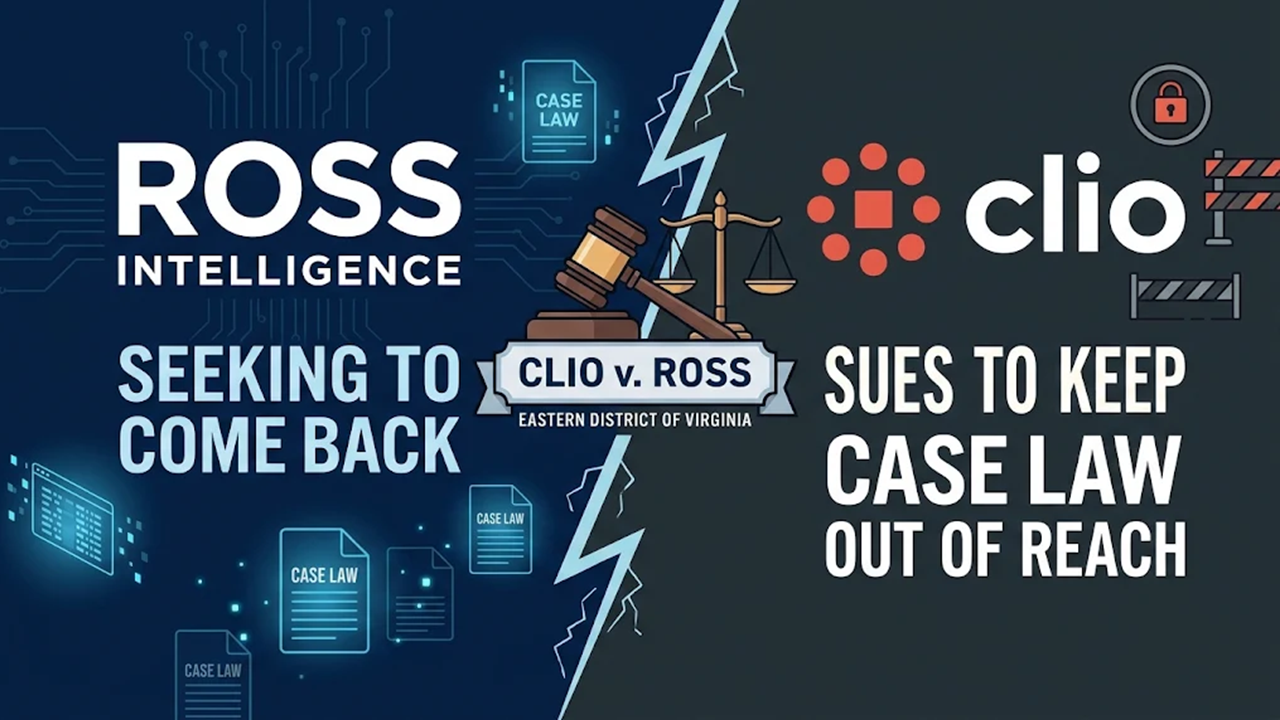
Now, it appears that ROSS is trying to revive its operations. But it faces a new obstacle and a new lawsuit, as legal tech company Clio has gone to federal court to avoid having to supply it with case law.
In a complaint filed Oct. 22 in the U.S. District Court for the Eastern District of Virginia, Clio asks for a declaratory judgment that it has no obligation to reactivate a case law data feed that ROSS licensed in 2017 from Casemaker, a legal research company whose data Clio now owns.
The lawsuit reveals that ROSS cofounder Andrew Arruda emailed Clio CEO Jack Newton on June 18, informing him that “we’re in the process of restarting ROSS operations and want to resume our agreement.”
“How much does ROSS owe,” Arruda asked, “and how much are Updates quarterly going forward?”
That email resulted in four months of emails and lawyers’ letters in which Clio refused to reactivate the feed and ROSS claimed the refusal would breach a contract that it contends remains in force through 2029.
When Arruda threatened that ROSS’s counsel would take “next steps,” Clio beat him to the courthouse.
To be clear, Clio’s suit is not an attempt to block ROSS from relaunching or to challenge whatever rights ROSS retains in the case law it received before the shutdown. It asks only for a ruling that it need not deliver any cases decided since.
A 2017 License, A 2021 ‘Pause’
At issue in the dispute is a Sept. 27, 2017, license between ROSS and Lawriter LLC, which did business as Casemaker. ROSS paid Casemaker $900,000 for its case law database and agreed to pay $50,000 a year, in quarterly installments of $12,500, for updates as courts issued new decisions.
According to the complaint, the contract gave ROSS a perpetual license to the case law database and a three-year license to case law updates, with the update service renewing automatically every three years unless ROSS gave notice of termination.
At the end of 2020, Casemaker merged with Fastcase, and then Fastcase merged with vLex in 2023, and then Clio acquired the combined company last year.
Meanwhile, in December 2020, ROSS announced that it would shut down, saying the lawsuit Thomson Reuters filed that May had left it unable to raise funding. Its platform went dark Jan. 31, 2021, and, according to the complaint, its access to the case law feed ended the same day.
Nine days later, Christina Steinbrecker Jack, then vice president of product and content at Fastcase, emailed Arruda to ask whether Fastcase should keep sending invoices.
“Our expectation is that we should pause invoicing, but we wanted to check with you first,” she wrote. “We’re all continuing to root for you and the team!”
“Yes, things are on pause for now as we fight the good fight but things are looking very good!” Arruda replied.
Dueling Readings
Those emails, ROSS now contends, confirmed a mutual pause of the agreement while it fought Thomson Reuters. Even with the pause, ROSS asserts, the agreement for updates automatically renewed in 2020, 2023 and 2026, and therefore should be considered to be still in effect.
In an Oct. 5, 2026, letter, ROSS lawyer Joshua Hafenbrack of Cozen O’Connor wrote that Arruda had reached that understanding in conversations with Fastcase executives, including then-CEO Ed Walters, “with the expectation that ROSS could pay the back-due amounts when ROSS restarted its service.”
“Fastcase cannot agree to a mutual pause in invoicing and then turn around and use ROSS’s nonpayment as the basis for a material breach,” Hafenbrack wrote.
ROSS also says Clio never gave it the notice and 30 days to cure that the contract requires before cancellation. When Newton sent a notice of breach on Sept. 24, expressly without conceding one was required, Arruda replied the same day that ROSS “hereby tenders cure” and asked for an invoice. Clio has declined to provide one.
Clio says no one at Casemaker or Fastcase ever agreed to suspend ROSS’s obligations. The 2021 emails concerned invoicing only, it says, and the contract can be modified only by a signed writing. It alleges that ROSS had stopped making the quarterly payments by mid-2020, months before the emails, and then went silent for more than five years.
“Fastcase regarded the commercial relationship as over,” Clio lawyer Jess M. Krannich of Wilson Sonsini Goodrich & Rosati wrote to ROSS’s lawyer on Oct. 16.
That prolonged nonpayment, Clio argues, was a material breach that excuses it from further performance, whether or not it ever formally cancelled.
“Clio disputes that any such renewal occurred or obligates it to resume delivering Updates notwithstanding that ROSS stopped making quarterly Updates payments in 2020 and ceased operating its legal-research platform on January 31, 2021, and, for over five years, never communicated about resuming performance under the Agreement or attempted to cure its prolonged, uncured material breach of its payment obligations,” the complaint says.
The complaint indicates that the two sides do not even agree on what ROSS paid. ROSS points to nine wire transfers in 2019 and 2020 as proof that it paid every invoice it received. Clio says those payments were for a separate 2018 license covering statutes and regulations.
‘Data Moat’
Earlier this week, I posted my LawNext interview with Jack Newton recorded at ClioCon in which he emphasized the importance of data as “the only durable moat.” The emails and letters that are part of the court filing demonstrate how that belief is changing the company’s strategy.
In a June 25 email, Newton told Arruda that “we are not doing these kinds of data licensing deals on a go-forward basis.” On Sept. 1, he wrote that Fastcase “has decided not to sell or license any further data to ROSS — we are winding down this part of the business.”
ROSS’s lawyer Hafenbrack cited that strategy in an Oct. 5 letter to Clio’s lawyer.
“Clio’s top executives have repeatedly made clear that — in sharp contrast to Fastcase — Clio has no intention to license the Fastcase caselaw data to tech and AI companies like ROSS,” he wrote. “Instead, Clio is using the Fastcase data to create a data moat around Clio’s own vertically integrated AI platform.”
That echoes the antitrust counterclaims that AI legal research company Alexi filed against Clio in January, after Fastcase sued Alexi over its use of licensed case law.
The correspondence reveals another irony. According to correspondence from Arruda and Hafenbrack, Newton was a member of ROSS’s board at the time of the 2021 pause. Hafenbrack’s letter says Arruda kept ROSS’s board, “which at the time included Mr. Newton,” informed of the arrangement with Fastcase. Clio’s complaint does not mention Newton’s board service.
What ROSS Plans
ROSS has not yet responded to the complaint. Asked for comment, Arruda responded, “We are confident the contract is clear on ROSS’s data rights and we will pursue all legal remedies. We remain excited about the future of AI in legal.”
The filings do not provide any specifics about ROSS’s plans to relaunch, including what that relaunch might look like or when it would occur. Arruda’s emails to Newton indicate that ROSS’s board “is asking for a timeline,” and in two he copies Karamdeep Nijjar, partner with the venture capital firm iNovia Capital.
Clio, in its complaint, notes that after the shutdown, Arruda cofounded Flexpa, a healthcare data company.
Arruda’s first email to Newton came one week after the 3rd U.S. Circuit Court of Appeals heard argument in ROSS’s appeal of the copyright ruling against it. On Sept. 29, the court affirmed that ROSS’s use of Westlaw headnotes to train its AI was not fair use. ROSS petitioned Nov. 3 for rehearing by the full court.
Clio cites that ruling among its reasons for refusing any new deal. ROSS “stopped paying its bills, announced its shutdown, and left substantial obligations unresolved for years,” Krannich wrote, and Fastcase “bore the burden of testimony and document production” in the copyright case.
In that initial June email to Newton, Arruda copied Fastcase cofounder Ed Walters, who is now at Clio, and ended the email with a side note to Walters: “Wanted to keep you in the loop as we restart. It’s time!”
But Clio’s final word before filing its lawsuit, delivered by its lawyer Krannich four months later, was less cheerful.
“ROSS should make other arrangements for its data needs,” he wrote.