 Robert Ambrogi Blog


Reports of the demise of the billable hour have been greatly exaggerated, at least at smaller law firms.
With apologies to Mark Twain, that is the central finding of a new report on billing and payment practices at small and midsized law firms. It finds that firms billing solely by the hour outnumber firms billing solely by flat fee by nearly 5 to 1, and that flat fees, far from gaining ground over the past year, actually lost a little.
The 8am SMB Law Billing and Payments Report, released today by 8am, the company formerly known as AffiniPay, analyzes aggregate billing and payment data from more than 60,000 law firms, predominantly in the U.S., that use its MyCase practice management and LawPay payments platforms.
It compares the first half of 2026 against the first half of 2025, and the company says it will publish the report twice a year going forward.
The report says it defines firm size by employee count, with a solo being one, small being 2-5, medium being 6-10, and large being 11 or more. That number is derived from either firm-reported data when available or platform user counts where not. The report does not break down how many of the 60,000 law firms fall into each category.
“For most of the past decade, the legal industry has been predicting a shift away from the billable hour, because clients want predictability,” the report says. “The data showed firms making a different choice.”
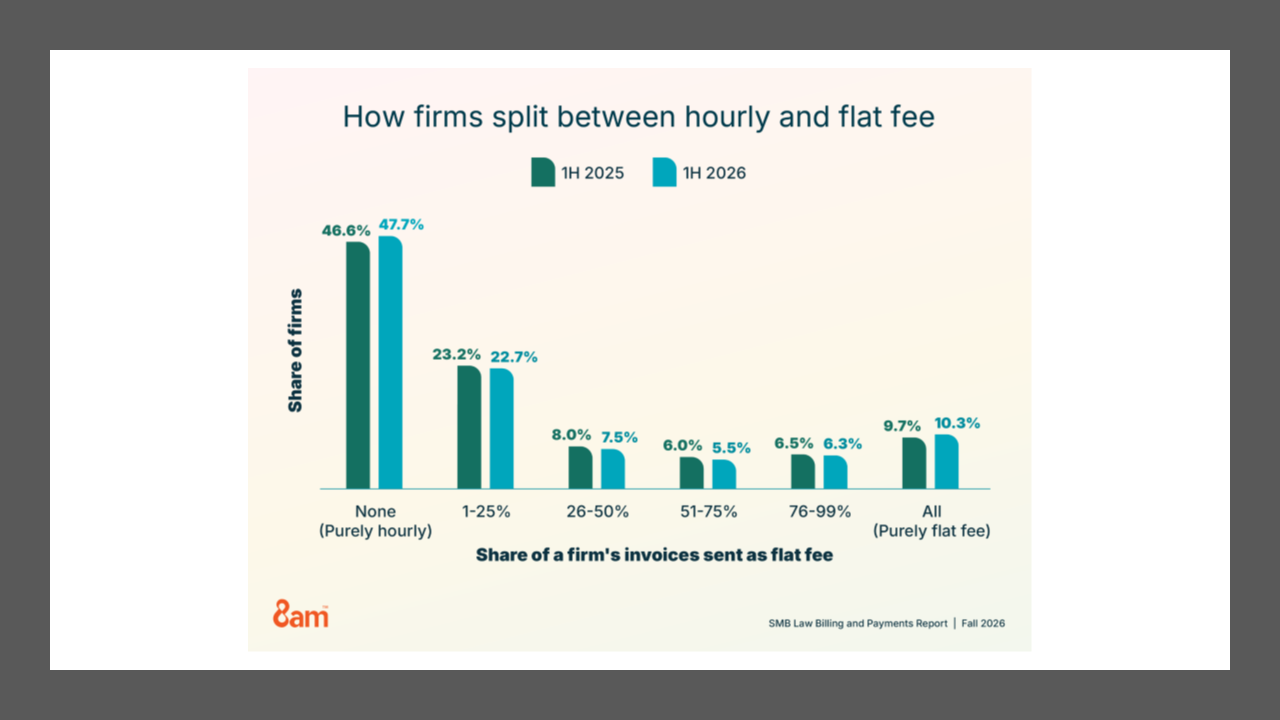
Of firms covered by the report, 47.7% billed entirely by the hour in the first half of 2026, up from 46.6% a year earlier. Just 10.3% billed exclusively by flat fee, up from 9.7%. The remaining 42% used a mix, but even they used flat fees in just a quarter or fewer of their invoices.
Measured by invoices rather than firms, flat fees made up 15% of all bills sent in the first half of 2026, down from 16% a year earlier. Large firms cut back the most, from about 16% to 14%. Solo firms were the exception, inching up to 17%.
“Flat fee trends are a prime example – the industry narrative suggests many are moving in that direction, but our data shows most SMB firms have not,” said Tanya Hendricks, chief product officer at 8am, in a statement. “All too often, firms are making consequential decisions about how they bill and receive payments without real benchmarks to measure against.”
The Practice Determines the Billing Method
Where flat fees have taken hold, it is because of the nature of the work, not a change in philosophy, the report says. Flat fees accounted for 87.7% of invoices at traffic firms and 64% at immigration firms, both practice areas built on routine, bounded matters. Bankruptcy and criminal defense firms each sent about half their bills as flat fees.
At the other end of the spectrum, flat fees made up 10% of invoices at business and corporate firms, 6.7% in civil litigation, 2.8% in family law and 0.8% in workers’ compensation.
Notably, immigration, even though it is one of the practice areas most likely to use flat fees, saw its flat-fee share drop more than four points, from 68.4% to 64%.
“Billing model is largely determined by the work, not preference,” the report says. “Before choosing between flat fee and hourly, consider whether a given matter is predictable and bounded enough to price up front. If it is, a flat fee makes sense. If it isn’t, hourly protects the firm.”
Billings Rose, But Not Rates
Beyond how firms structured their fees, the report finds that firms grew their monthly billings by 5% to 8% over the year.
That was not the result of raising rates, as the report finds that hourly rates were unchanged at three of the four firm sizes the report tracked, with only medium firms having raised their rates by 4.3%.
Instead, the report attributes the growth to realization, finding that more of the time firms were already recording made it onto an invoice.
Large firms billed nearly 12% more hours while logging slightly fewer, raising the share of recorded hours they billed from 44% to 49%. The amount firms earned per hour billed rose between 3% and 5% across all sizes.
Solo firms went the other way. Their recorded hours rose nearly 9%, but the share they billed slipped from 70% to 69%.
“Before raising rates, assess how much tracked time is being invoiced,” the report advises.
Payments Become More Reliable
On the payments side, the report has good news for firms. Every month in the first half of 2026 outperformed the same month in 2025, across all firm sizes. The report finds:
- Invoices paid within 30 days rose from 57.7% to 59.1%.
- Invoices overdue at 30 days fell from 26.8% to 25.6%.
- The share of invoiced dollars collected within 30 days rose from 43.4% to 45.1%.
- The average unpaid balance per invoice fell from $2,073 to $1,979.
Even so, roughly seven in 10 firms were still carrying at least one past-due invoice, which was the same as the prior year. “Less money is outstanding,” the report says, “but the number of firms carrying outstanding balances did not change.”
Solo practitioners had the lowest overdue rate, at 18.8%, compared with 26.8% at small firms, 27% at medium firms and 24.1% at large firms.
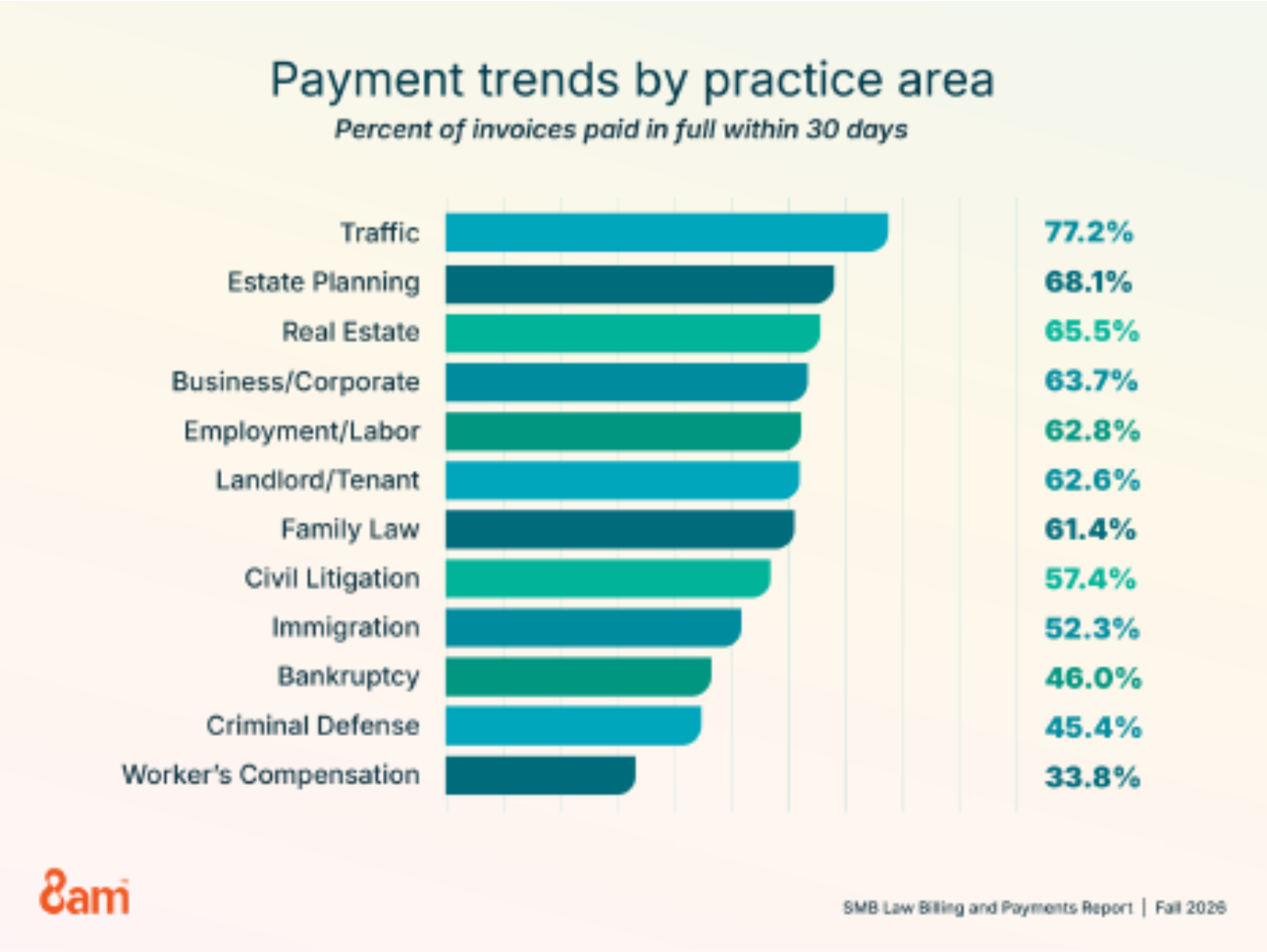
The speed at which payments were made varied by practice area. Traffic firms were the most likely to have an invoice paid in full within a month (77.2%), followed by estate planning (68.1%) and real estate (65.5%).
Workers’ compensation firms were the least likely (33.8%), but they also had the fewest overdue invoices of any practice area (8%), because insurers pay on longer but more predictable schedules.
Family law had the highest overdue rate, at 32%. Debt-collection firms improved the most, cutting their overdue rate by almost nine percentage points.
The Cost of Getting Paid
The report also finds that firms are becoming more deliberate about what it costs them to accept payment. The number of firms adding a surcharge to card payments rose 16% year over year, while the surcharge rate itself held steady at about 2.6%. On average, firms collected 25% more in surcharges than a year earlier.
Firms also steered larger payments toward e-check, which is priced per transaction rather than as a percentage. The average e-check payment was $2,206, compared with $1,491 for card payments, and card payments’ share of dollars collected fell about two percentage points.
Large firms led the way on both fronts, which the report attributes to their larger average payments — $2,231 per transaction, versus $1,503 at solo firms — making percentage-based card fees costlier for them.
Small firms, by contrast, moved in the opposite direction, offering clients flexibility such as pay-later options rather than pushing costs onto them. The report notes that firms should check their state’s rules before surcharging, since some jurisdictions prohibit it.
“The picture that is emerging is one of firms getting more disciplined: getting paid more reliably, billing more of what they’ve already earned, and making more deliberate choices about how they get paid,” Hendricks said.
A Focus on Smaller Firms
The report makes clear that the findings solely reflect 8am’s own customer base. “Data reflects the activity of 8am users and is not representative of every law firm in the U.S. legal market,” it says.
That means that the data skews towards toward solo and small firms in consumer-facing practice areas.
The company says it compared the same firms across both periods, weighted each firm equally in the payment figures, counted invoices as paid or overdue against a 30-day window, and excluded test accounts, trial accounts, draft invoices and inactive firms.
That said, 60,000 firms are a large sample, and the report is based on actual invoices rather than self-reporting.
Its finding that small firms are not abandoning the billable hour is consistent with what other industry surveys continue to show – and underscores that the billable hour, despite reports to the contrary, remains alive and well.