 Robert Ambrogi Blog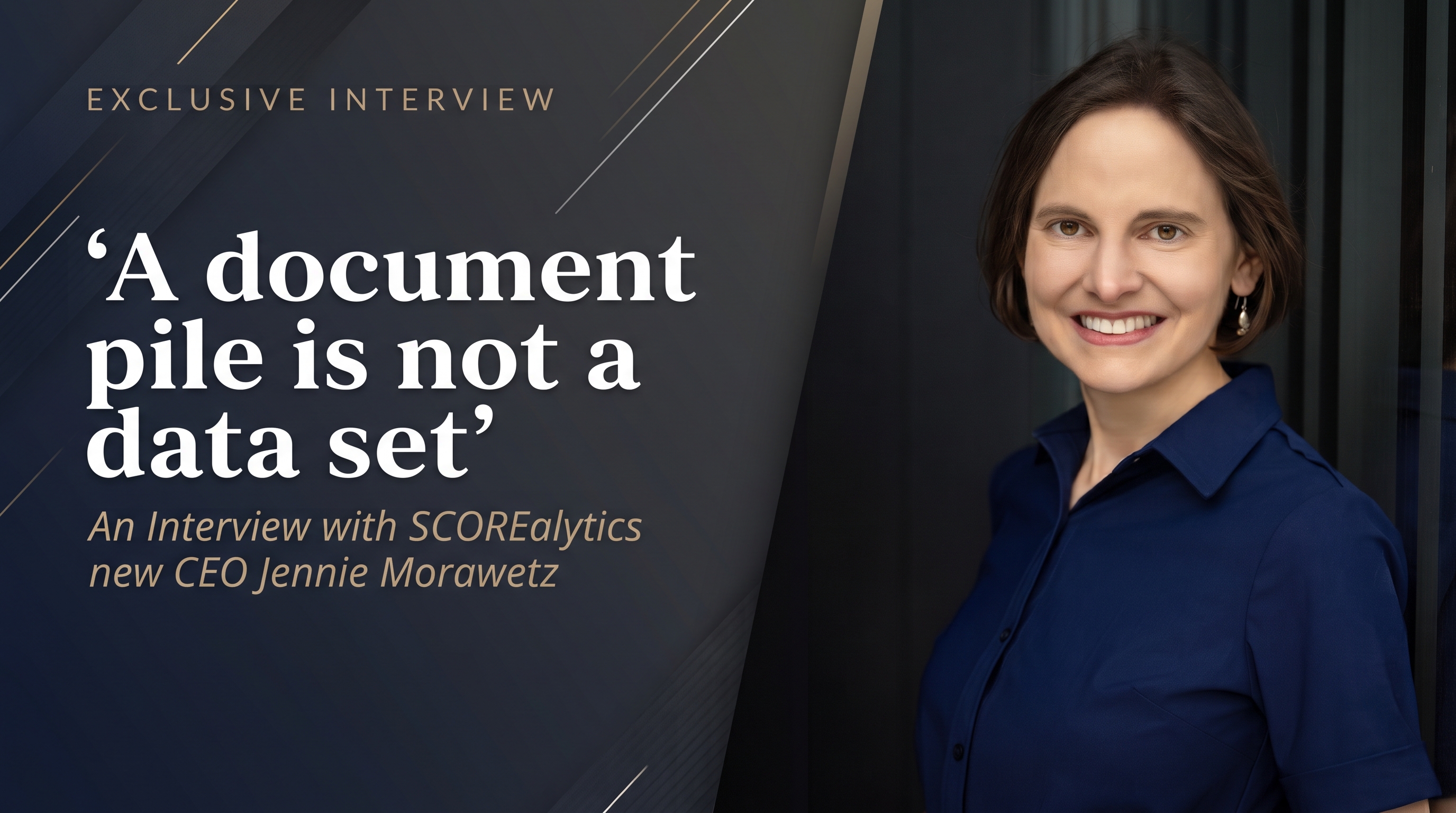


Jennie Morawetz, who was named this week as CEO of regulatory intelligence company SCOREalytics, wants the company’s product to become the accepted standard for how lawyers keep up with regulatory change.
“I want using SCORE to be the standard for due diligence, or for a general counsel who’s tasked with staying on top of changes and updating the board quarterly on what matters,” Morawetz told me in an interview yesterday.
She wants a system “that enables people to say, I can rely on this, and that in the market is viewed as a reasonable decision.”
To get there, she said, the company has to do work that many AI vendors skip. “There’s a lot of companies out there right now that advertise scale of data,” she said. “But one of the things that I like to say is a document pile is not a data set.”
Morawetz, a former Kirkland & Ellis partner, moves into the CEO position after a year as the company’s chief strategy officer and general counsel.
She said the move was “a fairly natural next step” after the former CEO left the company.
“I had been very embedded for the last year with the product team, working very closely with our chief technology officer Lawrence Krubner, our VP of product Lizzie Palmer, and all of the engineers that have been working on the product,” she said.
“I’ve also been very closely involved with our customer interactions, so it’s a pretty natural step for me.”
An ‘Impulsive’ Leap From Big Law
During her 10 years at Kirkland & Ellis, she helped build the firm’s Sustainability Practice Group. She called that practice “kind of a startup within a big law firm,” and she said she loved the experience of building it.
Leaving Kirkland for a legal tech startup, she said, “was actually one of the more impulsive decisions I’ve ever made. And I’m not a particularly impulsive person. I’m a lawyer, so I think things through.”
But her client work had familiarized her with the problem of managing and tracking regulatory change, and then figuring out how to make strategic business decisions around it, and she knew that was the problem SCOREalytics was trying to solve.
“I was the one that approached SCOREalytics and said, ‘What do you think about me joining you and helping to make this a reality?’” At the time, the company had no lawyers on the team.
Two Scores: Applicability and Priority
Legal teams at law firms and corporations often tell the company they feel overwhelmed trying to keep up with regulatory changes, she said. Most still rely on email alerts, perhaps with AI summaries layered on top, and they keep reading because they fear missing the one development that matters.
SCOREalytics’ approach to addressing that problem starts directly at the source. “We don’t just rely on internet searches, internet research, law firm alerts,” she said. “We actually monitor the regulators.”
The company currently tracks regulators in about 30 countries. It also tracks courts and litigation and enforcement trends.
Tracking currently focuses on energy and climate, environmental, labor and human rights, corporate governance, and information governance, which takes in cybersecurity, responsible AI and data privacy, with plans to add other topics.
For example, the company recently added data centers as a topic in response to client requests, said Lydia Flocchini, a go-to-market adviser to the company who sat in on the interview.
“Our goal is huge,” Morawetz said. “We want to cover every area of law everywhere in the world.” But she acknowledged that it can be challenging to get data from some regulators and for some areas of law, so the company is expanding a step at a time.
As it monitors new developments, the platform matches them to entity profiles and gives each one two separate scores. The applicability score assesses whether an entity might fall within a rule’s scope. When the answer is uncertain, the platform says what information the entity’s profile lacks to make that determination.
The priority score assumes the rule applies and asks how big a deal it is. It weighs factors such as enforcement trends, potential fines and penalties, deadlines and compliance burden.
Morawetz offered an example from her sustainability practice. A greenhouse gas reporting law may be a light lift for a cloud-based tech company that mostly has offices, but a heavy one for a company with complex industrial operations.
‘AI Isn’t A Silver Bullet’
Although the product uses AI, it does not overly rely on it, Morawetz said. “AI isn’t a silver bullet by any means, but it does allow us to do some things that we weren’t previously able to do.”
The company’s process relies on both automation and people. Scrapers monitor government websites and AI pulls in the text of new developments. When the AI fails, as she said it sometimes does, an offshore team in the Philippines retrieves documents manually.
The company then places each document within its regulatory structure, for example by linking a guidance document to the framework it interprets. It also parses regulations into chunks a lawyer would find intuitive – narrower than a whole title of the U.S. Code, for example, but not so narrow that they lose context.
That structuring step uses what Morawetz described as “antagonist agents,” a multi-LLM system in which disagreements among the models get routed to a human for a final call. “If it’s really complicated, it often bubbles all the way up to me,” she said.
“Lawyers don’t like black boxes, so we try to make nothing a black box,” she said.
The platform shows how the scoring algorithm was applied so users can test it, and some customers have asked to layer their own risk algorithms on top of the company’s, which the company is glad to do, Morawetz said
She described the structuring work as “pretty cutting edge.”
“We’re butting up against the capabilities of the LLMs in many ways,” she said. “We’re pushing to see how much we can accomplish, how sophisticated we can get with the parsing.”
Immediate Focus: Product and Market
The company’s customer base is a mix of law firms and in-house legal teams at large multinationals. Some private equity firms use the product for portfolio management, and some consulting firms have expressed interest.
Customers use a SaaS dashboard where they set up entity profiles or topical focus areas, such as human rights. They can track specific regulations or cases and get email notifications.
But Morawetz said the company recognizes “a bit of platform fatigue out there,” and it is looking at agent-to-agent communication and MCP connections that would deliver its output into the tools customers already use.
“We’re not trying to create the all-encompassing legal operating system,” she said. “We really are trying to create a data set.”
As she steps into the CEO role, Morawetz told me that her immediate priorities are to keep developing the product and expanding the data set, and above all to accelerate the company’s go-to-market over the next few months.