 Robert Ambrogi Blog
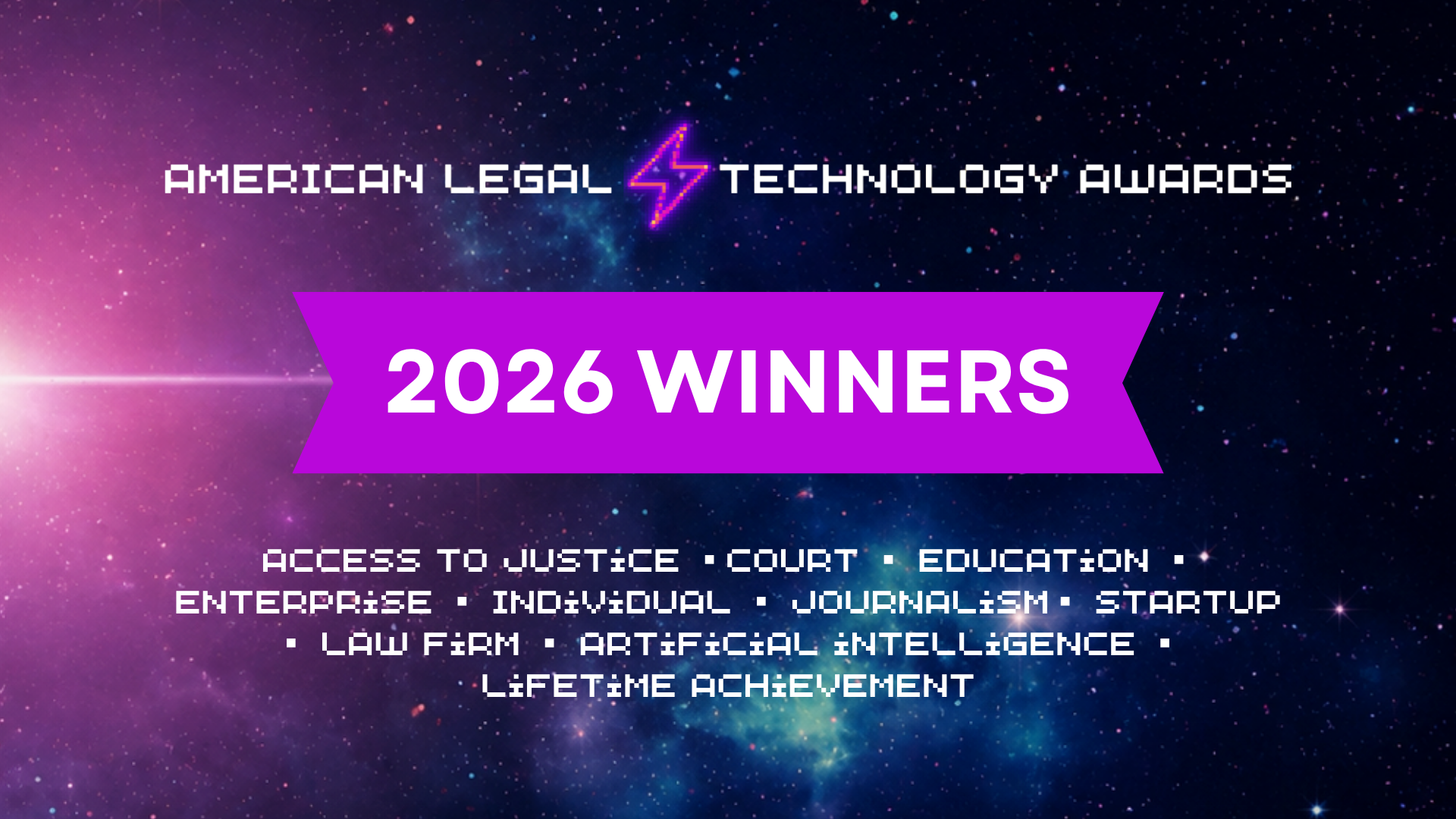


Seventh annual awards celebrate legal innovators who put technology to work for a bigger purpose
BOSTON, October 26, 2026: The American Legal Technology Awards announced its 2026 winners at its annual gala on Sunday, October 25, at Suffolk University Law School in Boston. Honorees were selected in ten categories from 234 submissions.
This year’s theme, “Ask Why,” recognizes people and organizations that use AI and technology not for its own sake, but for a bigger purpose. This year’s honorees serve clients, strengthen courts and open the doors of justice wider.
2026 Honorees
Access to Justice
- Winner: Frontline Justice, for empowering trusted community advocates with the training and technology they need to deliver legal help at scale.
- Runner Up: Julio Oyhanarte / Immigration TV, for bringing trusted immigration information to underserved communities and creating a model other lawyers can replicate.
- Honorable Mention: Stanford Rhode Center and Legal Design Lab, for advancing access to justice nationwide through research, court innovation and evidence-based legal technology.
Court
- Winner: Austin Community Court’s Mobile Court Team, for taking the court directly to shelters and community centers, helping people experiencing homelessness clear the warrants and fees that stand between them and stable housing.
- Runner Up: Illinois Court Help, for pairing trained, multilingual court guides with a 24/7 chatbot to help more than 100,000 court users across all 102 Illinois counties.
- Honorable Mention: Stanford Rhode Center, Stanford Legal Design Lab, and L.A. Superior Court, for partnering to rebuild the digital front door of the nation’s largest trial court, including an AI default judgment assistant tested through randomized trials.
Education
- Winner: Korin Munsterman, for moving educators, students and practitioners from asking whether to use generative AI to learning how to use it responsibly.
- Runner Up: David Colarusso, for founding Suffolk Law’s LIT Lab and the Document Assembly Line, where students build access to justice tools for self-represented litigants.
- Honorable Mention: Tracy L.M. Norton, for nearly three decades of legal education innovation, from the Interactive Citation Workstation to the Law Profs’ AI Sandbox.
Enterprise
- Winner: Harbor, for closing the gap between the technology legal teams buy and the technology they use, from strategy through implementation to managed operations.
- Runner Up: Epiq AI, for an eDiscovery platform that reviews 500,000 documents an hour, cuts review costs by up to 90 percent and produces defensible results accepted by courts and regulators.
- Honorable Mention: Benchly, for a Legal Knowledge Graph that grounds research, verification and drafting in real case law, with pay-as-you-go citation checks for solo lawyers and pro se litigants.
Individual
- Winner: Amanda Brown, for building Lagniappe Law Lab and the Louisiana Legal Navigator, the shared technology backbone connecting Louisiana’s courts, legal aid and self-help programs.
- Runner Up: Aliza Shatzman, for founding The Legal Accountability Project and its Clerkships Database, bringing transparency to judicial clerkships for more than 4,000 law students and graduates.
- Honorable Mention: Claire Robinson, for leading Upsolve’s AI Paralegal, which helped more than double the number of families getting free bankruptcy relief in a single year.
Journalism
- Winners: Stephanie Everett and Zack Glaser, for The Lawyerist Podcast, which turns big ideas into practical guidance for solo and small firm lawyers.
- Runner Up: Steven Lerner, for reporting that surfaces real-world legal AI use cases and holds the industry accountable as it adopts AI.
- Honorable Mention: Jennifer Leonard, for her leadership, consulting, authorship, and podcast, which keep access and ethics at the center of the conversation about the profession’s future.
Startup
- Winner: Techtivist, for giving public defenders a shared database of police misconduct records, so they can hold officers accountable and prevent wrongful convictions.
- Runner Up: Skribe.ai, for reinventing the deposition record as searchable, AI-ready intelligence at less than half the cost of the legacy model.
- Honorable Mention: Project Fortress, for helping courts reclaim capacity, cutting opinion drafting time by more than half in a Kansas Judiciary pilot.
Law Firm
- Winner: Law Office of Sergei Tokmakov, for showing that a single attorney, using AI as infrastructure, can run a full-service firm and offer free self-help tools used by tens of thousands of people each month.
- Runner Up: Evolve Family Law, for running AI as core infrastructure to make flat-fee family law affordable, and openly sharing its playbook so other firms can follow.
- Honorable Mention: Baker, Donelson, Bearman, Caldwell & Berkowitz PC, for conceiving and sustaining ABA Free Legal Answers for more than a decade, helping answer over 500,000 civil legal questions.
Artificial Intelligence
- Winner: OpenLaws, for making current, structured U.S. law available like a public utility, so legal aid organizations and startups can build on it in weeks, not years.
- Runner Up: Ashley Oborn / Lone Star Legal Aid, for building a suite of attorney-vetted AI tools for legal aid staff and the public, and openly sharing the blueprint with the field.
- Honorable Mention: Frontline Justice / Frontline Q, for equipping community justice workers with locally accurate AI answers, kept current by a human-in-the-loop network of peers.
Lifetime Achievement: Marc Lauritsen
The 2026 Lifetime Achievement award went to Marc Lauritsen. The honoree is kept secret until the gala and was announced at the event by co-founder Cat Moon.
Lauritsen was recognized for building the systems, institutions and standards that keep legal technology evolving. He proved that small firms could compete through smart technology adoption. He taught that smartphones, cloud computing and practice management software could turn solo practitioners into efficient businesses. Throughout, he understood that technology education is a matter of social justice.
A Celebration of Purpose
“Every year, we ask what legal technology can do. This year, we asked why,” said Tom Martin, co-founder of the American Legal Technology Awards and CEO of LawDroid. “Our honorees answered with purpose. They built tools that help people find legal help, help courts serve the public and help lawyers do better work. That is what innovation in law should look like.”
The gala was hosted by Jackie Schafer, founder of Clearbrief. Awards were presented by Allie Winterhof of ARAG Legal, Bridget McCormack of Clio, Sharon Crane of Practising Law Institute, Bob Ambrogi of LawNext, Rachel Huff of Cloud925, Maddy Martin of Smith.ai, Ed Walters of Clio, Jackie Schafer of Clearbrief, and co-founders Patrick Palace and Cat Moon.
The Awards thank this year’s sponsors: Clio, ARAG Legal, Practising Law Institute, Smith.ai, 8am, Cloud925, Palace Law, LawDroid and VAILL, and event host Suffolk University Law School. Special thanks go to the amazing volunteer judges who reviewed this year’s submissions.
About the American Legal Technology Awards
The American Legal Technology Awards recognize excellence and innovation in legal technology across ten categories. Founded in 2020 by Tom Martin, Patrick Palace and Cat Moon, the Awards celebrate the people and organizations using technology to improve the practice of law and expand access to justice.
Media Inquiries Contact: Tom Martin, Co-Founder, American Legal Technology Awards
Email: tom@lawdroid.com