 Robert Ambrogi Blog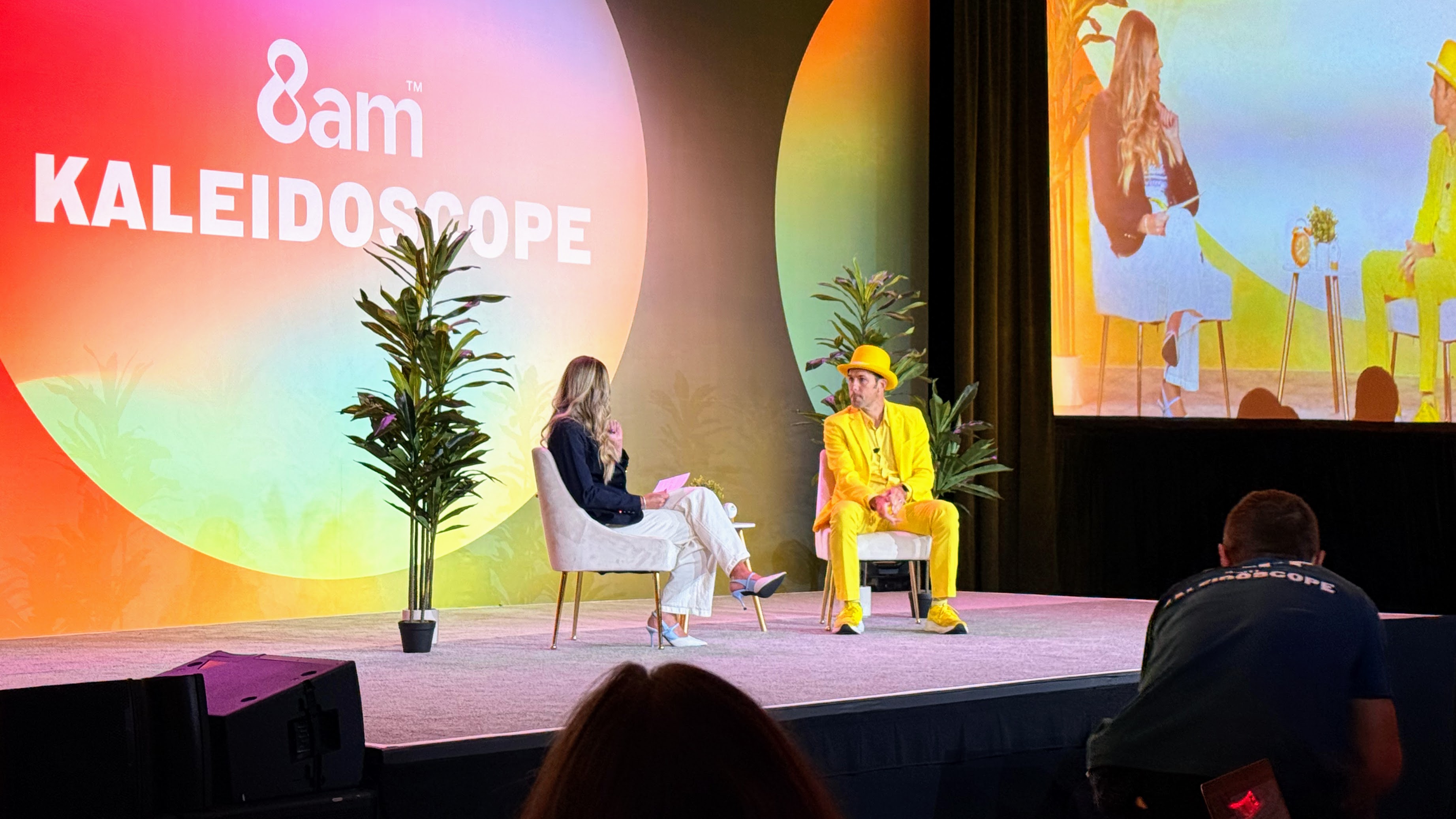


I’ll confess: When I heard that Jesse Cole, the founder of the Savannah Bananas baseball team, was to be the keynote speaker at 8am’s Kaleidoscope conference, I found myself scratching my head. After all, what could the founder of a baseball team known for dancing players and a senior-citizen dance squad possibly teach lawyers about running a small firm?
Turns out, it was quite a bit. At a conference focused on technology and business for small firm lawyers, Cole offered a philosophy of business built around making customers feel seen, removing the things they hate, and constantly finding ways to improve their experience.
Much of it was directly transferable to running a small law firm, and Cole constantly made those connections throughout his fast-paced, hour-long interview conducted by Ana Van de Hinz, 8am’s senior vice president of sales.
And it also turns out that Cole knows quite a bit about building up a small business. He described selling his house, emptying his savings, and sleeping on an air bed as he and his wife struggled to get the Savannah team off the ground.
Perhaps his biggest lesson was that doing business like everyone else is not going to get you where you want to go.
So here are 15 lessons from his talk and what they could mean for a small practice.
1. Figure out what business you are really in.
One of Cole’s earliest breakthroughs was realizing that his team was not in the baseball business, it was in the entertainment business. As a small college summer baseball operation, it could not compete by offering the highest level of play. It needed to offer an experience people could not get elsewhere, from grandma beauty pageants to garbage can nachos.
He urged the audience to ask the same question: “I think it’s important to know what business are you in. What business are you really in?” For a law firm, that invites thinking beyond the legal work to what clients really need.
2. Start by eliminating what clients hate.
For Cole, innovation starts with eliminating friction. Baseball was too long, too slow, and full of extra charges. The Bananas began by tackling those frustrations.
Law firms can start with the same exercise, Cole said. “What are those friction points that clients and just regular people hate? And how do you eliminate those?” The best marketing for your firm is the clients you treat differently, he said, and the best business model in the world is to stop doing what your customers hate.
3. Design the entire client journey.
Cole encouraged lawyers to map the client experience from the first impression through the end of a matter and beyond. “The key is to map the journey – what’s the journey of a client?” Based on his own experiences with lawyers, he said, paperwork, communications and follow-up all contribute to how clients remember a firm.
He suggested that firms start by imagining the perfect testimonial, and then working backward from there. For the Bananas, the perfect testimonial is for fans to say it was the most fun they had ever had at a ballpark. The company designs every interaction to support that experience.
4. Every pay point is a pain point.
As a follow-up to that, Cole urged firms to consider how they invoice. “Every pay point is a pain point,” he said. Recalling his own experiences as a client, he described watching his lawyers trade long emails and thinking, “That bill is going to be crazy.”
“No one likes to get nickel and dimed,” Cole said, challenging firms to reconsider both their billing structures and how they communicate about payment. For the Bananas, the answer to the nickel-and-dime problem was a single all-inclusive $15 ticket covering food and drinks. He did not have a ready answer for how lawyers could make billing less painful.
5. Do the unscalable before you do the scalable.
“To do the scalable, you’ve got to start by first doing the unscalable,” Cole said. For their first seven years, the Bananas called every ticket buyer to say thank you, making some 150,000 calls. Now that it has more than 3.5 million fans a year, the organization can no longer call every one of them, but it has found other ways to preserve the practice, such as by calling its merchandise buyers around Christmas.
His point is to begin with the personal attention that may eventually become difficult to scale. For lawyers, he suggested recognizing client anniversaries, perhaps with a brief video thanking someone for 10 years of working together. The relationship deserves acknowledgment beyond the next assignment or invoice.
6. Find your ‘upper deck.’
Cole spends two innings of every game in the upper deck, connecting with fans who might otherwise get little attention. He put the question directly to the lawyers: “What’s your upper deck?”
It is easy to prioritize the clients who spend the most. But Cole reminded the audience that he and his wife were once a tiny operation sleeping on an air bed. A lawyer who judged the couple’s value solely by their spending at that moment could have missed a lasting relationship.
7. Give your team a purpose they can act on.
The Bananas’ guiding phrase is “fans first.” In fact, the company’s name is Fans First Entertainment. Cole told the story of an 18-year-old player who learned of a grieving fan, rallied to get the whole team to sign a baseball for her, and then sat with her for an entire inning. When Cole asked him why he did it, his answer was simple: “Fans first, right?”
For a law firm, Cole suggested, the lesson is to make client service more than a statement on a website. Discuss examples in staff meetings, recognize people who get it right, and make sure the behavior the firm rewards matches the experience it promises.
8. Make generating ideas a daily habit.
“The only way you’re going to get great is if you have lots of ideas and you just start doing,” Cole said. “The greatest entrepreneurs, the greatest leaders, they learn from doing every night.”
Cole said he has written down 10 ideas every day since 2018. Many are bad, he admits, but that is part of the process. “Quantity leads to quality,” he said.
He treats creativity as a muscle strengthened through use. “You have to work your idea muscle,” he urged. “I’ve trained that muscle that I can see ideas in everything.”
9. Use AI to “plus” your thinking, not replace it.
Asked whether he uses AI, Cole said he uses it as a companion for developing ideas, but he cautioned against handing over the entire creative process to it and becoming “a reliant culture.” Start with your own ideas, he advised, then use the technology to improve them.
He said he likes to think of it in the context of Walt Disney’s term, “plussing.” Cole told the story of how Disney insisted on a $350,000 Christmas parade at a Disneyland that was already at capacity, just because he wanted guests to have a reason to come back.
“I’m betting on AI,” he said. “I’m also betting on anti-AI.”
10. Get through the messy to get to the great.
“Are you willing to get through the messy to get to the great, to create a remarkable experience?” Cole prodded. He recalled the Bananas’ first try at an all-inclusive food offering, which backfired badly, producing waits of almost three hours. The organization quickly rethought the setup, added service points, and kept improving. Today, fans get food within five minutes.
Cole said the team tries 10 to 15 new things in front of a live crowd each night. Most do not work, but the experiments produce some ideas that become lasting fixtures. “Failure is one of the greatest gifts,” he said, adding that law firms should not “outsource the learning.”
11. Make the mundane memorable.
Attention beats conventional marketing any day, Cole said. The strongest promotion comes from what customers experience and share.
He challenged lawyers to imagine a client saying, “You wouldn’t believe what my attorney did today,” because of the care the client received. Professionalism matters, he said, but people also respond to someone who is human and authentic. “I don’t remember the last time my spouse came home and said, ‘Honey, I met the most professional person today,'” he joked.
12. Listen carefully and respond personally.
“Listen carefully, respond creatively” is a principle Cole teaches his staff. When a child lost a tooth at a game, employees created a tooth fairy experience, complete with a letter from the players.
His advice to lawyers was to notice when a client is going through something difficult and find a thoughtful way to respond, “even though it might not make sense in the moment.” The gesture need not be elaborate. Its value comes from showing that someone paid attention to the person behind the matter.
13. Outthink rather than outspend.
Asked about financial discipline, Cole recalled the lesson he and his wife took from the book Profit First: Learn to enjoy saving more than spending. Even as the organization has grown, he said, he has resisted the assumption that every problem requires a bigger budget.
“Outthink, don’t outspend,” he said. For a small firm, that puts ingenuity and care within reach regardless of its marketing budget. A more thoughtful process, a timely response, or a personal thank-you may improve the client experience without requiring a major purchase.
14. Have a moonshot goal.
Cole said every organization should have a “moonshot goal.” For the Bananas, it is reaching a billion fans. “If you create fans,” he said, “the money takes care of itself – you never have to market again.” One fan is so loyal he has tattoos of the logos of every one of the Bananas’ six spin-off teams.
He asked the audience to imagine their clients getting tattoos of their firm’s logo. “That’s kind of weird,” he admitted, but then he suggested some clients might love you so much they would want to wear your merchandise. “Your clients support you, but what if they continue to find new ways to support you?”
15. Use being small as an advantage
Cole closed with a point particularly suited to the Kaleidoscope audience. Large organizations have layers of approvals and competing interests that can make change difficult. Because he and his wife own 100% of their business, they can move quickly on new ideas.
Small law firms have a similar advantage. “I think it’s a better opportunity to be in a smaller practice than in a huge firm because you can make things happen,” he told the audience. “You could go back on Monday and try something.”