 Robert Ambrogi Blog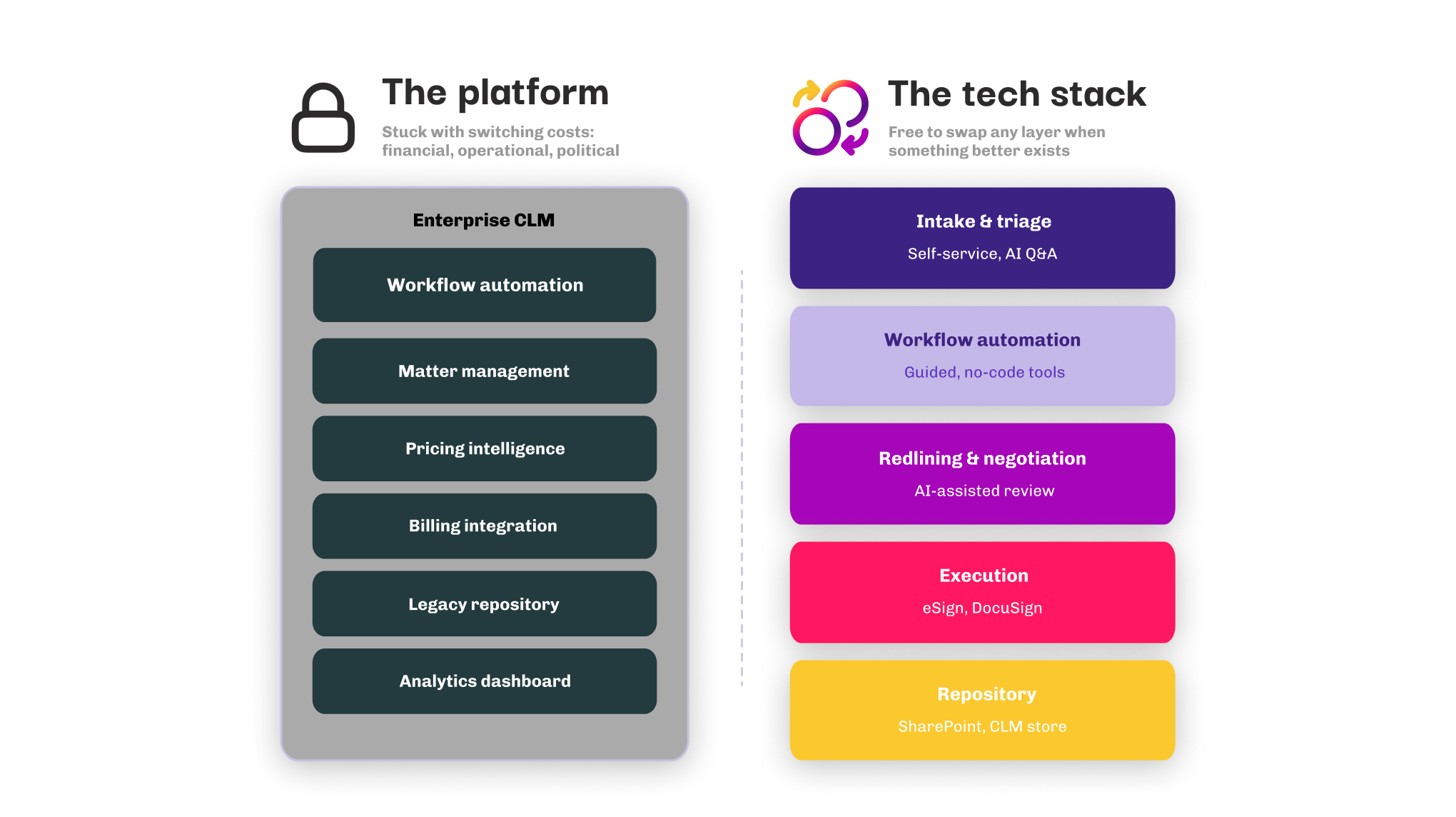


A legal operations professional requested a demo earlier this year with a note that intrigued me. She said that she was going to “stack” a CLM solution, and she was looking for the workflow portion (which is what my product, Josef, does).
When we met, I dug in further, finding that she’d piloted three CLM tools in the preceding year, only to find that each one had one or two great features, and that the rest were substandard.
During that time, she went to a conference where she learned about “stacking,” the practice of bringing together disparate pieces of technology to build a solution, and decided to bring that approach to bear in the contracting space. She mapped out what she actually needed – rather than looking at all of the features the CLM tools had – and then went to market to find best-in-class solutions for each: intake, redlining, repository.
So many people have been talking about the “death of CLM,” yet this was one of the first times that I’d seen a legal ops team in the market trying to come up with a solution.
CLM isn’t the problem – the platform is
Once I started sharing this story with people, I learned that more and more people had similar complaints, though it really wasn’t limited to CLMs. Another legal ops leader in the insurance space complained about her ELM, which she primarily used for a legal front door, but which didn’t allow her to integrate with her preferred matter management tool because it was trying to force her to use their version.
What legal ops leaders are doing differently
At CLOC earlier this year, I brought together a room full of legal operations leaders, under the Chatham House Rule, to talk about whether this really could be a new approach to building legal technology, and whether the platform play had run its course. We published a report with leaders from companies like Ford, DHL and Canva off the back of what was shared in the room. You can read it here.
One of the strongest themes to come out of the room was that people are finding it very difficult to invest in platforms in the current technological landscape, where it feels like new possibilities – let alone features and functionality – are being deployed every other week. In that environment, how are you supposed to sign a three year contract with one provider? For a room of people whose job it was to advise legal on technology procurement, that felt like a negligent move.
Beyond the technological uncertainty, people were also concerned about the amount of money flowing into the space (Harvey raised another half a billion dollars this month!). While this is an exciting development for anyone who believes that the future of legal is technological, it undoubtedly causes upheaval in the market, with M&A activity higher than ever before.
Another common complaint was about how the previous capital flows into CLM over the past ten years have altered the unit economics such that CLM providers were forced to expand horizontally – even if the functionality wasn’t best-in-class – to capture as much revenue as possible. The room was concerned that they were paying for features and modules they weren’t using, and that very few platforms in the space allowed them to pick and choose what they paid for.
How AI has changed the game
Beyond diagnosing the problem, though, what was more exciting was that AI has opened up new possibilities, expectations, and value creation when it comes to the contract stack. Previously, platforms made sense as integrations were complex and expensive – if they came in one seamless package, then people could avoid the difficulty of stitching them together. Now, though, even non-technical people can use AI to learn how to build a Zap on Zapier, or how to set up a webhook. As long as you have the permissions, you do not need to wait for IT. As MCP becomes more widely available, it opens up a whole new world of interoperability as well.
People in the room were also hopeful about the ability of stacking and AI to empower them to build solutions that were better aligned with the way they worked. One technologist I met recently was looking to build her own gifts and hospitality module because none of the tools on the market actually lined up with the way this worked in her organization. While that might sound strange to some, in multinational enterprises, it’s now easier to build a solution to match the process than it is to change the process.
The catch
That said, there were still concerns about how to make stacking stick. One company had onboarded thousands of salespeople onto a CLM; getting them onto something else felt like too big a job to tackle. Another individual warned us about a homegrown SharePoint stack that started as a clever workaround and became a maintenance nightmare. And none of this is free: you inherit the integration risk the platform used to absorb, you multiply your security reviews, and you have to decide who owns the problem when something breaks between two vendors at 2am.
But those are costs you can now price, weigh and mitigate, rather than reasons the question was closed before you asked it. The tech stack approach has always made logical sense. What’s changed is that two things now point the same way at once: the market is making platform commitments feel reckless, and the technology has made the alternative practical for the first time.
Integrations are easier than ever
What’s changed is that the market and the technology are now pointing the same way at once. Platforms won the last decade because integration was genuinely hard. Stitching six tools together meant a project, a budget and a queue in IT, and a single vendor that promised to have done the stitching for you was worth paying a premium for, even if half the modules were weak. That premium was really an integration fee. It is now a great deal smaller than it was two years ago, and it is still falling.
The discipline the stack demands is knowing what you need before you go shopping. That was always good practice. The difference is that it used to be optional, because the platform would decide for you.
 Sam Flynn is cofounder and COO of Josef and leads the company’s business operations, governance, marketing and customer success functions. An ex-BigLaw litigator, Sam is on the board for the Center for Legal Innovation, and on the Emerging Leaders Council of the Legal Services Corporation. He regularly speaks on generative AI, including at schools such as Cornell and NYU, and at Stanford’s 2024 conference on AI in legal & compliance: JURIX.