 Robert Ambrogi Blog


Did you know that the law practice management company Smokeball is named for a famous court case — Carlill v. Carbolic Smoke Ball Co. — that stands for the proposition that a company has a duty to deliver on its promises?
It is fitting, then, that Smokeball is today unveiling a new global brand that focuses on both its duty to empower the lawyers who are its customers and their duty to do their best for the clients who are their customers.
It’s all about “powering people-law,” Smokeball now says. “Less admin. More time for the people who need you most.”
At a time when so many legal tech companies focus on the big law firms that serve big corporations, Smokeball is deliberately targeting the lawyers in solo, small and mid-sized firms who serve actual people.
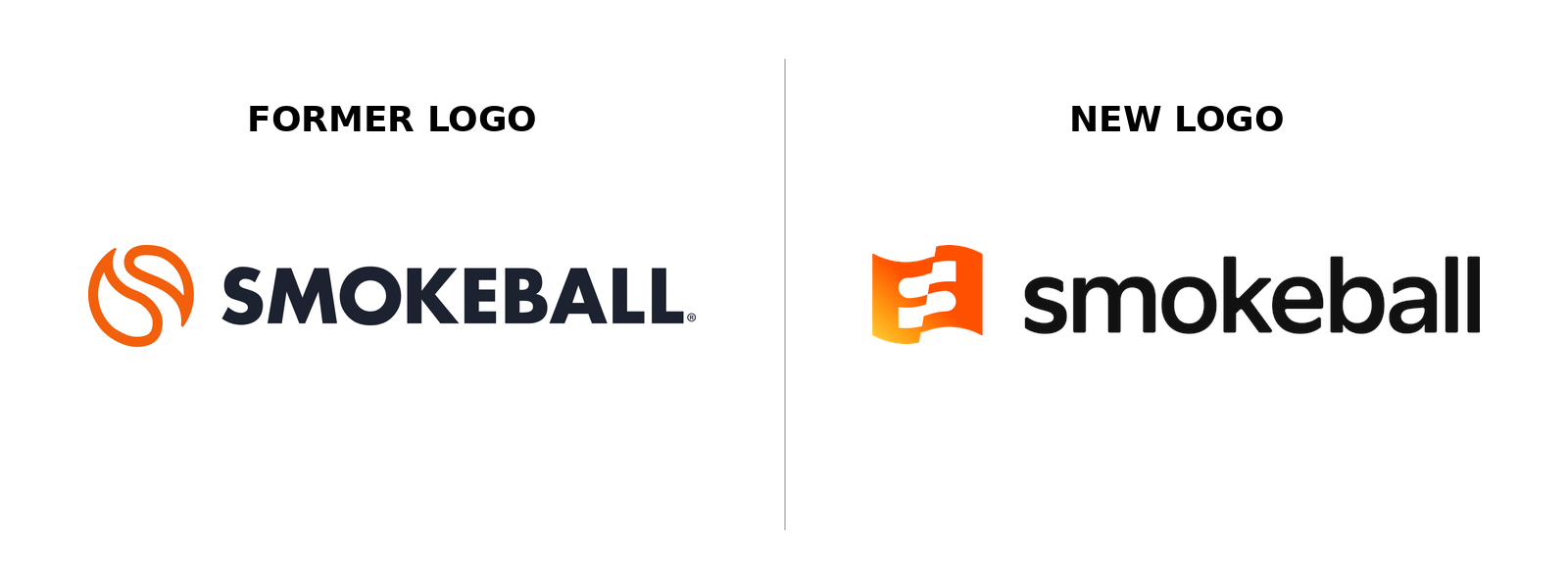
Smokeball’s former orb logo and its new flag logo.
In fact, the company is claiming the phrase “people-law” as the heart of its new branding campaign – and claiming to have coined the phrase as a way of putting a name to the very human work those lawyers do every day.
“The company’s new global brand places people at the center of the story and reflects the legal work that holds communities together, and that Smokeball exists to power,” its press release says. “It’s the families navigating change, the first-time home buyers, the small business owners, and the individuals seeking justice.”
This is not Smokeball going after a new audience, Jane Oxley, chief operating officer and a cofounder of the company, told me in an interview this week. This is Smokeball doubling down on the lawyers it already serves.
Of the firms that are its customers, she said, not one has more than 100 total staff, and they practice in areas such as family law, personal injury, real estate, criminal defense and employment, along with business law.
“We talk a lot about community at Smokeball, and it’s something we feel really strongly about,” Oxley said. “They’re out there helping the communities all day, every day, and doing that stuff that glues us all together.”
Pride and Productivity
Oxley says this new initiative is a brand refresh, not a rebranding, and that part of the point is to give those lawyers a name – not to mention credit – for work that too often goes unrecognized.
“They know they do important work,” Oxley said. “No one ever thanks them for it. People complain to them a lot. It’s pretty thankless work a lot of the time.”
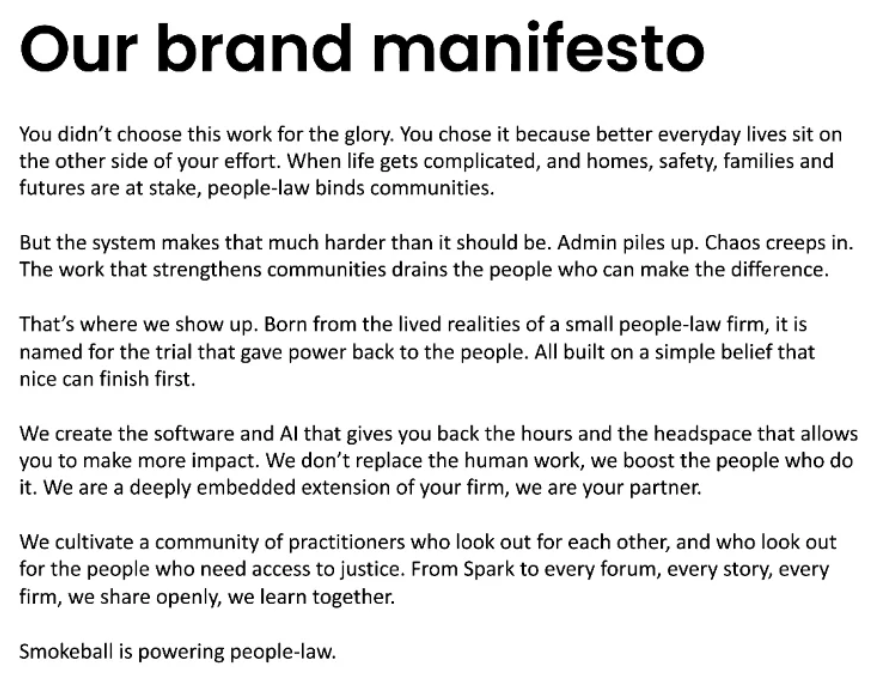
As part of the new branding, Smokeball created a new brand manifesto.
The branding grew out of conversations with at least 50 of Smokeball’s customers across the United States, Australia and the United Kingdom. The conversations, Oxley said, focused not on software, but on why those lawyers do what they do.
Out of that process, which included working with a branding expert, the company developed both a new vision statement, “We connect lawyers to pride in their profession,” and a new mission statement, “We enable productivity that lightens the burden of administration.”
Although the mission statement is new, the focus on productivity is not, Oxley said. When Smokeball first exhibited at ABA TECHSHOW after its 2012 launch, it did not even have a billing module.
“We started as productivity, and we were probably a little bit early for it back then,” she said. “People were like, ‘Well, we just need a billing system.’ We were like, ‘No, you need to be more efficient.”
Flying the Flag of People-Law
The most visible change in the new branding is the logo. Gone is the orb that had long marked the Smokeball brand, replaced by a flag, which the company describes as “a universal symbol of advocacy.”
When I asked Oxley whether the flag was meant to symbolize flying the flag of people-law, she said that was exactly right.
“It is exactly that – flying the flag of people-law,” she said. “Our clients are beautiful advocates for their clients, and we want to be the best advocate for our clients.”
Look closely, she added, and the flag’s straighter edge is a nod to the equality symbol, while the mark’s rippled form gives it a sense of motion.
The new logo is also more modern, Oxley said, designed to stand up alongside the marks of major technology companies. “It serves our aspirations of where Smokeball is going to go over the next few years.”
For Oxley, two non-negotiables in the company’s branding were its name and its distinctive orange color scheme. But while the orange remains, it has a refreshed shade with a name of its own, Power Orange.
Why Now?
So why undertake this brand refresh now, I asked Oxley.
Growth is one reason. Oxley said Smokeball has been growing faster than ever, gaining market share in the U.S. and Australia and building its presence in the U.K.
Beyond that, she said, the company felt its image had fallen behind its technology, which has changed substantially in recent years, driven in large part by AI.
“We were at that point where we felt like we didn’t have a unique place in market, and we needed to really do better,” she said. “Showing the market that we are a powerfully good choice if you work in these kinds of practice areas was something we didn’t think we were doing the best job of before.”
In the company’s press release, Hunter Steele, cofounder and CEO, echoed that idea. “As we’ve grown into a global business, we realized our brand had not kept up with the value we provide.
“This isn’t a reinvention of Smokeball, it’s who we’ve always been. Law has always been, and will always be, a people business. Our role is to power the lawyers behind that work, giving them more time to focus on the people who need them most.”
The Bottom Line
A simple Google search confirms that Smokeball did not coin the term “people law,” although its hyphenated use of it – “people-law” – makes it distinctive.
Even so, I’ll confess a soft spot for the “people-law” positioning. Legal tech vendors and customers get so focused on technology and innovation – on the shiny objects – that they we can lose touch with what this is all about – with why lawyers went to law school in the first place and who it is they serve.
“Powering people-law” makes it about why lawyers do what they do, rather than the tools they use to do it.
As one line from the new brand campaign puts it quite succinctly: “Because you didn’t go to law school for admin.”