 Robert Ambrogi Blog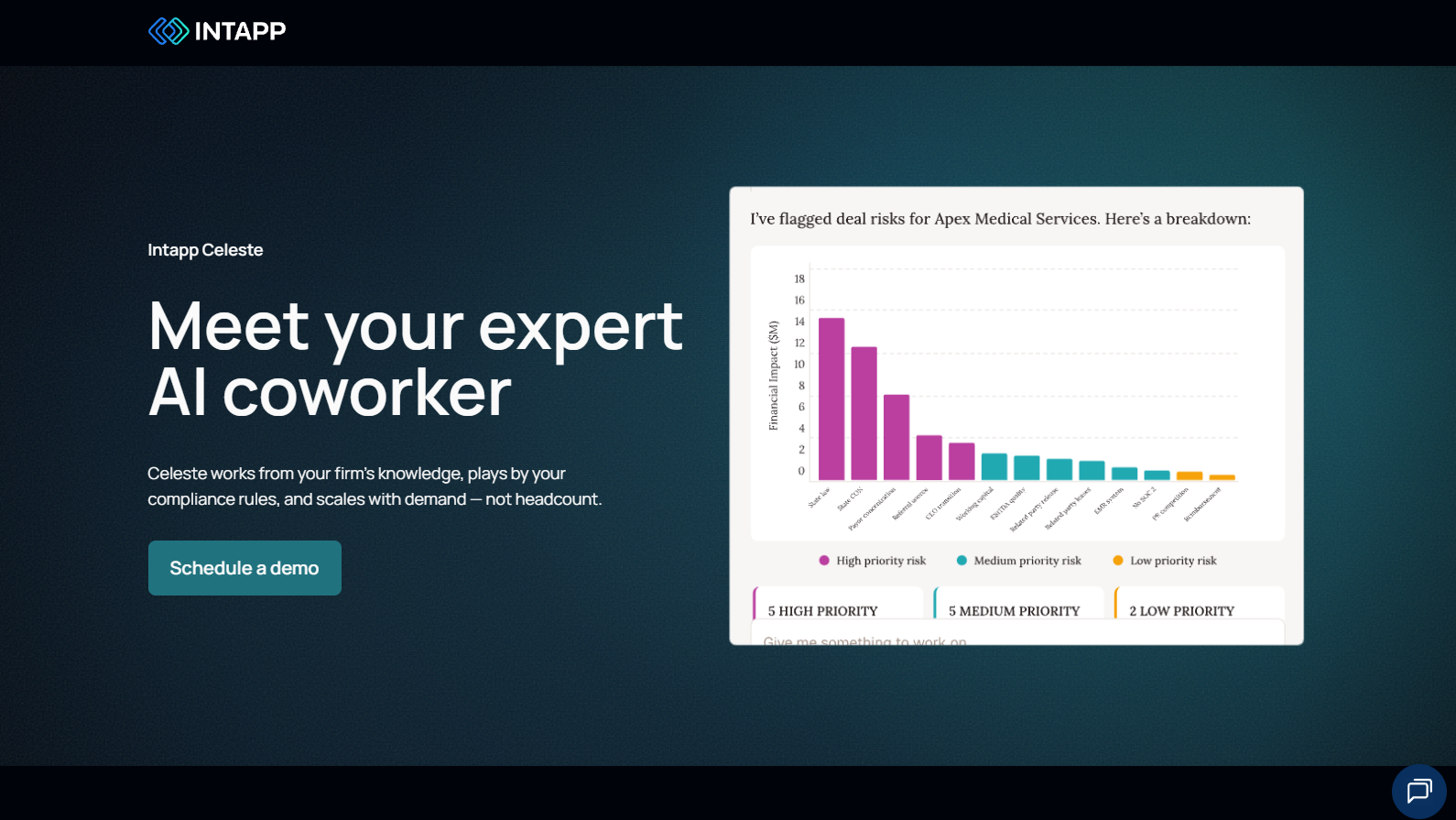


Intapp, the publicly traded company whose software manages intake, conflicts, and deal workflows for law firms and other professional services firms, yesterday announced the general availability of Celeste, an agentic AI product it describes as an “expert AI coworker” designed to run the business operations of a firm — from deal screening and conflicts clearance to business development and lateral hiring.
The launch, announced during a global broadcast event, comes roughly five months after Intapp first previewed Celeste at its annual product event in New York in February, where the company described it as a purpose-built agentic AI platform for professional firms in regulated industries.
Since then, Celeste has been in limited release with early-adopter firms, including the law firm BakerHostetler and the private equity firm Hg.
For the Business, Not the Practice, of Law
With Celeste, Intapp is targeting what it sees as a gap in legal AI. While most firms now have AI assistants on every desk, drafting and reviewing faster than ever, that AI is built for the individual practitioner. It speeds up the practice of law without speeding up the business behind it.
Intapp’s answer to that gap is what it is branding “Firm AI,” a category it distinguishes from horizontal assistants (general-purpose tools for everyday tasks) and practice AI (tools that help produce the legal work product itself). Firm AI is aimed at the operational side of the firm, functions such as origination, intake, conflicts, pricing and hiring.
“Firms will run several kinds of AI: horizontal assistants for everyday work, practice AI for the work product, and Firm AI for the business of the firm itself,” said Thad Jampol, Intapp’s co-founder and chief product officer, in a statement. “That last category is the hard one, and it’s the one almost nobody is building.”
“When a conflicts team can clear 10 times the matters and a fund can screen 10 times the deals, that’s not saved time — that’s a new business model,” he said.
(Jampol lays out more of his thinking on this in A Blueprint for Firm AI, co-authored with Intapp’s chairman and CEO John Hall.)
Executing Multi-Step Workflows
According to Intapp, Celeste operates autonomously rather than waiting to be prompted, executing multi-step workflows designed as playbooks. It ships with a library of playbooks covering origination, business development, intake, conflicts, pricing, fundraising and lateral hiring, along with a no-code builder that lets firms create their own.
“Celeste encodes the firm’s own methods as playbooks — multi-step workflows that automate the firm’s best practices,” the company says.
The product is natively integrated with a firm’s systems of record — which makes sense given that Intapp’s applications already sit atop the intake, conflicts and relationship data of many large firms — andit can ingest the firm’s documents and connect to outside data partners through open connectors.
On the governance front, Intapp says the same ethical walls, need-to-know restrictions, and audit requirements that apply to a firm’s people apply equally to Celeste. Restricted information stays restricted regardless of who asks, and firms can produce a full record of every action the AI takes for clients and regulators.
Intapp had previously announced a partnership with Harvey, allowing Celeste to invoke Harvey’s practice-of-law workflows while enforcing compliance and ethical wall standards. It similarly announced a partnership with Anthropic to bring its Claude models into Intapp’s governed environment.
Feedback from Early Adopters
For law firms specifically, Intapp says Celeste can surface relevant matters, partner experience, and prior pitch materials in response to an urgent client request in minutes rather than hours, and can run an end-to-end lateral hiring lifecycle, from candidate research and conflicts pre-screening through clearance preparation and onboarding.
At BakerHostetler, the focus so far has been on intake and conflicts. according to Katherine Lowry, the firm’s chief information officer and head of its IncuBaker innovation team.
“We believe that Celeste can have a very positive impact on our intake and conflicts process,” she said in a statement provided by Intapp, adding that the firm’s substantial lateral growth in recent years has brought a significant volume of new clients and complex engagements. “We believe that Celeste will help us operate more efficiently as we continue to grow.”
At Hg, the appeal is that the AI works from the firm’s own accumulated knowledge. “The intelligence is ours, not something generic applied to our firm,” said Shirin Veeran, who leads data and platform strategy at Hg, in a statement. “Celeste screens against our actual mandate, drawing on knowledge we have built across the firm over two decades.”
My Take
Intapp is not alone in seeking to stake a claim on the business side of legal AI — territory that Harvey, CoCounsel, and the rest of the practice-focused AI products are not directly contesting.
And it is, unquestionably, an area where the potential impact of AI could be significant. Large-firm workflows such as conflicts clearance, intake, lateral hiring, and others often remain highly inefficient, with process improvement hindered by the proprietary nature of firm data.
This is an area in which Intapp has the advantage of incumbency. It has spent two decades embedding itself in the systems of record where that data lives, and that makes it a natural home for AI that acts on that data.