 Robert Ambrogi Blog


There was a time, not so long ago, when the most exciting sponsorship deal a legal technology company might land was having its logo on a tote bag at an ABA conference. Those days, it appears, are decidedly over.
Today, 8am — the company formerly known as AffiniPay and parent of LawPay, MyCase, CasePeer and DocketWise — announced a partnership with the Tampa Bay Buccaneers that will make it the NFL team’s “Official Professional Services Partner.”
The deal includes naming rights for a premium lounge at Tampa’s Raymond James Stadium, which will now be known as the 8am Club — a nearly 10,000-square-foot, air-conditioned space with all-inclusive food and drinks, comfortable lounges, and panoramic field views.
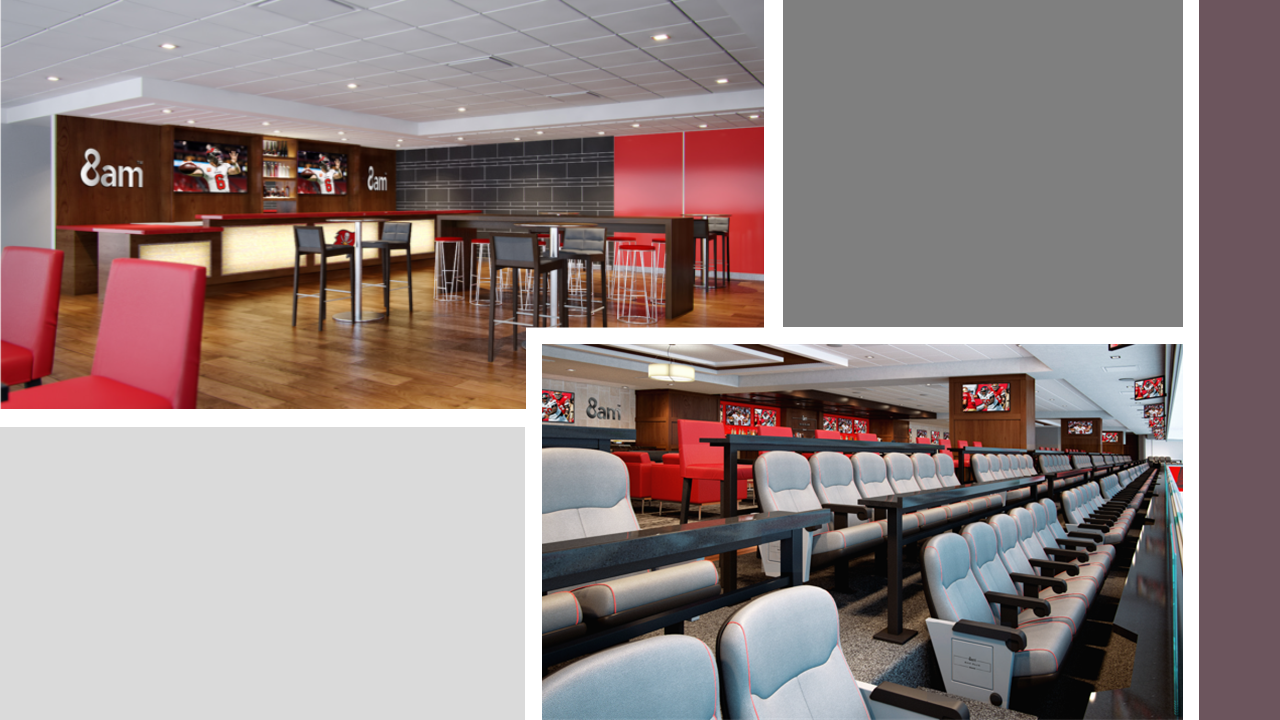
Views of the new 8am Club at Raymond James Stadium.
“8am’s partnership with the Buccaneers is rooted in a shared commitment to performance and to the communities and customers we serve,” said 8am CEO Dru Armstrong in a statement.
It is, to put it mildly, a long way from a tote bag.
But the Bucs deal is not an isolated play. It is the latest — and perhaps splashiest — in what is becoming a trend: legal tech companies are muscling their way onto the field of professional sports sponsorships, a place historically dominated by beer brands, insurance companies and automakers.
A Trend Takes Shape
The sports-sponsorship wave in legal tech began in September 2024, when Vancouver-based Clio announced a multiyear deal to become the official away-jersey partner for the NHL’s Vancouver Canucks — the first company ever to hold that designation for the team.
The Clio logo now appears on every Canucks away jersey, visible in arenas across North America.
“Seeing the Clio logo on the Canuck’s away jerseys is a standout moment for us,” Clio CEO Jack Newton said at the time.
Then, in September 2025, Filevine landed a multiyear deal as the official helmet partner for the Utah Mammoth, the NHL’s newest franchise (formerly the Arizona Coyotes, relocated to Salt Lake City). The Filevine logo now rides on the team’s helmets at every home and away game.
And in March, Harvey, the AI-powered legal research platform, announced a multiyear partnership with the US Open tennis tournament, becoming its first-ever “Official Legal Assistant.”
Harvey’s logo will appear in Arthur Ashe Stadium and on virtual on-court placements in the tournament’s international broadcast. Harvey CEO Winston Weinberg called it the company’s first sports sponsorship and said the team wanted to ensure it was “the right match” for customers, prospects and employees.
Now, with 8am’s Buccaneers deal, the legal tech industry has sponsorships spanning the NFL, the NHL, and a Grand Slam tennis tournament, all within roughly 18 months.
But … Why?
The obvious question here — and one that would certainly cross the mind of any attorney watching a Bucs game from the newly christened 8am Club — is: Why?
Legal tech companies are not, as a general matter, consumer brands. The average football fan cracking open a beer and watching Baker Mayfield throw a deep ball is probably not in the market for practice management software. The person watching the US Open from their couch is unlikely to pause between sets and think, “You know what, I should really look into AI-powered legal research.”
But that, of course, is probably not the point. These deals, I suspect, are not really about reaching the person in section 312 who just wants to see a slap shot. They are about brand prestige, about signaling that a company has arrived, about being able to wine and dine prospective customers in a luxury suite rather than a hotel conference room.
And, let’s face it,they are also about the fact that some legal tech companies have a lot more money to spend than they used to. The industry has seen a torrent of venture capital and private equity investment in recent years, with Clio, Filevine and Harvey all at the head of the pack in terms of money raised.
When your company has that kind of capital behind it, a stadium lounge starts to look less like an extravagance and more like a marketing strategy.
There is also a competitive dimension. In an industry where dozens of companies are fighting for mindshare among the same relatively narrow universe of law firms and legal departments, a splashy sports deal is a way to differentiate, to break out of the echo chamber of legal conferences and LinkedIn posts and plant your flag somewhere the general public, and maybe lawyers, might actually notice.
Legal Tech at the Super Bowl?
If the trend continues at its current pace, it may only be a matter of time before we see a legal tech company sponsoring a Super Bowl halftime show or slapping its logo on a Formula 1 car.
In fact, just this year, one legal tech company did make a “cameo appearance” in a Super Bowl ad. The technology show TBPN had an ad featuring all of its guests — one of whom was legal tech company Spellbook, whose logo was among those the ad featured.
For now, it is worth pondering the sheer improbability of the moment. An industry that, not so long ago, measured marketing success by the quality of its conference swag or the size of its booth is now negotiating naming rights at NFL stadiums and Grand Slam tennis tournaments.
Somewhere, a box of branded pens in a storage closet is quietly weeping blue tears.