 Robert Ambrogi Blog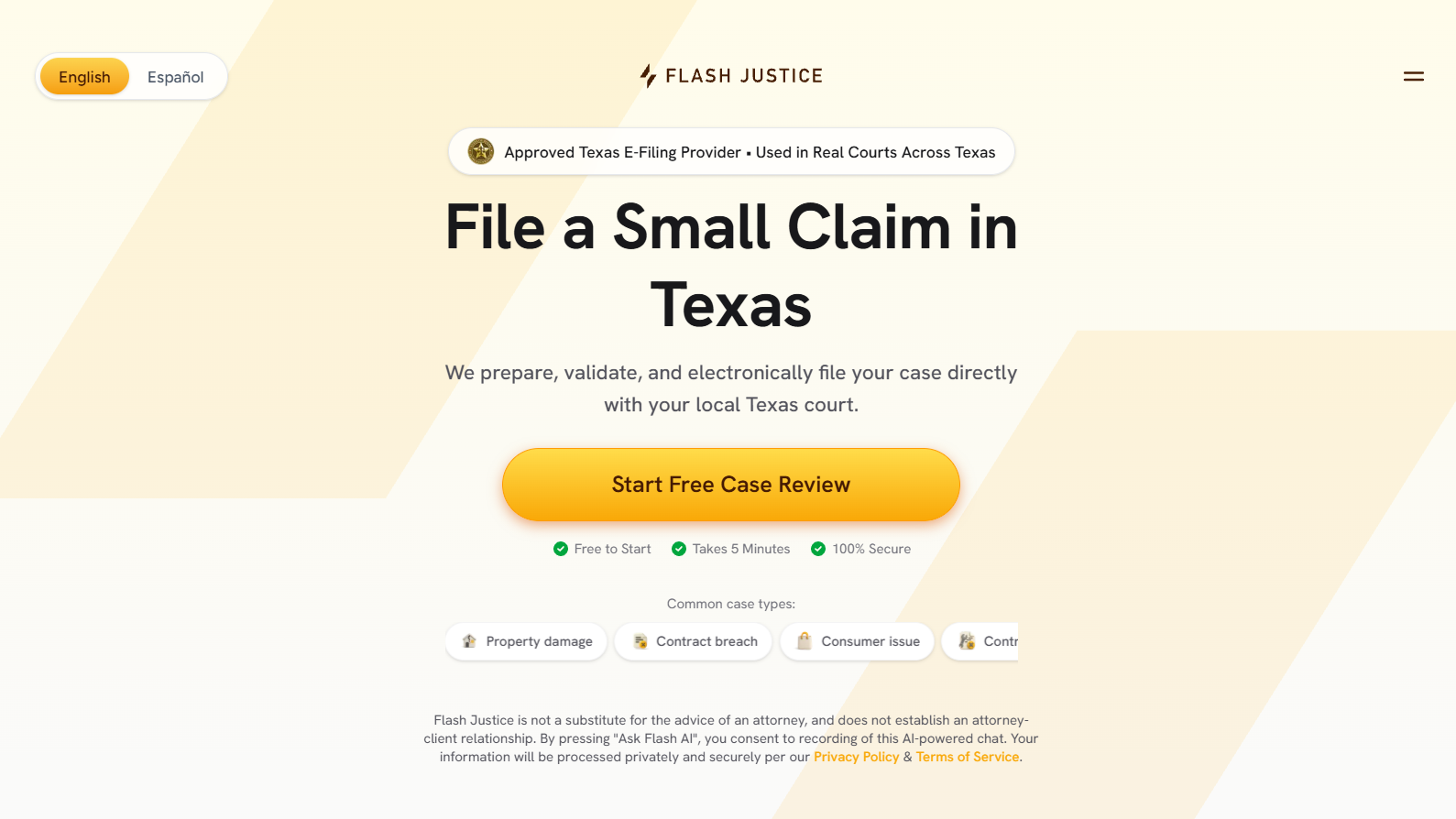


In the wake of the Oct. 7, 2023, Hamas attack on Israel, Israeli entrepreneur Erez Vega-Kadoch kept receiving what he considered to be inappropriate text messages from an Israeli company. Never having consented to the messages, he decided to fight back and file a small claims case against the company.
But when he searched for a tool that would help him do that, he could not find one. So, entrepreneur that he is, he built one himself.
That origin story led to Flash Justice, a consumer legal tech startup that made its U.S. launch in Texas in January as a certified electronic filing service provider (EFSP) under the Texas Office of Court Administration.
The company has now processed a few hundred small-claims cases in Texas and is beginning to gain traction – after already handling more than 1,000 small claims cases in Israel, where it has been operating since the middle of last year.
What Makes It Different
Vega-Kadoch, now the company’s CEO, and Lee Trink, its cofounder and CEO, recently gave me a briefing and demonstration of Flash Justice.
Trink, a former prosecutor turned entertainment executive before investing in Flash Justice, said the need for the product is straightforward: most consumer legal tech gives people a form and sends them on their way. Flash Justice does the whole thing.
“The distinction matters,” said Vega-Kadoch. “Most consumer legal tools give people a template and send them on their way – leaving them to figure out which court has jurisdiction, how to serve the defendant, which filing code the clerk wants this week, and what to do when the case gets rejected for a formatting issue they didn’t know existed.”

Flash Justice handles it all. A user describes their dispute through a conversational intake process. The system analyzes the claim, drafts a petition, identifies the correct Justice of the Peace court (the Texas version of small claims court), locates the defendant and their registered agent, and e-files the case directly through the eFileTexas system.
The user, the company says, never has to touch a form or set foot in a courthouse to get the case filed.
The product is currently designed to assist plaintiffs in small claims matters – those seeking to file a claim – but the company plans at some point to add a product for defendants.
The Texas Proving Ground
While Flash Justice’s founders hope eventually to expand nationwide, their choice of Texas as a starting point was deliberate.
The state sees roughly 250,000 small claims cases a year, has one of the higher caps at $20,000, and was seen as a tech-friendly regulatory environment for a startup learning to navigate the complex intersection of legal services, e-filing infrastructure, and court administration.
That infrastructure, it turns out, is something of a maze. Texas has around 650 Justice of the Peace courts – and each one has historically set its own codes for claim types, subtypes, and filing formats.

“Each court in the small claims sphere in Texas decided on their own code,” Vega-Kadoch told me. “So basically they make it a whole lot more difficult to even try to file with them.”
Court clerks, overwhelmed and trying to manage crowded dockets, tend to quickly reject erroneous filings rather than work with filers to fix problems.
After nearly three months of operation in Texas, the company says it has reduced rejection rates significantly and established working relationships with clerks at many of the larger courts.
The complexity of navigating all of that, Trink acknowledged, actually serves as a competitive moat.
“Getting that locked in ends up being a good advantage for us,” he said. “The learnings from the next markets will help us understand what we’re up against.”
Under the Hood
The AI architecture powering Flash Justice is more elaborate than a simple prompt-to-petition pipeline, Vega-Kadoch told me.
Rather than relying on a single frontier model to generate legal documents from scratch – and risking the hallucinations that come with that – the product uses a graph database to connect causes of action to relevant statutes, regulations and past cases.
Multiple LLMs then work in concert, checking their reasoning against that structured legal knowledge base before producing output.
“The law is complex, it’s not linear, and you have to make connections like a web of things,” Vega-Kadoch said. “For that we use a graph, and that way we iterate between a few different LLMs that discuss with each other and then figure out what will be the best thing to use for this specific case.”
The goal, he said, is to produce documents that read like actual legal filings rather than filled-in forms – something that, anecdotally at least, contributed to settlement outcomes in Israel where defendants faced a properly drafted petition rather than an obviously templated complaint.
Pricing and Support
Pricing for the service is a $99 flat fee, with filers also responsible for their own court costs.
Beyond the initial filing, Flash Justice also assists with post-filing steps including continuances, non-suits, and default judgment filings, all from a single user dashboard.
Through an integration, the product also handles service of process, with the company connecting directly through an API to dispatch, coordinate, and file the affidavit of service automatically.
The product also supports Spanish-language intake, with the final claim drafted and filed in English but made available to the claimant in Spanish as well – a feature Trink sees as particularly relevant to the populations they hope to serve.
A2J and UPL
Trink sees Flash Justice not merely as a small claims tool but as an access-to-justice platform, noting that many Americans lack access to any legal guidance for disputes that fall well below the threshold where it makes economic sense to hire an attorney.
In my conversation with them, I asked if they have any concerns about being perceived as engaged in the unauthorized practice of law.
Trink said the company has worked closely with attorneys to structure the product with appropriate disclaimers (including an explicit statement that there is no attorney-client privilege).
But he acknowledged the regulatory landscape is far from settled. “This may come to a head, especially in some particular states,” he said. “But it’s actually an issue that is really important to confront.”
The tension between what these platforms can offer and what they’re legally permitted to say is genuinely consequential for claimants, Vega-Kadoch added.
A pro se litigant seeking return of a security deposit, for example, may not know they are entitled to statutory penalties, including treble damages.
Drawing the line on what the platform can and cannot tell users about their legal rights is, as he put it, “the core tension when it comes to access to justice.”
Funding and What’s Next
Flash Justice has been self-financed, primarily by Trink, who said he wanted to get the product launched and revenue coming in before seeking outside funding. A seed round is planned for later this year, possibly preceded by a bridge round.
In terms of expansion to other states, Florida is next on the geographic roadmap, with California to follow. The company plans to expand language support beyond English and Spanish, and is thinking longer-term about tools that could help courts themselves manage their workloads – including AI-assisted processing on the court administration side.
For now, the focus is proving out the model in Texas. With a few hundred claims filed since January and early customer feedback described as strong, they appear to be gaining traction in a corner of the legal market that, as Trink put it, “nobody’s paying attention to.”